
FortiExtender FEX-200F LAN Extension Gateway in Africa
Designed for compact remote sites that need centrally governed network access, this indoor Ethernet gateway extends a FortiGate LAN across a secured tunnel and presents five configurable Gigabit Ethernet ports at the branch. It helps organisations place users, payment terminals, printers, phones, cameras and operational devices behind familiar FortiGate policies without treating every small site as a separate security island. A key buying detail is that this model is the Ethernet member of the FortiExtender family; it does not include an internal mobile broadband modem.
Request QuoteCheck Africa Availability
Quick Product Information
Product Overview
Small branches often need the same network discipline as a head office, yet installing a complete security appliance, local management stack and separate policy set at every tiny location may add cost and operational work. A remote service desk, retail counter, clinic reception, education office, warehouse gate or temporary project room may only require a few wired devices, but those devices still need controlled access to business applications, segmented connectivity and dependable administration. The FortiExtender FEX-200F addresses this type of requirement by extending a LAN interface from a central FortiGate to the remote location through a protected Layer 2 tunnel.
This approach allows the remote Ethernet ports to be treated as part of a centrally managed network design rather than as an isolated collection of local switch ports. The FortiGate can remain the main control point for addressing, policy, security services, segmentation and traffic decisions, while the compact endpoint provides practical connectivity at the branch. That can be especially useful when an organisation wants repeatable microbranch deployments, simpler policy ownership and fewer independent configurations to maintain.
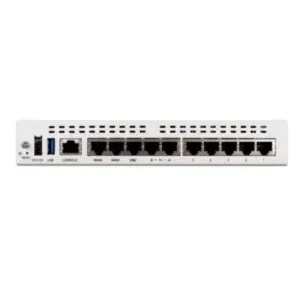
The device includes five Gigabit Ethernet RJ45 ports that can be assigned by software as WAN or LAN interfaces. This flexibility gives designers room to use one or more connections for uplink and others for local equipment, subject to the selected FortiExtender profile and FortiGate design. It also includes a USB 2.0 Type-A interface and low-energy Bluetooth capability for supported management or deployment functions. Its small indoor enclosure can be placed on a desk or mounted on a wall, which suits branch locations where rack space is unavailable.
A critical distinction should be understood before purchase. The model belongs to a product family widely associated with 4G and 5G wireless WAN, but the 200F itself is listed by Fortinet as an Ethernet model with no internal modem, no cellular antennas and no GPS antenna port. Buyers needing embedded LTE or 5G should review another FortiExtender model or a cellular-enabled FortiGate. Buyers who already have an internet handoff, ISP router, fibre ONT, external modem or managed WAN connection and need a secure LAN extension endpoint may find this model much more appropriate.
FourTeck helps turn the model number into a complete deployment requirement. The discussion can cover FortiGate compatibility, software release, tunnel topology, port assignment, VLANs, DHCP design, local power, mounting, cabling, support term, remote rollout process and delivery planning. This buyer-first review is important because the appliance is only one element of the solution; the central firewall, transport path and configuration method determine whether the branch works as intended.
Key Business Benefits
The strongest value comes from connecting technical features to daily operations. These benefits explain why a centrally controlled branch extension can be more useful than placing a basic unmanaged router or isolated switch at every remote site.
◆ Central Policy Ownership
Remote devices can remain part of a FortiGate-led design, allowing the IT team to apply a more consistent approach to addressing, access rules, segmentation and protected traffic paths. This reduces the risk of every branch developing a different local setup that becomes difficult to audit or support.
↗ Practical Microbranch Deployment
A compact endpoint can be easier to place in a small office than a full rack appliance. Desktop and wall-mount options help teams work with limited space, while the five-port layout can serve a focused group of branch devices without adding unnecessary hardware.
✓ Cleaner Multi-Site Standards
Organisations opening repeated small sites can build a standard port, VLAN and naming model. A repeatable design makes rollouts easier to document, helps support teams know what to expect and reduces the number of one-off branch configurations created under deadline pressure.
⚙ Flexible Port Assignment
Each Gigabit Ethernet port can be configured as WAN or LAN through software. That gives network designers room to adapt the device to the selected tunnel and branch layout instead of being restricted to a single permanently labelled port arrangement.
● Controlled Branch Access
Payment devices, staff computers, printers, phones and operational equipment can be placed into a defined network design rather than connecting through an unmanaged consumer gateway. The result can be clearer ownership of who is allowed to reach which services.
🔒 Fortinet Ecosystem Fit
For organisations already using FortiGate, the appliance can extend existing operational practices instead of introducing an unrelated branch platform. This can simplify responsibility, training and troubleshooting when the central team already understands FortiOS policies and interfaces.
Business value depends on correct design. The protected tunnel still needs a dependable transport path, and the central FortiGate must be sized and configured for the number of remote extensions, users, services and inspection requirements. FourTeck can help buyers review those dependencies so the device is selected as part of a working architecture rather than as a standalone box.
Product Highlights
A compact port set for uplinks and local branch connections, with assignments controlled by software.
Designed to connect remote Ethernet services back to a FortiGate-led network using a protected Layer 2 tunnel.
Suitable for desktop or wall placement in branches where a rack is unnecessary or unavailable.
Uses a 12V/1A external adapter and is designed for modest power consumption in compact deployments.
The hardware is deliberately simple. There is no internal cellular modem, antenna array or GPS port, which means the appliance is not intended to replace an LTE or 5G router. Instead, it is built for Ethernet-based remote extension. This can be an advantage where the branch already receives connectivity from fibre, fixed wireless, satellite equipment, an ISP router or another external WAN device.
Fortinet documentation describes the model as an extension of a FortiGate LAN interface for branch offices, with protection extending from Layer 2 through Layer 7 through the central security design. The practical implication is that buyers should focus less on standalone router features and more on how the endpoint participates in the FortiGate architecture. The central firewall remains the important platform for policy, inspection and secure networking functions.
The USB interface can also support supported out-of-band or serial-management workflows when used with appropriate adapters and configuration, but those accessories and use cases should be confirmed before ordering. The Bluetooth radio supports local deployment functions at 2.4 GHz. Feature availability may depend on the installed FortiExtender software release, FortiGate release and selected management mode.
Technical Specifications
| Specification | FEX-200F Details | Buyer Note |
|---|---|---|
| Brand | Fortinet | Confirm current supply route and support option. |
| Model | FEX-200F | Ethernet model in the FortiExtender family. |
| Primary Function | FortiGate LAN extension for remote branches | Requires a planned FortiGate and tunnel design. |
| Cellular Modem | None | Choose another model when embedded LTE or 5G is required. |
| Ethernet Ports | 5 x Gigabit Ethernet RJ45 | Ports can be configured as WAN or LAN by software. |
| USB | 1 x USB 2.0 Type-A | Accessory-dependent management uses should be confirmed. |
| Bluetooth | Low-energy Bluetooth, 2.4 GHz, maximum transmit power 10 dBm | Used for supported local deployment and management functions. |
| PoE Powered | No | Plan a nearby power outlet for the external adapter. |
| Power Input | 12V/1A external adapter | Confirm plug type and local power requirements. |
| Power Consumption | Approximately 6.5W average; up to about 6.81W in listed conditions | Allow suitable ventilation and stable power. |
| Dimensions | 27 x 180 x 99.9 mm | Compact for desk or wall placement. |
| Weight | Approximately 0.46 kg | Check mounting surface and cable strain. |
| Installation | Indoor, desktop or wall mount | Not a rugged outdoor device. |
| Operating Temperature | 0°C to 40°C | Use in a controlled indoor environment. |
| Storage Temperature | -20°C to 70°C | Applies to non-operating storage conditions. |
| Humidity | 5% to 95% | Avoid condensation, dust and water exposure. |
| Warranty and Support | Based on selected FortiCare term and supply route | Confirm entitlement before purchase approval. |
The correct configuration is determined by the wider solution rather than by the hardware table alone. Buyers should confirm how the remote site reaches the internet or private WAN, how the protected tunnel will be established, which ports carry the uplink, which ports serve local equipment and whether VLANs need to be extended. The central FortiGate model and software version must support the planned number of FortiExtenders and the selected management mode.
Power and placement also deserve attention. Because this model is not powered through Ethernet, a stable outlet is required near the installation point. The device should be placed in a ventilated indoor location away from moisture, excessive heat and cable stress. For multi-site projects, it is useful to standardise power adapters, labels, patch leads, wall-mount positions and remote-hands instructions before shipping equipment to each branch.
Configuration and Buyer Guidance
A successful purchase begins with the intended network role. This appliance is not a generic replacement for every branch router, switch or firewall. It works best when the organisation wants a compact endpoint that participates in a FortiGate-managed LAN extension design. Before requesting a quote, document the central FortiGate platform, current FortiOS version, expected branch count and any existing FortiExtender deployments. This helps identify software compatibility and management limits early.
1. Define the Uplink
State whether the branch uses fibre, fixed wireless, satellite, an ISP router, an external modem or a private WAN handoff. Include public IP, NAT and firewall restrictions that could affect tunnel establishment.
2. List Local Devices
Count computers, printers, phones, payment devices, cameras and controllers. Confirm whether five local ports are sufficient or whether a managed switch is required behind the gateway.
3. Plan Segmentation
Identify staff, guest, voice, payment, surveillance and operational networks. VLAN requirements should be defined before deployment so port profiles and DHCP behaviour are not improvised on site.
4. Check Power and Mounting
Confirm wall space or desk placement, local socket type, cable routes, ventilation and protection from tampering. Add a small UPS where brief power interruptions would disrupt critical branch activity.
The number of users is only one sizing factor. The central firewall may inspect and route traffic for many branches, so total tunnel count, combined bandwidth, security services, logging, VPN usage and application mix matter. A deployment supporting payment systems or healthcare workflows may also require stricter change control, documentation and recovery procedures than a basic administration office.
FourTeck can help create a quotation checklist that includes the endpoint, FortiCare option, compatible FortiGate requirement, switches, power protection, patch cables and implementation assistance. A clear scope helps procurement compare like-for-like offers and avoids purchasing an Ethernet extension when the real need is embedded mobile broadband.
Ideal Business Use Cases
The appliance fits environments where a few remote Ethernet devices need controlled access to central services and the organisation already uses, or plans to use, FortiGate as the main network policy platform. These examples show practical deployment patterns without assuming that every site has the same risk, bandwidth or support requirement.
Retail and Service Counters
Connect payment terminals, receipt printers, staff workstations and local phones at a small outlet while keeping access governed through the central network design. A managed switch may be added when more ports or PoE are needed.
Clinics and Reception Offices
Provide controlled connectivity for appointment systems, records access, printers and administrative devices at a satellite location. Segmentation and privacy requirements should be defined at the FortiGate before rollout.
Education Administration Sites
Extend staff and administrative services to a small campus office, registration desk or remote learning centre without creating a completely separate local policy environment.
Warehouse Gates and Logistics Desks
Connect scanning terminals, gate computers, label printers and access devices to central logistics applications. Cable routes, environmental control and backup power should be checked carefully.
Financial Service Microbranches
Support a small set of controlled branch endpoints where consistent policy, documented access and central administration are important. Project teams should verify resilience, compliance and support processes.
Temporary Project Offices
Create a repeatable network endpoint for construction, field service or event administration when an Ethernet internet handoff is already available. The transport connection remains a separate design decision.
The gateway can also support centrally managed home-office or executive remote-site designs where an organisation needs corporate Ethernet ports under a FortiGate-led policy. Such deployments require careful attention to residential ISP NAT, dynamic addressing, bandwidth, privacy, physical access and remote troubleshooting. A pilot deployment is sensible before a large rollout.
It is not the correct choice for an outdoor cabinet, vehicle, factory floor exposed to harsh conditions or site that needs a built-in SIM connection. Those requirements should be matched with rugged or cellular models. FourTeck can help compare alternatives so the selected device fits the actual environment rather than relying on the family name alone.
FortiExtender FEX-200F Secured LAN Extension
The defining capability is the ability to extend a FortiGate LAN to a remote endpoint through a protected overlay. Fortinet describes the connection as a secured Layer 2 tunnel, and current administration guidance explains that VXLAN is established over IPsec to create a Layer 2 network between the FortiGate and devices behind the remote extender. For the business, this means the remote branch can participate in a centrally designed broadcast domain and policy structure without relying on an independent local firewall configuration.
Layer 2 extension can simplify certain branch applications, but it should be used deliberately. Extending broadcast domains over a WAN creates dependencies on tunnel health, latency, DHCP availability and central firewall uptime. The design should define what happens when the uplink is interrupted, how users are notified, which services must remain local and whether the branch requires a secondary path. Critical locations may need a different architecture or additional resilience.
Security also depends on the central FortiGate policy. The endpoint does not remove the need for correctly designed zones, address objects, service rules, inspection profiles and logging. It creates a controlled path through which those central services can be applied. This is valuable when one network team supports many small sites and wants policy changes to remain under a common process.
Before implementation, FourTeck recommends documenting the tunnel endpoints, uplink interface, addressing, DNS, DHCP, VLANs, permitted applications, monitoring method and recovery steps. A simple diagram and standard branch template can greatly reduce remote troubleshooting time. Pilot the design with a representative site, then use the results to refine installation instructions for wider deployment.
FortiExtender FEX-200F Flexible Gigabit Port Design
Five software-configurable Gigabit Ethernet ports give the appliance more flexibility than a fixed one-WAN, four-LAN label might suggest. The selected profile can allocate ports according to the role of the branch. A deployment may reserve ports for the transport side, local user devices, a managed access switch or a dedicated equipment segment. The exact arrangement must match the supported operating mode and central FortiGate configuration.
This flexibility helps standardise hardware across different small-site layouts. One branch may connect two workstations and a printer directly, while another may use a downstream FortiSwitch to add PoE phones and access points. The same gateway can remain at the edge while local switching changes according to site size. Buyers should not assume the five ports will always be available for endpoints; uplink design and redundancy can consume one or more interfaces.
Cabling quality matters. Use suitable Category 5e or better Ethernet cabling, label both ends, protect connectors from strain and document which physical port maps to each logical role. Where the device is wall-mounted, leave enough clearance for power and patch leads. A compact installation should still be serviceable by local staff without unplugging the wrong connection.
When more than a few devices are present, a managed switch is usually better than adding unmanaged splitters or daisy chains. A FortiSwitch can provide additional ports, PoE and central management options, while a suitable third-party managed switch may fit existing standards. FourTeck can help review port count, PoE load, uplink speed, VLAN requirements and mounting so the gateway and switch operate as a coherent branch package.
FortiExtender FEX-200F Compact Branch Operations
A device that fits on a small wall or desk can reduce installation friction, but compact hardware still needs disciplined operations. The endpoint should have a clear asset label, serial number record, assigned branch name, port map and support contact. Remote teams should know which lights indicate power and link state, which cables may be safely reseated and when to escalate to the central network team.
The external power adapter means power protection is a separate decision. For a site running payment, communications or customer service workloads, a small UPS can keep the gateway, ISP equipment and switch operating during brief interruptions. The UPS must be sized for the combined load and local power quality. Surge protection and proper grounding may also be important depending on the building.
Software lifecycle planning is equally important. FortiExtender and FortiGate releases must remain compatible, and upgrades should be tested against the branch template before broad rollout. A maintenance plan should define configuration backup, firmware approval, monitoring, incident response and replacement procedures. Treating the unit as a managed infrastructure endpoint rather than a disposable router improves support quality over its lifecycle.
For large projects, FourTeck can help organise model confirmation, quantity planning, accessory review and staged delivery. Buyers can also discuss whether pre-deployment configuration, lab validation, remote installation guidance or documentation support is required. A repeatable operational package often creates more long-term value than purchasing the appliance alone.
What Buyers Should Check Before Purchase
Model names can create confusion because the wider family contains cellular gateways while this unit is an Ethernet LAN extension endpoint. Buyers should confirm the requirement in plain language: Do you need a SIM-based 4G or 5G connection, or do you already have an Ethernet uplink and need to extend a FortiGate-managed network? This single question can prevent the most expensive selection error.
Configuration Fit
Confirm FortiGate model, FortiOS release, intended management mode, number of remote sites, tunnel topology, port assignments and whether FortiSASE LAN extension is part of the plan.
Compatibility Check
Review ISP NAT, firewall restrictions, DHCP, DNS, VLANs, authentication, managed switch support and any third-party applications that expect local Layer 2 behaviour.
Power and Environment
Verify indoor placement, 0°C to 40°C operating conditions, nearby mains power, plug type, UPS needs, wall-mount surface, cable length and protection from dust, water and tampering.
Support and Lifecycle
Choose the required FortiCare term, define firmware responsibility, identify who monitors tunnel health and clarify replacement, warranty and escalation procedures.
Required accessories are another common gap. The standard project may need patch cables, an outlet adapter appropriate to the destination, a small UPS, wall fasteners, a managed switch, PoE injectors for downstream devices or USB-to-serial equipment for supported out-of-band workflows. These items should be listed in the bill of materials rather than discovered during installation.
Long-term cost includes more than the gateway price. Consider FortiCare, central firewall capacity, implementation time, monitoring, support travel, replacement units and bandwidth. A low-cost endpoint can still be expensive if every branch uses a different design or if no one owns firmware and incident response.
For an accurate quote, provide the required quantity, deployment schedule, delivery country, central FortiGate details, software version, branch uplink type, local device count, VLAN plan, mounting preference and support term. FourTeck can then help identify whether this model, a cellular FortiExtender, a compact FortiGate or another branch solution is the best match.
Africa Availability and Service Support
FourTeck supports business and project inquiries across Africa with assistance for model selection, configuration review, quotation preparation, delivery coordination and warranty guidance. Availability can vary according to supplier status, order quantity, support term and project schedule, so the most useful request includes both commercial and technical details.
For this gateway, the team can help verify that the requested part is the Ethernet LAN extension model rather than a cellular version. FourTeck can also review the central FortiGate requirement, software compatibility, branch count, uplink type, port needs, power accessories and whether a managed switch or UPS should be included. This helps buyers receive a complete project quotation instead of a single appliance line that may not cover deployment needs.
Regional delivery planning may include documentation, quantity staging, destination details, preferred shipment timing and coordination with local implementation teams. Warranty and support handling depend on the selected FortiCare entitlement and supply route. Buyers should confirm these terms before approval so lifecycle expectations are clear.
Africa Country and Regional Coverage
Businesses in Kenya, Uganda, Nigeria, Ghana, Tanzania, Rwanda, Ethiopia, South Africa, Zambia, Botswana, Senegal and other African markets can contact FourTeck for product availability, configuration guidance and quote assistance. The team can help procurement departments, system integrators and IT managers review the correct model, quantity, FortiCare term, delivery destination and deployment requirements. Country-specific availability and logistics depend on supplier status, import conditions, order volume and the chosen delivery method, so each inquiry is reviewed individually rather than relying on unverified stock claims.
GCC, Middle East and Africa Availability
FourTeck Africa can assist organisations with branch connectivity inquiries across Africa while coordinating suitable regional guidance through FourTeck platforms serving GCC and Middle East markets. Businesses with offices in the UAE, Saudi Arabia, Qatar, Oman or Bahrain can discuss project consistency, model alignment and support requirements alongside their African sites.
Regional supply is not identical in every country. Product status, support entitlement, power adapter, commercial documents, taxes, delivery method and warranty process may differ by destination. Multi-country buyers should provide a site list, quantity per location, preferred support term and rollout schedule so the quotation can distinguish central standards from local logistics.
Useful regional starting points include FourTeck Africa, FourTeck Kenya, FourTeck Uganda and FourTeck UAE. The appropriate team can help route the inquiry and clarify the next commercial steps.
Other Options Buyers May Consider
A branch extension endpoint is often purchased with a firewall, switch or alternative cellular device. The following FourTeck pages can help buyers explore related parts of the solution. Selection should be based on the final topology, security requirement and number of local devices.
FortiGate FG-41F Firewall
A compact Fortinet firewall option for small offices and branches that need local firewalling, VPN and security services rather than only LAN extension.
FortiGate FG-40F-3G4G
Consider this category of appliance when the branch needs a compact firewall with integrated mobile broadband planning and secure edge services.
FortiSwitch FS-124F-POE
A managed access switch can add more Ethernet ports and PoE for phones, cameras and access points behind a branch gateway.
FortiGate 31G
A newer compact firewall may be more suitable when each small site needs its own local firewall, VPN and security inspection platform.
FourTeck can help compare these approaches without assuming one design fits every branch. A centrally extended LAN may simplify very small sites, while a full FortiGate can provide local security and resilience. A cellular appliance may be necessary where fixed connectivity is unavailable. The right architecture depends on application criticality, available WAN services, local support, compliance, budget and expected growth.
Why Buyers Choose FourTeck
Technology procurement is easier when the supplier understands both the product and the wider business requirement. FourTeck helps buyers move from a model request to a clearer solution scope by asking about the site, applications, users, network design, support expectations and delivery plan. This is especially important for products whose family name can suggest features that the exact model does not include.
Assistance for single-site orders, multi-branch projects and reseller or integrator requirements.
Review of FortiGate compatibility, port needs, uplink type, VLANs, switches and power accessories.
A structured request covering hardware, support term, quantity, delivery destination and project timing.
Practical discussion of destination, staging, documentation and project delivery requirements.
Clarification of FortiCare options and support expectations based on the selected supply route.
Help comparing Ethernet extension, cellular gateway and compact firewall options when requirements are unclear.
FourTeck does not rely on unverified stock, price or partnership claims. Availability, final configuration and commercial terms are confirmed during the inquiry process. This gives procurement teams a more realistic basis for approval and helps technical teams avoid receiving hardware that does not match the intended branch design.
Frequently Asked Questions
What is this gateway used for?
It is used to extend a FortiGate-managed LAN to a remote indoor site through a secured Layer 2 tunnel. The branch receives configurable Gigabit Ethernet ports for local devices, while the central FortiGate remains the main policy and security control point. It suits microbranches and compact locations that already have an Ethernet uplink.
Does the FEX-200F include 4G or 5G connectivity?
No. Fortinet lists this exact model as an Ethernet model with no internal cellular modem, antennas or GPS antenna port. Buyers needing SIM-based LTE or 5G connectivity should review another FortiExtender model or a cellular-enabled FortiGate. FourTeck can help compare the correct alternatives before quotation.
How many network ports are available?
The appliance provides five Gigabit Ethernet RJ45 ports. Fortinet states that each can be configured as WAN or LAN through software. The number left for local devices depends on the selected uplink and branch design, so buyers should confirm port allocation before deciding whether an additional switch is required.
Can FourTeck help with FortiGate compatibility?
Yes. Share the FortiGate model, FortiOS version, existing FortiExtender count, planned branch quantity and management mode. FourTeck can help review the requirement and identify questions that should be resolved before the order is approved. Final compatibility should be validated against the current Fortinet documentation and project design.
Is PoE power supported?
This model is not listed as PoE powered. It uses a 12V/1A external adapter, so the installation needs a nearby outlet. For sites where continuity matters, buyers can consider a small UPS sized for the gateway, ISP equipment and any downstream switch or access device.
Is it suitable for outdoor or industrial locations?
No. The unit is an indoor desktop or wall-mount device with an operating range of 0°C to 40°C. It should not be placed where it is exposed to rain, dust, vibration, extreme heat or uncontrolled outdoor conditions. Rugged Fortinet models should be considered for harsh environments.
Does availability depend on configuration and support?
Yes. Availability may depend on supplier status, quantity, destination, required FortiCare term and project schedule. The gateway hardware is standard, but the overall quotation may include support, switches, power protection, accessories and implementation services. Contact FourTeck with the complete requirement for current options.
Can businesses request multi-site or bulk supply?
Yes. Businesses, project teams and system integrators can request supply planning for multiple branches. Provide the site count, quantity per site, delivery locations, rollout phases, central FortiGate details, standard accessories and support term. This information helps prepare a consistent bill of materials and delivery plan.
How do I request a quote?
Use the FourTeck contact page and share your company name, delivery country, quantity, FortiGate model, software version, branch uplink type, local device count, VLAN requirements, support term and expected delivery schedule. The sales and technical teams can then review availability and prepare a more relevant quotation.
Need Help Choosing the Right Branch Connectivity Option?
FourTeck can help confirm whether your requirement calls for Ethernet LAN extension, an embedded cellular gateway or a compact branch firewall. Share your topology, quantity, support term and delivery destination for practical buying guidance.

Reviews
There are no reviews yet.