
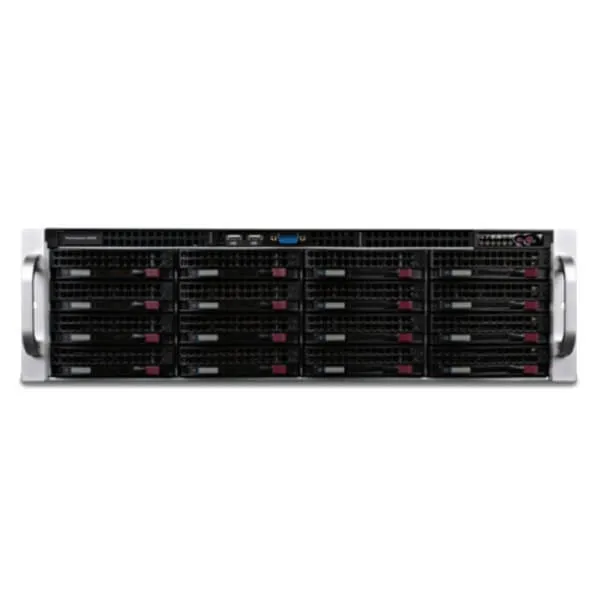
Fortinet FortiWeb FWB-3000F in Africa
Protect high-value websites, online services and APIs with a dedicated 2U security appliance designed for demanding enterprise environments. The FWB-3000F combines high-capacity inspection, hardware-based SSL/TLS processing, machine-learning-assisted application protection, API discovery, bot mitigation, graphical analysis and resilient network interfaces. FourTeck helps business buyers translate these capabilities into a correctly sized deployment, suitable service bundle and practical rollout plan.
Request QuoteCheck Africa Availability
Quick Product Information
Fortinet
FortiWeb 3000F / FWB-3000F
Web application and API firewall appliance
Large enterprise and data-centre application protection
Up to 10 Gbps, traffic and policy dependent
2U rack-mount appliance
Contact FourTeck for current options
Bundle, warranty and deployment guidance
Product Overview
Modern businesses expose more application services than a traditional perimeter firewall was designed to understand in depth. Customer portals, online payment pages, partner integrations, mobile applications, web-based ERP systems, public APIs and internal administrative interfaces all process requests that may look legitimate at the network layer while carrying malicious parameters, automated abuse or attempts to exploit weaknesses in application code. A dedicated web application firewall sits closer to this risk. It evaluates HTTP and HTTPS behaviour, application structure, user sessions, request patterns, API schemas and known attack techniques before traffic reaches the protected server.
The FortiWeb 3000F is positioned for organisations that need this protection at substantial scale. It is a physical appliance with hardware-based SSL/TLS processing, ten 10GE SFP+ ports including two bypass interfaces, eight Gigabit Ethernet bypass ports, two management interfaces, dual hot-swappable AC power supplies and two 960 GB SSDs. The appliance supports active/passive and active/active high-availability designs, giving architects several ways to place application security into an environment where downtime, maintenance windows and single-device failure must be considered carefully.
Its role is different from a conventional next-generation firewall. A network firewall remains important for segmentation, routing, VPN, intrusion prevention and broad traffic control. A web application firewall focuses on the language and behaviour of web applications. It can help identify attacks associated with the OWASP Top 10, discover APIs from observed traffic, apply schema validation, profile normal application behaviour, reduce malicious bot activity, monitor client-side scripts and provide administrators with application-focused dashboards and reports. This specialisation matters when online revenue, citizen services, digital banking, healthcare portals, education systems or customer self-service platforms depend on trustworthy application delivery.
For Africa-based buyers, correct sizing is especially important because projects may involve mixed data-centre standards, international hosting, regional cloud links, variable internet capacity, centralised applications serving several countries and limited maintenance opportunities at remote sites. FourTeck supports the buying process by reviewing protected domains, expected peak traffic, encryption usage, server topology, API volume, redundancy requirements, rack environment, required optics and the desired FortiCare or FortiWeb service bundle. The objective is to help the buyer select a complete solution rather than receive an appliance that is technically powerful but commercially or operationally incomplete.
Key Business Benefits
The value of a web application firewall should be measured by the business services it helps keep available, trustworthy and manageable. The following benefits connect the appliance capabilities with the practical concerns of security leaders, application owners and procurement teams.
◆ Application-Layer Risk Control
Inspection focused on HTTP, HTTPS, APIs, sessions and application behaviour can identify threats that ordinary port-based controls may not fully understand. This helps protect customer-facing services without relying only on secure coding or emergency patching.
◆ High-Capacity Service Protection
Up to 10 Gbps of rated throughput gives large organisations a platform for busy application estates. Final performance depends on traffic mix, encryption, enabled protections and deployment design, so realistic sizing remains essential.
◆ Reduced Operational Guesswork
Machine-learning-assisted profiling can build a model of normal application behaviour and help security teams evaluate anomalies with better context. This supports more focused tuning than a strategy based only on static allow and deny lists.
◆ API Visibility and Validation
API discovery and schema-aware controls help teams understand exposed endpoints and validate expected request structures. This is valuable for mobile applications, partner integrations and machine-to-machine services that change frequently.
◆ Resilient Data-Centre Design
Bypass interfaces, dual hot-swappable power supplies and supported high-availability modes give architects practical building blocks for fault tolerance, planned maintenance and continuity of protected application traffic.
◆ Better Protection Against Automation
Bot mitigation features can help distinguish legitimate users and approved automated services from credential attacks, scraping, harvesting and abusive request patterns that consume resources or target customer accounts.
◆ Clearer Security Reporting
FortiView dashboards, attack categorisation, user tracking and logging options help administrators explain application threats to operations teams, auditors and management without reducing every incident to raw network events.
Together, these benefits support a more mature application-security operating model. The appliance does not replace secure development, vulnerability management, endpoint protection or network security. It adds a specialised enforcement and visibility layer that can reduce exposure while developers remediate code, administrators investigate suspicious activity and the business continues to deliver digital services.
Product Highlights
Ten 10GE SFP+ ports support high-speed application paths, with two interfaces identified for bypass use.
Eight GE RJ45 bypass interfaces offer deployment flexibility for existing copper-connected application environments.
Dedicated processing helps the appliance inspect encrypted application traffic more effectively than a software-only design.
Two 960 GB SSDs support the appliance platform and operational data needs associated with a large deployment.
Active/passive and active/active clustering options support different resilience and traffic-distribution strategies.
Capabilities include application learning, API discovery, bot controls, client-side protection and policy-based enforcement.
A strong specification does not remove the need for careful design. Throughput is an up-to value and can change with SSL key sizes, enabled security services, request complexity, logging depth and traffic behaviour. The right bundle also matters because security services, support coverage and advanced capabilities may be licensed separately or included through a chosen term. Buyers should therefore request a commercial proposal that identifies the hardware SKU, subscription or service bundle, support duration, power cords, SFP+ optics, rack accessories and any central management requirement as separate line items.
Technical Specifications
| Specification | FortiWeb 3000F Details |
|---|---|
| Brand and model | Fortinet FortiWeb 3000F, SKU FWB-3000F |
| Product class | Physical web application and API firewall appliance |
| Rated throughput | Up to 10 Gbps; actual performance varies by configuration and traffic |
| Latency | Less than 5 ms under vendor test conditions |
| 10GE interfaces | 10 x 10G BASE-SR SFP+ ports, including 2 bypass ports |
| Gigabit copper interfaces | 8 x GE RJ45 bypass ports |
| Management interfaces | 2 x GE management ports |
| SSL/TLS processing | Hardware based |
| USB interfaces | 2 |
| Storage | 2 x 960 GB SSD |
| Application licences | Unlimited at appliance level; service subscriptions may still be required |
| Administrative domains | 64 |
| High availability | Active/passive and active/active clustering |
| Trusted Platform Module | Supported |
| Form factor | 2U rack mount |
| Dimensions | 3.5 x 17.5 x 22.6 inches; 88 x 444 x 574 mm |
| Weight | 56.2 lb / 22.5 kg |
| Power supplies | Dual hot-swappable AC power supplies |
| Power input | 100–240V AC, 50–60 Hz |
| Average power consumption | 200 W |
| Heat dissipation | 1045.5 BTU/h |
| Operating environment | 0°C to 40°C; 5% to 90% non-condensing humidity; front-to-back airflow |
| Final configuration | Bundle, optics, support term, accessories and software version are configuration dependent |
The specification table should be treated as a platform summary rather than a complete bill of materials. An organisation protecting a few high-value applications may need different policies and subscriptions from a managed service provider hosting many customer domains. Encrypted traffic can also have a major impact on design because certificate type, key size, handshake rate and the number of simultaneous sessions influence real-world performance. Buyers should provide peak and average traffic figures, not only internet circuit capacity, because application traffic may move internally between load balancers, servers, cloud gateways and data-centre zones.
Interface planning is equally important. Confirm whether existing switches and load balancers use multimode or single-mode fibre, the required distance, connector type, port speed and redundancy method before ordering optics. Verify rack depth, rail requirements, available power feeds, plug type, cooling capacity and front-to-back airflow. A high-availability pair normally needs duplicated network paths and separate power sources to provide meaningful resilience. FourTeck can help convert these technical requirements into a quotation checklist so missing transceivers, cables, service terms or implementation dependencies are identified before procurement approval.
Configuration and Buyer Guidance
Start with the applications rather than the appliance model. List every public website, API gateway, mobile backend, partner portal, administrative interface and internal web service that may pass through the platform. Record the business owner, hosting location, domain name, peak request rate, current bandwidth, certificate arrangement and acceptable outage window for each service. This inventory helps determine whether a single appliance, a high-availability pair or a staged rollout is appropriate.
Traffic and Encryption
Share measured HTTP and HTTPS throughput, peak connections, certificate types and expected growth. Circuit speed alone does not show the load that inspection will create.
Deployment Mode
Confirm whether the design will use reverse proxy, transparent inspection, offline protection or another supported architecture. The choice affects addressing, routing, certificates and change planning.
Service Bundle
Identify required application-security, reputation, malware, bot, analytics, client-side and support services. Compare one-, three- and five-year commercial terms on a like-for-like basis.
High Availability
Decide whether maintenance and failure tolerance require a second appliance. Include duplicated links, switch ports, optics, rack space and power feeds in the design.
Operations and Logging
Define administrator roles, log retention, SIEM integration, reporting needs, backup procedures and change control before production deployment.
Implementation Skills
Assign trained security and application personnel. Effective tuning requires knowledge of legitimate application behaviour, not only network configuration.
A proof of concept may be useful for unusually complex applications, high transaction volumes or environments with strict latency targets. During testing, measure protection effectiveness, false-positive handling, SSL performance, failover behaviour, logging volume and the effort required to move policies from monitoring to enforcement. Procurement should also ask how application owners will notify the security team about releases, new endpoints and changes to authentication flows. A web application firewall provides the best value when it becomes part of the application lifecycle rather than a device configured once and left unchanged.
Ideal Business Use Cases
Digital Banking and Financial Portals
Banks, fintech providers, insurers and payment organisations can place the appliance in front of customer portals and APIs where credential abuse, automated attacks, injection attempts and service availability have direct financial and reputational impact.
Government and Citizen Services
Tax, licensing, identity, permit and public-information platforms often process sensitive data and experience demand spikes. Application-focused inspection can strengthen the protection layer while administrators improve code and patching processes.
Telecom and Service Provider Platforms
Subscriber portals, billing applications, reseller systems and hosted customer services may need high-speed interfaces, multiple administrative domains and robust operational visibility across a shared infrastructure.
E-commerce and Online Marketplaces
Retail and marketplace systems can benefit from controls against scraping, credential stuffing, abusive automation, payment-page threats and attacks that target catalogue, checkout or customer-account workflows.
Healthcare and Education Systems
Patient portals, learning platforms, examination systems and student services handle private information and experience seasonal peaks. A dedicated appliance can help maintain visibility and policy consistency across these applications.
Large Enterprise API Estates
Organisations connecting ERP, CRM, mobile, logistics, supplier and cloud platforms through APIs can use discovery and schema controls to understand exposed endpoints and enforce expected request formats.
The appliance is most appropriate where application traffic and security requirements justify a large physical platform. A smaller business with limited traffic, a cloud-native project with no data-centre presence or an organisation protecting only one modest application may be better served by a smaller appliance, virtual edition or cloud-delivered service. FourTeck can help compare these delivery models without assuming that the largest model is automatically the correct choice. The buying decision should reflect application criticality, hosting architecture, internal skills, recovery objectives and the total cost of support and subscriptions over the planned lifecycle.
FWB-3000F Machine-Learning-Assisted Application Protection
Traditional application-firewall controls often depend on signatures, protocol validation, reputation data and manually maintained positive-security rules. These mechanisms remain valuable because they identify known attack patterns and reject clearly invalid requests. The operational challenge appears when a complex application has thousands of legitimate request variations, frequent releases and unusual user behaviour. Excessive blocking can interrupt customers, while overly relaxed policies reduce protection.
FortiWeb adds machine-learning-assisted analysis that profiles normal application behaviour and evaluates anomalies with additional context. In practical terms, the platform can learn how users normally interact with parameters, URLs, methods and application flows, then identify requests that differ meaningfully from the established model. This does not eliminate policy management or human review. It gives the security team another decision layer that can reduce the need to treat every unusual request as equally dangerous.
For business buyers, the important outcome is more sustainable enforcement. A web application firewall that generates constant false alarms may be moved into monitoring mode or configured with broad exceptions. A platform that helps administrators separate malicious anomalies from legitimate variation has a better chance of remaining active and useful. The organisation should still assign application owners to validate behaviour, establish a tuning period, document exclusions and review policy changes after software releases.
FourTeck recommends defining measurable acceptance criteria during deployment. Track blocked attacks, false positives, support tickets, application latency and analyst workload before and after policy changes. This creates evidence for management and helps the team decide when a protected service is ready to move from observation to blocking. The strongest result comes from combining the appliance with secure development, vulnerability scanning, patch management and incident response rather than treating machine learning as a replacement for those controls.
FWB-3000F API, Bot and Client-Side Protection
Web security now extends far beyond browser pages. Mobile applications, partner portals, payment services and automated business processes communicate through APIs that may expose sensitive functions directly to the internet. Development teams can release new endpoints quickly, sometimes before the security team has a complete inventory. FortiWeb API discovery observes application traffic to identify APIs and can use supported schema formats such as OpenAPI, XML and JSON to build stronger validation policies.
Schema validation is valuable because it defines what a legitimate request should contain. Unexpected fields, incorrect data types, malformed structures or calls to undocumented endpoints can be evaluated before they reach the application. Organisations should connect this capability with their release process so policy updates follow API changes. When development and security teams share specifications through a controlled pipeline, the firewall can protect new versions without relying entirely on emergency manual changes after deployment.
Automated traffic creates another challenge. Some bots are useful, including approved search crawlers, monitoring systems and partner integrations. Others scrape content, harvest data, test stolen credentials or consume application resources. FortiWeb combines behavioural techniques, threshold controls, deception, browser enforcement and challenge methods to distinguish users from automation and apply different actions. Effective bot management requires a clear business policy because blocking every automated request can also disrupt legitimate integrations.
Client-side protection addresses risks that appear in the user’s browser, particularly where first- and third-party scripts run on sensitive pages. Monitoring script activity can help identify unauthorised changes, formjacking and online skimming. This is relevant to payment pages and compliance programmes that require better visibility over scripts. Buyers should confirm whether the desired bundle includes the needed client-side and advanced bot services, how monthly request entitlements are measured and what renewal costs will apply. These details can significantly affect the total commercial package even when the hardware model stays the same.
FWB-3000F Resilience, Management and Operational Control
Application security becomes part of the production delivery path, so resilience must be designed rather than assumed. The appliance supports active/passive and active/active clustering. Active/passive designs are often easier to reason about because one node serves traffic while the second remains ready to take over. Active/active designs can distribute work but may require more detailed planning for sessions, routing, persistence and failure behaviour. The correct approach depends on topology, application state and the organisation’s operational skills.
Bypass ports provide another resilience option for selected deployment modes. They can preserve a physical traffic path under certain failure conditions, but bypass behaviour must be tested against the security policy and the desired fail-open or fail-closed outcome. Some organisations prefer service continuity even if inspection is temporarily unavailable. Others protect highly sensitive systems where uninspected traffic is unacceptable. This decision should be approved by the business owner and security leadership before installation.
Dual hot-swappable power supplies help reduce the risk of a single power-module failure, but they deliver real value only when connected to independent power distribution units and protected circuits. Rack depth, weight, airflow and heat output should be checked with the data-centre team. A 2U appliance weighing about 22.5 kg needs appropriate rails, safe handling and sufficient clearance. Cooling should support front-to-back airflow and the specified environmental range.
Operational control includes more than hardware. FortiView dashboards, real-time views, user and device tracking, OWASP categorisation, SNMP, syslog and email monitoring can support day-to-day administration and incident investigation. Larger environments may also consider central management and external log platforms. Before go-live, define who can change policies, who reviews alerts, how configuration backups are stored, how certificates are renewed and how firmware upgrades are tested. FourTeck can help buyers include these operational dependencies in the project scope rather than limiting the purchase discussion to appliance delivery.
What Buyers Should Check Before Purchase
A model number alone is not enough to produce an accurate quotation. Before requesting commercial terms, buyers should confirm the expected application workload, deployment architecture, licence bundle, support duration, physical environment and project responsibilities. FourTeck can review these details so the selected package matches the operational requirement instead of being chosen only from a throughput headline.
Configuration Fit
Provide peak traffic, HTTPS percentage, request rate, session count, protected domains, application count and three-year growth expectations. Include internal east-west traffic if the appliance will protect data-centre segments.
Compatibility Check
Identify load balancers, reverse proxies, firewalls, switches, cloud gateways, certificate systems and authentication platforms. Confirm routing, VLAN, SFP+ optic and logging compatibility before finalising the bill of materials.
Licensing and Renewal
Ask for a line-by-line explanation of Standard, Advanced or Enterprise services, FortiCare level, term length, renewal date and any usage entitlement for bot or client-side protection.
High-Availability Scope
Decide whether the quotation needs one appliance or a pair. Include duplicated optics, cables, rack positions, switch ports, power feeds and implementation time when budgeting for resilience.
Installation Requirements
Confirm who will rack the equipment, configure interfaces, import certificates, build policies, migrate traffic, tune applications, integrate logs and conduct failover testing.
Warranty Expectations
Review support hours, hardware replacement process, escalation path and country-specific service conditions. Do not assume every support tier or replacement commitment is identical across locations.
Delivery Preparation
Share destination country, city, consignee requirements, tax status, quantity and desired project date. Availability and delivery lead time can change with bundle, supplier allocation and import process.
Alternative Model Review
Ask whether a smaller appliance, FortiWeb 4000F, virtual edition or cloud-delivered option better fits the traffic profile, hosting model and total lifecycle budget.
For the fastest quotation process, send FourTeck a simple requirements sheet containing the current application diagram, traffic statistics, required interfaces, high-availability preference, licence term, country of delivery and target deployment date. State whether professional services are required and whether the security team already manages Fortinet products. This information allows the sales and technical teams to distinguish hardware cost from subscriptions, support, optics, logistics and implementation. It also gives the buyer a clearer basis for comparing proposals from different sources without accidentally comparing a bare appliance against a fully bundled multi-year solution.
Africa Availability and Service Support
FourTeck supports product enquiries across Africa with assistance for model selection, application-security sizing, service-bundle review, commercial quotation, delivery coordination and warranty guidance. Availability may vary according to the hardware model, selected security services, support duration, supplier allocation, order quantity and destination. High-end application-security appliances are commonly supplied as planned projects, so buyers should allow time for technical validation and logistics rather than basing a rollout on an unconfirmed delivery date.
The support process begins with a requirement review. FourTeck can help the buyer identify whether the FWB-3000F capacity is appropriate, whether a high-availability pair is required and which related items should appear on the quotation. Typical dependencies include SFP+ transceivers, fibre patch leads, power cords, rack accessories, support contracts, FortiWeb services, logging integration and implementation assistance. Where specifications or bundles have changed, the current vendor ordering information should be checked before purchase approval.
Warranty guidance is provided according to the quoted support package and regional service conditions. Buyers should retain serial numbers, support registration information, purchase records and deployment documentation. FourTeck can also help structure renewal discussions so security services and support do not expire without review. For a current availability check, send the delivery country, quantity, preferred term and desired deployment date through the contact page.
Africa Country and Regional Coverage
Businesses across Africa, including Kenya, Uganda, Nigeria, Ghana, Tanzania, Rwanda, Ethiopia, South Africa, Zambia, Botswana, Senegal and neighbouring commercial markets, can contact FourTeck for product availability, configuration guidance and quotation assistance. The team can help buyers review suitable models, related Fortinet options, deployment requirements and project-supply needs based on the actual business application.
Regional projects often involve more than one delivery or operating location. A central data centre may host applications for several countries, while local offices require separate administrators, reporting views or disaster-recovery connections. Buyers should explain these relationships during the requirement review because they can affect administrative-domain planning, network topology, certificate handling and support processes. FourTeck can coordinate commercial communication for multi-site requirements while each delivery remains subject to country-specific logistics, import procedures and service conditions.
For local project discussion, buyers may also visit FourTeck Kenya or FourTeck Uganda. These regional platforms can support location-specific enquiries while the Africa site remains the main reference for broader continental requirements.
GCC, Middle East and Africa Availability
FourTeck Africa can support product enquiries for organisations operating across Africa while also guiding connected technology requirements through selected FourTeck platforms for GCC and Middle East markets. This is useful for companies with data centres, regional headquarters or shared digital platforms spanning the UAE, Saudi Arabia, Qatar, Oman, Bahrain and African operating countries. A consistent application-security architecture can simplify policy governance, but local delivery, support and regulatory requirements still need individual review.
Cross-region buyers should specify where the appliance will be installed, where applications are hosted, which teams will administer the platform and how support incidents will be raised. Power cords, optics, import requirements, tax treatment, warranty processes and professional-service availability can differ by destination. A single global model number does not guarantee an identical commercial package in every market.
For wider regional guidance, visit FourTeck UAE or use the Africa contact channel. FourTeck will help route the enquiry to the relevant team and clarify which platform should issue the quotation for the final delivery destination.
Other Options Buyers May Consider
The correct alternative depends on whether the buyer needs more capacity, less capacity, a virtual deployment, cloud delivery or supporting security products. The cards below provide useful directions for a broader solution discussion without assuming that one option is universally better.
FortiWeb 2000F
Consider for a lower-capacity physical deployment where 5 Gbps class throughput and fewer 10GE interfaces may be sufficient.
FortiWeb 4000F
Review for substantially larger application traffic or designs requiring 40GE bypass connectivity and a higher appliance class.
FortiWeb Virtual Appliance
Suitable for organisations that prefer software deployment on supported hypervisors or cloud platforms and can size compute resources appropriately.
FortiAppSec Cloud
A cloud-delivered option for buyers seeking protection without installing a physical or virtual appliance in their own infrastructure.
Fortinet FortiGate 3001G
Consider as a related high-capacity network firewall platform when the project also requires perimeter control, segmentation, VPN and threat inspection.
Fortinet FortiSandbox
Useful where suspicious files from web, email or other security controls require deeper behavioural analysis and shared threat intelligence.
Buyers building an integrated Fortinet environment can also review Fortinet Security Fabric solutions. This helps connect application protection with network firewalls, central management, analytics, endpoint visibility and other security controls. FourTeck can prepare a phased proposal so the immediate WAF requirement does not force every related purchase into the same budget cycle.
Why Buyers Choose FourTeck
Enterprise security procurement is rarely a simple hardware transaction. Buyers need to know whether the model is correctly sized, which subscription is required, what the support term covers, whether optics and cables are included and how the appliance will fit into the existing application path. FourTeck approaches the enquiry as a business and technical requirement rather than a request for a box number alone.
Support for translating application, traffic and resilience needs into a practical quotation brief.
Discussion of appliance class, high availability, interfaces, optics, services and support terms.
A structured commercial response that separates hardware, subscriptions, support, accessories and services.
Planning support based on destination, quantity, supplier status and project timeline.
Help reviewing the quoted support level, registration needs and escalation expectations.
Guidance on firewalls, management, analytics, sandboxing and other components that may support the project.
FourTeck supports small and medium organisations, large enterprises, public institutions, resellers, system integrators and project buyers. The team does not assume that every customer needs the same deployment. Some buyers require only product supply. Others need a full bill of materials, multi-year licensing, delivery coordination and implementation planning. Explaining the requirement clearly allows the quotation to reflect the appropriate scope and reduces the risk of unexpected cost after purchase.
Frequently Asked Questions
What is the FortiWeb 3000F used for?
It is used to protect enterprise websites, web portals and APIs from application-layer attacks, malicious automation, abnormal requests and known vulnerability techniques. It is placed in the application delivery path and inspects HTTP and HTTPS traffic before requests reach protected servers. It complements, rather than replaces, a network firewall and secure software-development practices.
How much traffic can the appliance handle?
The vendor rates the platform for up to 10 Gbps throughput. Actual results depend on encryption, enabled protection features, request complexity, logging, connection rate and deployment design. Buyers should size with measured application traffic and growth projections rather than assuming the headline figure will apply unchanged to every environment.
Does the appliance support high availability?
Yes. FortiWeb 3000F supports active/passive and active/active clustering. A resilient design normally requires two appliances, duplicated network connections, suitable switch capacity, independent power feeds and a tested failover process. The preferred mode should be chosen according to application state, routing, session persistence and operational experience.
Can it protect APIs as well as websites?
Yes. FortiWeb includes API discovery and protection capabilities and can work with supported schema formats such as OpenAPI, XML and JSON. API security should be integrated with the application release process so new endpoints, methods and data structures are reflected in policy updates before production changes create gaps.
Are FortiWeb security services included with the hardware?
The exact package depends on the SKU and bundle selected. Standard, Advanced and Enterprise options can include different services and support entitlements. Buyers should request a quotation that names each service, term and renewal requirement so a bare hardware price is not compared with a complete multi-year security package.
Can FourTeck help choose the correct configuration?
Yes. FourTeck can review traffic, HTTPS usage, protected domains, APIs, deployment mode, high availability, interfaces, optics, support term and delivery destination. The resulting guidance helps identify the appropriate appliance and commercial bundle, although final architecture and implementation decisions should involve qualified security and application professionals.
Is FortiWeb FWB-3000F available in Africa?
FourTeck supports enquiries across Africa, but availability must be confirmed for the selected hardware, bundle, quantity and destination. Supplier allocation, licensing term, import process and project timing can affect delivery. Send the country, city, quantity and preferred deployment date when requesting a current quotation.
What accessories should be included in the quote?
Common items include SFP+ transceivers, fibre patch leads, appropriate power cords, rack accessories, additional appliance hardware for high availability and any central management or logging platform. The exact list depends on the data-centre environment. Confirm optic type, distance, connector, rack depth and power standard before ordering.
What warranty and support guidance is available?
FourTeck can explain the support package included in the quotation, registration requirements and regional warranty considerations. Response times and replacement processes depend on the selected FortiCare level and destination. Buyers should keep serial numbers, purchase records and support details available for future cases and renewal planning.
Can businesses request bulk or project supply?
Yes. Enterprises, public institutions, service providers, resellers and system integrators can request project supply. Share quantity, installation locations, bundle term, high-availability requirement, desired delivery schedule and whether professional services are needed. FourTeck can then coordinate a structured commercial and logistics review for the complete requirement.
Need Help Planning Your Web Application Firewall?
FourTeck can help you review application traffic, deployment mode, licensing, high availability, optics, warranty guidance and delivery requirements before preparing a quotation for your organisation.

Reviews
There are no reviews yet.