

FortiVoice FVE-500F Phone System in Africa
Build a more organised business calling environment with a dedicated 1U IP PBX appliance sized for up to 500 endpoints. The FortiVoice FVE-500F gives growing organisations a central platform for extension management, call routing, conferencing, voicemail, queues and user communications while allowing procurement teams to plan around defined appliance capacity rather than an undersized office system. FourTeck helps buyers review the required phones, trunks, gateways, licensing, support and deployment conditions before quotation.
Request QuoteCheck Africa Availability
Quick Product Information
Fortinet
FortiVoice FVE-500F
Enterprise IP PBX and unified communications appliance
Up to 500 endpoints
Up to 50
Up to 75
1U rack mount
1 TB integrated drive
Subject to bundle, quantity and supplier status
Configuration, quote and warranty guidance from FourTeck
Product Overview
Business telephony is more than a collection of desk phones. It is the routing layer that connects customers to departments, links employees to colleagues and gives administrators control over how calls move through an organisation. The FVE-500F is designed for businesses that have moved beyond a small-office PBX but do not require the much larger capacity of a service-provider or very large campus platform. Its defined ceiling of 500 endpoints, 50 VoIP trunks and 75 concurrent calls makes it a practical fit for medium-sized enterprises, expanding institutions, hotels, multi-floor offices, contact-oriented teams and organisations consolidating separate phone systems.
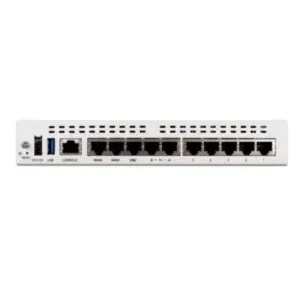
The appliance runs as a dedicated 1U rack-mounted system, helping IT teams keep communications infrastructure within a controlled server-room or network-rack environment. Four Gigabit Ethernet interfaces provide network connectivity options, while the integrated 1 TB drive supplies local storage for system functions. It does not include built-in PRI, FXO or FXS interfaces, so organisations that must connect traditional telephone lines, analogue devices or legacy services should plan suitable FortiVoice gateways or other supported interfaces. This distinction is important because the correct deployment depends on the carrier service and existing telephony estate, not only on the number of employees.
FortiVoice brings call handling, extension administration, auto attendants, conferencing, voicemail, routing policies, user portals and related collaboration tools into a central management environment. Optional call-centre and hotel functions can be considered when those workflows are required, subject to the appropriate licences and project design. For a customer service department, the value lies in orderly queues, routing and agent workflows. For a hospitality property, it lies in matching communications to front-desk and guest-service requirements. For a corporate office, the focus may be consistent extension numbering, departmental routing and controlled administration.
Africa buyers should also assess network quality, internet resilience, SIP carrier compatibility, electrical protection, rack conditions and local support arrangements. Voice quality can be affected by latency, packet loss, congestion and poor switching design. FourTeck therefore treats the phone system as part of a complete communications project. The team can help review endpoint counts, branch plans, IP phones, gateways, PoE switching, firewall policy, support bundles and delivery requirements before an order is placed. This approach helps procurement teams avoid buying an appliance that is technically capable but incomplete for the actual operating environment.
Key Business Benefits
The strongest reason to consider this platform is not a single feature. It is the ability to bring core voice services into a manageable appliance with capacity that can support a sizeable organisation. The following benefits translate the technical profile into practical business outcomes.
◆ Capacity for Growth
Support for up to 500 endpoints gives expanding organisations room to add departments, desks and approved user devices without replacing a small PBX too early. Buyers can plan phased deployment while still respecting the system’s concurrent-call and trunk limits.
◆ Central Call Control
A unified administration point helps IT teams apply extension plans, call routes, schedules, privileges and messaging settings consistently. Central control reduces the confusion that develops when departments use disconnected phone services.
◆ Better Customer Routing
Auto attendants, queues, ring groups and routing rules help direct callers to the right people. A well-designed call flow can reduce unnecessary transfers and give customers a clearer path to sales, service, accounts or support.
◆ Departmental Collaboration
Conferencing, extension groups, user portals and mobility-oriented options support communication between teams. The result is a more coherent calling experience for staff working across floors, departments or approved remote arrangements.
◆ Deployment Flexibility
SIP trunks and IP endpoints allow businesses to design around modern network-based voice services. Where analogue or traditional carrier connections remain necessary, compatible gateways can be included as a planned component rather than an afterthought.
◆ Defined Procurement Scope
Published limits for endpoints, trunks, concurrent calls and conference resources give buyers a clearer sizing framework. This makes it easier to compare business demand with appliance capacity and identify when a larger or smaller model is more appropriate.
These benefits depend on correct implementation. A phone system with generous endpoint capacity can still disappoint if the WAN link is unstable, the PoE switches are undersized, the dial plan is poorly structured or the chosen SIP provider is incompatible. FourTeck can help turn the appliance specification into a practical bill of materials covering phones, switching, gateways, licences, rack accessories and support options.
Product Highlights
The FortiVoice FVE-500F Phone System Africa configuration is positioned for organisations that need a substantial on-premises voice platform without stepping into the capacity class of the 2000-endpoint appliance. Its 500-endpoint limit is complemented by support for 50 VoIP trunks and 75 concurrent calls. This balance is useful because the number of registered phones is not the same as the number of simultaneous external or internal call sessions. Proper sizing should consider peak calling periods rather than employee count alone.
Suitable for a sizeable extension estate across multiple teams.
A key planning figure for busy-hour traffic and call-centre demand.
Designed for structured installation in a suitable equipment rack.
Call-centre and hotel functions are supported with applicable licensing.
The appliance includes four 10/100/1000 Ethernet interfaces and 1 TB of storage. It uses a single power supply and does not provide RAID storage management on this model, points that should be considered in business-continuity planning. Organisations requiring storage redundancy or larger scale should review higher FortiVoice models. The platform supports widely used audio codecs including G.711, G.729a, G.722 and Opus, with H.263 and H.264 listed for video-related capabilities. Codec selection and media quality remain dependent on endpoints, network design, carrier support and configuration.
The system can support up to 50 auto attendants, 20 conference bridges with up to 20 attendees per bridge and a maximum of 55 call-centre agents when the relevant call-centre capability is licensed and configured. These figures provide useful boundaries for project planning, but they should not be treated as a substitute for a traffic study. Busy sales operations, schools at registration time, hospitals, hotels and service desks may experience concentrated calling patterns that require careful concurrent-call and queue analysis.
Technical Specifications
| Specification | FortiVoice FVE-500F Details |
|---|---|
| Brand | Fortinet |
| Model / SKU | FortiVoice 500F / FVE-500F |
| Product Type | Enterprise IP PBX and unified communications hardware appliance |
| Network Interfaces | 4 × RJ45 10/100/1000 Ethernet ports |
| Integrated Storage | 1 TB total hard-drive capacity |
| RAID | Not supported on this model |
| Endpoints / Extensions | Up to 500 |
| VoIP Trunks | Up to 50 |
| Concurrent Calls | Up to 75 |
| Auto Attendants | Up to 50 |
| Conference Resources | Up to 20 conference bridges; up to 20 attendees per bridge |
| Maximum Call-Centre Agents | Up to 55 with applicable call-centre licensing and configuration |
| Traditional Interfaces | No built-in PRI, FXO or FXS ports; compatible gateways may be required |
| Audio Codec Support | G.711 μ-law/A-law, G.729a, G.722 and Opus |
| Video Codec Support | H.263 and H.264 |
| Form Factor | 1U rack mount |
| Power Supply | Single power supply |
| Dimensions | 44 × 432 × 270 mm (1.73 × 17.01 × 10.63 inches) |
| Weight | Approximately 4.54 kg (10 lb) |
| Optional Workloads | Call-centre and hotel functionality supported with suitable licences |
| Availability and Warranty | Configuration, region and support-bundle dependent; confirm with FourTeck |
The specifications establish the system boundary, but correct selection requires context. A 400-person organisation may fit comfortably when only a modest number of calls occur at once, while a 150-seat contact-oriented operation may place heavier demand on the 75 concurrent-call capacity. Likewise, 50 VoIP trunks may be sufficient for one organisation and restrictive for another depending on inbound campaigns, outbound calling, queue behaviour and branch connectivity. Buyers should measure peak-hour traffic, not daily averages.
The lack of built-in analogue or PRI interfaces means the project should identify how external services will connect. A pure SIP deployment may not need a traditional voice gateway, but analogue fax devices, door phones, emergency lines or existing PSTN circuits can change the bill of materials. The single power supply and non-RAID storage design should also be considered in continuity planning. A suitable UPS, controlled rack environment, configuration backup and documented recovery process are sensible parts of a professional deployment.
Configuration and Buyer Guidance
Begin with the real communication workload. Count desk phones, reception phones, conference-room devices, approved softclients, common-area phones and any special endpoints. Then estimate simultaneous calls during the busiest thirty minutes of a normal high-demand day. An endpoint count below 500 does not automatically mean the appliance is correctly sized; the 75 concurrent-call limit and 50-trunk limit must also align with expected traffic.
1. Define the user estate
List current users, shared phones, future hires, branches and temporary project staff. Include a growth allowance that reflects the organisation’s realistic plan.
2. Measure call concurrency
Review busy-hour inbound, outbound and internal traffic. Contact centres and booking teams often need more call capacity per employee than back-office departments.
3. Confirm carrier design
Identify SIP providers, required DIDs, number portability, emergency calling, failover and any analogue or PRI services that need a gateway.
4. Audit the LAN and WAN
Check PoE budget, VLAN capability, QoS design, firewall rules, internet resilience and cabling. Good voice service depends on a network prepared for real-time traffic.
5. Choose endpoint types
Match executive, operator, reception, standard-user, conference and remote-user needs to suitable phones or softclient options rather than selecting one handset for everyone.
6. Plan support and continuity
Confirm support term, firmware entitlement, UPS protection, configuration backup, administrator training and the escalation route for carrier or system incidents.
Organisations should also decide whether call-centre or hotel capabilities are part of the initial project or a later phase. Optional features can affect licences, setup effort, reporting, user training and integration requirements. FourTeck can use a completed requirements list to identify the base appliance, FortiCare bundle, handsets, gateways and supporting network components needed for a workable deployment.
Ideal Business Use Cases
This appliance is best suited to organisations whose calling environment is large enough to justify centralised enterprise telephony but remains within the published 500-endpoint and 75-concurrent-call boundaries. The most appropriate projects are those with a clear dial plan, structured departments and a network team or service provider capable of managing IP voice.
Corporate Headquarters
A multi-floor office can centralise extensions, reception handling, department routes, conferencing and voicemail while using a common administrative platform.
Customer Service Teams
Organisations with sales, booking, help-desk or service queues can design more orderly call distribution, subject to the applicable call-centre licence and the 55-agent capacity.
Hotels and Hospitality
Properties can consider the supported hotel functionality for front-desk and guest-service workflows, after confirming licensing, property-system requirements and room-phone design.
Education and Training
Campuses, colleges and training groups can organise administrative, faculty, reception and support communications across a substantial extension estate.
Healthcare Administration
Clinics and healthcare groups may use structured routing for reception, appointments and administration, provided clinical, emergency and regulatory requirements are separately validated.
Multi-Department Institutions
Government, nonprofit, logistics and professional-service organisations can consolidate fragmented extension systems and introduce a consistent call-routing policy.
The system can also fit a distributed organisation when branch connectivity, survivability, numbering and WAN quality are properly designed. It should not be selected solely because the endpoint number appears generous. Very high call concurrency, more than 500 users, strong storage-resilience requirements or a need for redundant power may point to a larger model or a different architecture. Conversely, a business with fewer than 200 endpoints may find a smaller appliance more economical. FourTeck can help compare the FVE-200F8, FVE-500F, virtual editions and higher-capacity appliances according to the actual requirement.
FortiVoice FVE-500F Capacity and Call Handling
Capacity planning is the first feature deep dive because telephony demand is uneven. A system may be quiet for most of the day and experience intense activity when a campaign opens, a school closes, a hotel reaches check-in time or a service incident occurs. The 500-endpoint rating describes how many extensions the platform can support, while the 75-concurrent-call figure describes simultaneous call activity. These values must be considered together.
Fifty VoIP trunks provide the external channel framework for SIP-based services. The appropriate trunk count depends on how many callers must reach the organisation at once, how many employees place outbound calls, and whether internal branch traffic also consumes designed resources. A business with 450 registered phones may need only 25 external channels, while a 120-seat customer-contact team might need a larger share of the available trunk and concurrent-call capacity. Queue design, abandoned-call targets, average handling time and peak traffic should influence the decision.
The appliance supports up to 50 auto attendants, allowing organisations to create structured entry points for departments, schedules, languages or business units. It also supports up to 20 conference bridges and up to 20 attendees per bridge. These resources can reduce dependence on ad-hoc calling methods, but conferencing should still be governed by user policy, bandwidth planning and endpoint capability. For call-centre use, the stated maximum is 55 agents with applicable licensing. Buyers should confirm the required reports, supervisor functions, queue logic and integration expectations before assuming that a capacity figure alone meets the operational brief.
FourTeck can help translate user numbers into a more reliable sizing worksheet. Useful inputs include the current phone bill, SIP channel count, busy-hour call records, expected growth, department list, branch topology and target service levels. This creates a stronger basis for quotation and reduces the risk of selecting by employee count only.
FortiVoice FVE-500F Management and User Experience
A business phone platform must be manageable after installation. Central administration allows authorised IT staff or service teams to maintain extensions, routing, schedules, privileges, voicemail settings, phone profiles and other communications policies from a consistent interface. This matters when departments move, employees change roles or opening hours vary. Without central control, small changes can become slow, inconsistent and difficult to audit.
User-facing capabilities can reduce routine administrator workload by allowing staff to access approved portal functions, call history, messaging preferences and supported communication tools. The exact experience depends on software version, endpoint choice, licences and organisational policy. Buyers should define which tasks remain under IT control and which tasks users may manage. Receptionists, executives, queue agents and standard office users often require different profiles, programmable keys and call permissions.
The system’s support for common audio codecs gives designers options when balancing voice quality and bandwidth. G.722 and Opus can support higher-quality audio where endpoints and networks allow, while G.711 and G.729a remain relevant in many deployments. Codec configuration should match SIP-provider support and WAN conditions. A mismatch can lead to transcoding, failed calls or degraded quality. Network QoS, VLAN design and monitoring remain essential because a capable PBX cannot correct severe packet loss or unstable connectivity by itself.
Management planning should include administrator roles, secure access, configuration backup, change records, firmware maintenance and a tested escalation path. It is also sensible to document the dial plan, emergency routes, carrier contacts and recovery steps. FourTeck can help procurement teams include these operational requirements in the project scope so the purchase covers more than hardware delivery.
FortiVoice FVE-500F Deployment, Connectivity and Continuity
The FVE-500F is a 1U rack appliance measuring approximately 44 × 432 × 270 mm and weighing about 4.54 kg. It should be installed in a suitable rack with controlled temperature, reliable power and appropriate cable management. The four Gigabit Ethernet ports provide network connectivity, but the final port design depends on segmentation, management policy and supported deployment architecture. IT teams should avoid treating a voice appliance as an isolated box; it forms part of the LAN, WAN, firewall and carrier environment.
Because the model has no built-in FXO, FXS or PRI interfaces, legacy line requirements should be identified early. Analogue fax machines, paging adapters, lift phones, door phones or existing PSTN circuits may require compatible gateways. A project that omits these dependencies can arrive on site with the correct PBX but no practical method to connect critical services. The carrier should also confirm SIP credentials, DID ranges, number-porting timelines, emergency routing and failover options.
Continuity planning deserves attention because this model uses a single power supply and does not provide RAID storage management. A correctly sized UPS can protect against brief outages and poor power conditions, while configuration backups and documented restoration procedures support recovery. Organisations with stricter resilience objectives may require a different design, spare equipment strategy, carrier failover or a higher-end model. The right choice depends on the acceptable downtime, business impact and recovery target.
Voice quality also depends on PoE switching, cabling and bandwidth. The phone count should be compared with switch-port availability and PoE budget, including expansion headroom. QoS policies should prioritise real-time traffic without starving essential business applications. FourTeck can help buyers identify related FortiSwitch, FortiGate, FortiFone, gateway and UPS requirements so the communications system is purchased as a coherent deployment rather than a standalone appliance.
What Buyers Should Check Before Purchase
Before requesting a quote, buyers should confirm the complete use case rather than submitting only the model name. The FortiVoice FVE-500F can be a strong fit for medium-to-large communications environments, but the correct order may include support, licences, phones, gateways, switches, power protection and professional services. A clear requirements brief helps FourTeck identify omissions before they become project delays.
Configuration Fit
Confirm total endpoints, busy-hour concurrent calls, SIP trunks, auto attendants, queues, conference demand and expected growth. Share separate figures for office users and contact-oriented teams.
Compatibility Check
Identify the SIP carrier, firewall, switching platform, IP phones, softclients and legacy devices. Confirm whether analogue or PRI connectivity requires a gateway.
Licensing Scope
State whether call-centre or hotel functions are required, how many agents or rooms are involved and which reporting or integration features are expected.
Infrastructure Readiness
Check rack space, UPS capacity, cooling, PoE switch budget, cabling, VLAN design, QoS and internet resilience. Include branch links and remote-user connectivity where relevant.
Availability and Warranty
Ask for the current hardware or FortiCare bundle, support duration, warranty handling process, delivery estimate and country-specific terms. Do not assume that all bundles are identical.
Continuity Requirements
Define acceptable downtime, carrier failover, power protection, backup practice and restoration responsibility. Consider the model’s single PSU and non-RAID design.
Accessories and Services
List handset classes, headsets, conference phones, gateways, rack accessories, transceivers, installation, migration, training and number-porting support.
Quote Preparation
Provide the deployment country, required date, order quantity, user count, carrier details, current PBX, preferred support term and any tender documentation.
Buyers comparing similar FortiVoice models should focus on capacity and resilience differences. A smaller model may lower initial cost when the user estate is modest, while a higher model may be justified by more concurrent calls, larger storage, RAID capability, redundant power or substantial growth. FourTeck can review replacement and alternative models when the requested appliance is unavailable or no longer aligns with the project. The objective is to match the full communications requirement, not simply provide the nearest product code.
Africa Availability and Service Support
FourTeck supports product enquiries across Africa with assistance for appliance selection, configuration review, quotation, delivery coordination and warranty guidance. Availability can vary according to the requested base unit or FortiCare bundle, licensing term, quantity, supplier position and destination. For that reason, buyers should request a current quotation tied to the actual project rather than relying on a generic online figure.
A useful enquiry includes the number of users, estimated simultaneous calls, preferred SIP provider, branch count, handset requirement, call-centre or hotel needs and the destination country. FourTeck can then review whether the 500F is correctly sized and identify related phones, gateways, switching and power components. This can also reveal when a virtual edition, a smaller appliance or a higher-capacity model is more appropriate.
Delivery planning may involve freight method, import requirements, lead time, insurance, documentation and local project scheduling. Warranty and support handling should be confirmed as part of the quotation, including the selected service term and the process for technical cases or hardware replacement. These conditions vary and should not be assumed from the model name alone.
Africa Country and Regional Coverage
Businesses across Africa, including Kenya, Uganda, Nigeria, Ghana, Tanzania, Rwanda, Ethiopia, South Africa, Zambia, Botswana, Senegal and nearby regional markets, can contact FourTeck for availability checks, configuration guidance and project quotation. The buying process can be adapted for private companies, government procurement, education, hospitality, healthcare, resellers, system integrators and multi-site organisations.
Regional requirements differ. Some buyers operate with SIP-first carrier services, while others must preserve analogue lines or legacy equipment. Power quality, internet resilience, customs procedures, tax documentation and delivery routes can also affect the final plan. FourTeck helps coordinate the commercial and technical information needed to prepare a realistic proposal, but final availability, delivery timing and support arrangements remain subject to confirmation.
For country-specific assistance, buyers may use the FourTeck Kenya platform, the FourTeck Uganda platform or the central FourTeck Africa website. A single concise project brief is preferable to repeated location enquiries because it allows the team to review the full deployment, quantity and destination together.
GCC, Middle East and Africa Availability
FourTeck Africa can support communications-product enquiries for organisations across Africa while guiding wider regional requirements through selected FourTeck platforms serving GCC and Middle East markets. Businesses with offices or projects spanning UAE, Saudi Arabia, Qatar, Oman, Bahrain and African locations can request coordinated product-selection and quotation support. The commercial route may differ by destination, local regulation, carrier environment and support entitlement.
Regional telephony projects should verify that the product and service design align with local telecommunications rules and approved carrier services. Hardware availability does not by itself confirm that every trunk type, emergency-call requirement, number plan or service-provider integration is suitable in every country. The deployment team should therefore validate local requirements before purchase.
For wider Middle East enquiries, buyers can visit FourTeck UAE. Delivery options, warranty handling, licensing, lead time and configuration support vary by country, selected bundle and order quantity. FourTeck can help organise a regional bill of materials when the same organisation needs phones, PBX systems, networking and security components across multiple operating locations.
Other Options Buyers May Consider
The best alternative depends on endpoint count, call concurrency, legacy interfaces, storage resilience and growth. Buyers should compare the full system requirement rather than choosing the nearest model number. The following options provide useful starting points for discussion with FourTeck.
FortiVoice FVE-200F8
Consider for smaller environments needing up to 200 endpoints and built-in FXO connectivity. Confirm current specifications and project fit.
FortiVoice FVE-2000F
Suitable for larger extension estates and projects that need higher call capacity, more storage and RAID options than the 500F.
FortiVoice Virtual Appliances
A virtual edition may suit organisations standardising on supported virtual infrastructure and preferring software deployment.
FortiFone IP Phones
Select handset profiles for executives, reception, standard users, conference spaces and customer-facing teams.
FortiVoice Gateways
Add suitable gateway capacity where analogue lines, extensions or other traditional interfaces must be retained.
Fortinet Network Stack
Review firewall, switching and wireless requirements when the voice project is part of a broader Fortinet environment.
FourTeck can compare these options based on the number of extensions, preferred deployment model, resilience target, carrier service and budget structure. A suitable alternative should preserve the required business outcome rather than merely matching one headline capacity figure.
Why Buyers Choose FourTeck
Enterprise communications purchases often involve more dependencies than the product title suggests. FourTeck helps buyers structure these dependencies into a clearer procurement request. The team can review appliance capacity, endpoints, network readiness, gateways, licensing, support duration, destination and project timing before preparing a quotation.
For procurement teams, this means the conversation can include quantities, commercial documentation, alternative models and regional shipping rather than only a retail-style checkout. For IT managers, it provides an opportunity to flag SIP, VLAN, PoE, rack, UPS and support requirements. For resellers and integrators, FourTeck can help organise project supply around a defined bill of materials and destination.
FourTeck does not rely on unverifiable stock or price claims. Availability is checked against the requested model, bundle and quantity. Warranty guidance is provided according to the offered support arrangement and destination. When a requested model is unsuitable or unavailable, the team can discuss practical alternatives without presenting a larger product as automatically better.
The result is a buyer-focused process: clarify the requirement, match the configuration, confirm current commercial terms and coordinate the order. This is especially useful for voice projects because carrier compatibility, user counts and infrastructure readiness can materially affect whether the final system works as expected.
Frequently Asked Questions
What is the FortiVoice FVE-500F used for?
It is an enterprise IP PBX and unified communications appliance used to manage business extensions, SIP trunks, call routing, voicemail, auto attendants, conferencing and related voice workflows. It is designed for organisations needing up to 500 endpoints and should be sized against concurrent-call, trunk and feature requirements.
How many phones and calls can the appliance support?
The published capacity is up to 500 endpoints, 50 VoIP trunks and 75 concurrent calls. These figures measure different aspects of the system. Buyers should review peak-hour call traffic and growth rather than assuming that a 500-user organisation will automatically fit every calling pattern.
Does it connect directly to analogue or PRI lines?
The FVE-500F does not include built-in FXO, FXS or PRI interfaces. A deployment using analogue devices, PSTN lines or traditional carrier circuits may require compatible FortiVoice gateways or other approved interfaces. FourTeck can help identify these requirements during configuration review.
Can it support a call centre?
Call-centre functionality is supported with the appropriate licence and configuration, with a published maximum of 55 call-centre agents for this model. Buyers should also confirm queue design, reports, supervisor tools, integration needs and expected call volumes before selecting the platform.
Is the FVE-500F suitable for hotels?
The appliance supports hotel-related functionality with applicable licensing. Suitability depends on room count, front-desk workflow, property-management integration, guest phones, emergency requirements and carrier design. FourTeck can help review the communications scope before quotation.
Is the system available across Africa?
FourTeck accepts enquiries from businesses across Africa. Availability depends on the requested hardware or support bundle, licensing, supplier status, quantity and destination. A current quotation is required to confirm commercial terms, delivery coordination and warranty guidance for the order.
What information is needed for a quote?
Provide the endpoint count, estimated simultaneous calls, SIP carrier, branch locations, handset quantities, required licences, support term, delivery country and target schedule. Details about analogue lines, PoE switching, rack space and UPS protection also help create a more complete proposal.
Does FourTeck help with configuration selection?
Yes. FourTeck can review model capacity, phones, gateways, licensing, support, switching and power requirements before quotation. The assistance is intended to reduce configuration gaps, although final installation scope and technical responsibility should be defined in the commercial proposal.
What are the main continuity considerations?
This model has a single power supply and does not support RAID storage management. Buyers should consider UPS protection, configuration backups, carrier failover, recovery procedures and acceptable downtime. Organisations requiring higher hardware resilience may need a larger model or an alternative architecture.
Can businesses request bulk or project supply?
Yes. Businesses, resellers and system integrators can request project quotations covering the appliance, FortiCare, licences, IP phones, gateways, networking components and delivery. Quantity, destination, documentation and schedule should be included so the proposal can reflect the complete requirement.
Need Help Planning Your Business Phone System?
Share your endpoint count, call traffic, SIP provider, handset requirement and delivery location. FourTeck can review product availability, configuration options, support terms, warranty guidance and related infrastructure for a practical business quotation.
Reviews
There are no reviews yet.