
Grandstream GWN7810 Layer 3 Switch Series in Africa
Build a more organised, resilient and manageable business network with a family of Layer 3 switches designed for growing offices, campuses, hotels, schools, healthcare facilities, warehouses, surveillance environments and multi-floor enterprise sites. The range combines Gigabit access ports, 10 Gigabit SFP+ uplinks, advanced routing, VLAN control, traffic prioritisation, security safeguards and flexible management options. FourTeck helps buyers choose the right port count, PoE capacity, uplink design and support path before ordering.
✓ PoE Budget Review
✓ Africa Delivery Guidance
✓ Quote Assistance
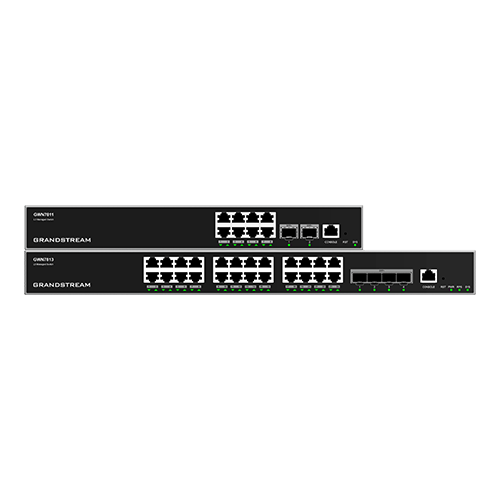
Choose by access-port count, PoE endpoint demand, 10G uplink quantity, routing scale, power-resilience requirement and expected network growth.
Quick Product Information
A Routed Switching Foundation for More Demanding Business Networks
The GWN7810 family sits above basic unmanaged and Layer 2 access switching by adding the control required to route traffic between network segments, apply detailed policies and operate a larger wired infrastructure from a more central point. It is intended for organisations that need to separate departments, voice devices, wireless access points, surveillance cameras, guests, servers and management traffic without forcing every local decision through a separate router. With Layer 3 functions built into the switching platform, an IT team can create a cleaner architecture for inter-VLAN communication, traffic control and growth.
The series covers several deployment sizes. Compact 8-port models suit a focused branch, equipment room, premium meeting floor or small aggregation point. The 16 and 24-port versions address larger access requirements, while the 48-port GWN7816 and GWN7816P serve high-density floors and enterprise racks. Every buyer does not need the largest model. The correct choice depends on current connected devices, spare-port policy, PoE demand, uplink count, redundancy goals and the rate at which the site is expected to expand.
High-speed SFP+ connections allow the switches to link to fibre backbones, servers, storage, distribution switches or remote cabinets at up to 10 Gigabit speeds with suitable modules and cabling. This matters where several access devices share one uplink. A busy wireless network, video-surveillance system or multi-department office can create far more aggregated traffic than a single Gigabit link should carry. Planning 10G uplinks early reduces avoidable bottlenecks and gives the network room to absorb additional users and applications.
For Africa-focused projects, procurement is often only one part of the decision. Rack depth, heat, power quality, fibre type, transceiver compatibility, installer readiness, replacement strategy and delivery route may be equally important. FourTeck supports buyers by reviewing these practical details before quotation. The goal is to match the model and accessories to the operating environment, rather than choosing from port count alone. This approach is useful for new builds, branch upgrades, campus expansions, hotel networks, school infrastructure, health facilities, logistics sites and organisations consolidating mixed switching environments.
Key Business Benefits
A technical feature matters only when it improves reliability, control, productivity or long-term cost. The following benefits explain how this switch family supports real operating requirements.
Scalable Port Choices
A single family spans 8, 16, 24 and 48 access ports. Businesses can standardise management and operating practices across small branches, medium floors and larger distribution points while selecting only the physical capacity each location needs. Spare ports can be planned deliberately instead of paying for excessive unused capacity or replacing an undersized switch too early.
10G Uplink Headroom
SFP+ uplinks give aggregated traffic a faster path to the core, server room or another cabinet. This is valuable when dozens of clients, cameras, phones and access points share the same upstream connection. Proper uplink planning can reduce congestion, improve backup transfer times and prepare the network for faster internet, storage and wireless technologies.
PoE Deployment Flexibility
PoE models can deliver data and power over the same Ethernet cable to compatible endpoints. This simplifies placement of access points, IP phones and cameras where local electrical sockets are inconvenient. Dynamic power control and per-port limits help the network team allocate available wattage according to device priority instead of treating every port as an identical load.
Centralised Administration
Local web and command-line access support hands-on administration, while GDMS Networking and GWN Manager provide central visibility for wider deployments. Multiple management paths let a business choose cloud-based oversight, on-premise control or direct device administration according to policy, team capability and connectivity conditions.
Stronger Access Control
Features such as 802.1X authentication, port security, DHCP snooping, ARP inspection, source guard and access-control lists help limit unwanted traffic and reduce common local-network risks. These controls support a layered security design in which devices, users and network segments receive only the access needed for their business role.
Traffic Quality and Segmentation
Advanced VLANs separate departments and device classes, while quality-of-service controls prioritise delay-sensitive traffic. Voice, video meetings and important applications can receive better treatment during busy periods. This improves user experience and gives administrators a more predictable network than a flat environment where every packet competes equally.
Product Highlights That Matter During Planning
This family combines enterprise-oriented switching and routing functions in a set of models sized for different access densities. The smaller GWN7811 platform provides eight Gigabit ports and two 10G SFP+ ports. The GWN7812P increases access capacity to sixteen powered ports with four 10G uplinks. GWN7813 variants provide twenty-four Gigabit ports and four 10G uplinks, while GWN7816 variants expand to forty-eight Gigabit ports and six 10G uplinks. Switching capability ranges from 56Gbps on the eight-port platform to 216Gbps on the forty-eight-port platform.
Static and dynamic routing options support communication between network segments and more capable campus designs.
Multiple VLAN methods help divide user, voice, surveillance, guest, server and management traffic.
Dual-protocol support helps organisations operate current networks while preparing for future addressing requirements.
IGMP and MLD snooping help reduce unnecessary multicast flooding in video and multi-receiver environments.
PoE budgets vary substantially. GWN7811P offers up to 120W total output, GWN7812P up to 240W, GWN7813P up to 370W and GWN7816P up to 740W with its standard power supply. The first eight ports on GWN7813P and GWN7816P can support higher-power PoE++ endpoints, while remaining powered ports support up to 30W. Actual device demand, cable quality, ambient conditions and safety margin should be reviewed before final selection. Buyers should also confirm current firmware support for planned stacking and routing features because implementation status can change by release.
Technical Specifications
| Specification | Series Detail | Buyer Note |
|---|---|---|
| Product type | Enterprise Layer 3 managed network switches | Designed for routed access, distribution and aggregation roles |
| Model range | GWN7811, GWN7811P, GWN7812P, GWN7813, GWN7813P, GWN7816, GWN7816P | P identifies models with PoE capability |
| Gigabit access ports | 8, 16, 24 or 48 | Allow spare capacity for growth and failover moves |
| 10G SFP+ ports | 2 on 8-port models; 4 on 16/24-port models; 6 on 48-port models | Modules and fibre type must match the link design |
| Switching capability | 56Gbps, 112Gbps, 128Gbps or 216Gbps by platform | Higher port density requires greater fabric capacity |
| Non-blocking throughput | 28Gbps, 56Gbps, 64Gbps or 108Gbps by model family | Useful when comparing expected aggregate traffic |
| PoE standards | IEEE 802.3af/at; selected models and ports add 802.3bt | Verify each endpoint’s wattage and class |
| Total PoE budget | 120W, 240W, 370W or 740W, model dependent | Maintain safety headroom; do not size at exact maximum load |
| VLAN and MAC scale | Up to 4K VLANs; 16K or 32K MAC addresses by platform | Confirm scale for large campuses or service environments |
| Routing | Static routing plus RIP, RIPng, OSPF, OSPFv3 and BGP support | Feature use depends on design, firmware and team capability |
| Quality of service | Port priority, mapping, queue scheduling, shaping and rate limiting | Plan policies for voice, video and critical applications |
| Security | 802.1X, MAC authentication, RADIUS, TACACS+, ACL, DHCP snooping, ARP inspection, source guard, DoS defence and port security | Controls require correct configuration and monitoring |
| Management | Web GUI, CLI, SNMP, embedded controller, GDMS Networking, GWN Manager and GWN router management | Choose cloud, on-premise or direct management by policy |
| Stacking | Vendor datasheets list up to four devices | Confirm current firmware and supported topology before deployment |
| Mounting | Desktop, wall, rack or rail options depending on model | Check rack depth, airflow and included hardware |
| Operating environment | 0°C to 45°C; non-condensing humidity range specified by vendor | Provide ventilation, clean power and appropriate cabinet conditions |
| Warranty and availability | Supplier, country and model dependent | Request written confirmation with the quotation |
How to interpret the table
Do not select solely from the largest switching-capacity number. Begin with the physical requirement: connected devices today, expected devices within three years, powered endpoints, uplink destinations and cabinet location. Then assess logical scale, including VLAN count, route volume, multicast traffic, authentication method and central-management preference. A 24-port PoE model may be more suitable than a 48-port non-PoE model when most endpoints require power. Conversely, a high-density non-PoE switch may be the better value in a rack serving desktops and servers that already have separate power. FourTeck can map these factors to the model range and identify transceivers, patching, rack hardware, redundant power options and deployment services that may need to appear on the final quotation.
Configuration and Buyer Guidance
A reliable switch purchase starts with a simple network inventory. Count every workstation, printer, access point, camera, IP phone, server, uplink, controller and special device that will connect. Add realistic growth capacity and identify which connections need PoE. This prevents two common problems: buying too few ports and discovering the shortage during installation, or selecting a large PoE platform without understanding whether the available power budget can support the intended endpoints.
1. Count devices and growth
List active ports by device type, then reserve capacity for future staff, new cameras, additional access points, temporary users and maintenance moves.
2. Calculate PoE demand
Use the maximum expected wattage of each endpoint, not only its average draw. Keep power headroom for startup peaks, replacements and future high-power devices.
3. Design the uplinks
Confirm the number of fibre or copper 10G links, distance, transceiver type, connector format, cable path and whether redundant links will be used.
4. Define routing boundaries
Document which VLANs should communicate, where filtering is required, which default gateway role the switch will hold and how it connects to the firewall.
5. Select management mode
Decide whether administrators need local web access, command-line control, cloud visibility, on-premise management or a combination with role-based access.
6. Review installation conditions
Check rack space, airflow, grounding, UPS support, power sockets, ambient temperature, patch-panel capacity, cable quality and labelling standards.
Compatibility deserves particular attention. SFP+ modules must match the switch, fibre type, wavelength, connector and link distance. PoE endpoints should conform to supported standards and stay within the per-port and total power limits. Network authentication must align with existing RADIUS or TACACS+ services. Firewalls, routers and servers should be reviewed as part of the routing design. Buyers who provide a current topology diagram, endpoint list and target outcome usually receive a more accurate quotation and avoid missing accessories that can delay commissioning.
Ideal Business Use Cases
The range is suitable where a business needs more than simple device connectivity. Its routing, segmentation, PoE, security and management capabilities support several practical deployment patterns.
Corporate Floors and Campus Blocks
Connect staff workstations, meeting rooms, printers, access points and IP phones while separating departments and services into controlled VLANs. Ten-gigabit uplinks can aggregate traffic from each floor to a core or server-room switch. Layer 3 routing reduces dependence on a remote gateway for every local segment and can make policy design clearer.
Hotels and Hospitality Sites
Support guest Wi-Fi, staff systems, phones, cameras, point-of-sale terminals and back-office applications on separated networks. PoE models simplify powering ceiling access points and surveillance devices. Quality-of-service controls can protect voice and operational traffic when guest demand is high, while central management helps teams oversee multiple floors or buildings.
Education and Training Campuses
Create distinct networks for administration, classrooms, laboratories, students, guests, surveillance and building systems. High-density models suit computer labs and distribution racks, while PoE supports access points, phones and cameras. Multicast controls can help where video or digital-learning content is distributed to multiple receivers.
Healthcare and Clinical Facilities
Segment administrative systems, staff communications, guest access, cameras, building devices and approved clinical endpoints. Port authentication, source controls and VLAN policies support a more disciplined local network. Redundant uplinks and power planning can improve continuity for areas where network interruptions disrupt daily service.
Warehouses and Logistics Operations
Connect wireless access points, cameras, label printers, scanners, workstations, access systems and office equipment across operational zones. Fibre uplinks can bridge distant cabinets, and PoE reduces local power requirements for ceiling or high-mounted endpoints. Segmentation helps separate corporate systems from operational and surveillance traffic.
Multi-Branch Standardisation
Use smaller models in branches and higher-density models at regional offices while retaining a familiar feature set and management approach. Standardisation can simplify training, template creation, troubleshooting and spare planning. Each site still needs correct sizing, but the shared platform reduces unnecessary variation across the organisation.
Grandstream GWN7810 Routing and Traffic Control
Layer 3 capability allows the switch to participate directly in routing rather than acting only as a bridge between devices. This is useful when a site has several VLANs and needs local communication between them under defined policies. For example, a corporate floor may separate finance, general staff, voice, printers, wireless guests and surveillance. The switch can provide VLAN interfaces and route approved traffic, while access-control lists limit unnecessary communication. The firewall can remain focused on internet access, security inspection and inter-site policy instead of becoming the only path for every internal conversation.
Static routing suits straightforward environments with known paths. Dynamic protocols such as RIP, OSPF and BGP can support more complex topologies, multiple links or integration with an established routing domain. Dynamic routing should not be enabled simply because it is available. It requires a documented addressing plan, route policy, monitoring and administrators who understand convergence and failure behaviour. For many organisations, a clean static design is preferable; for larger campuses, dynamic routing can reduce manual changes and improve resilience.
Quality-of-service features add another layer of control. Voice packets, video meetings and time-sensitive applications can be marked, classified and placed into suitable queues. Rate limits can prevent a noisy endpoint or guest segment from consuming disproportionate bandwidth. Traffic shaping and scheduling policies should be based on measured needs rather than assumptions. Poorly planned priority rules can create new bottlenecks, so testing is important.
The business outcome is a network that behaves more predictably during busy periods. Departments stay logically organised, critical services receive appropriate treatment, and routing decisions occur closer to the devices that generate traffic. FourTeck can help buyers identify whether the required design fits the series and what information an installer or network engineer will need before commissioning.
Grandstream GWN7810 PoE and High-Speed Uplinks
Power over Ethernet is one of the most practical differences between models. A PoE switch can power supported endpoints through network cabling, reducing the need for local adapters and simplifying installation in ceilings, corridors, reception areas and outdoor enclosures with protected cable routes. This is particularly useful for wireless access points, IP phones, cameras, intercoms and selected building devices. It also allows the network cabinet’s UPS strategy to support both data connectivity and powered endpoints from one central location.
Port count and power budget must be assessed separately. A 24-port PoE switch does not automatically mean every port can deliver maximum power at the same time. Add the maximum requirement of each endpoint and keep a margin for startup, environmental variation and future replacements. The GWN7811P, GWN7812P, GWN7813P and GWN7816P provide progressively larger power budgets. Selected PoE++ ports on the higher models can support devices requiring more than standard PoE+ output, but the exact endpoint class and cabling must be confirmed.
The SFP+ uplinks solve a different problem: aggregated bandwidth and distance. A switch serving many Gigabit endpoints can easily exceed a single Gigabit upstream connection. Two, four or six 10G ports allow faster links to core switches, servers, storage or other cabinets. Fibre can also cover distances and electrical environments that are unsuitable for standard copper Ethernet. Direct-attach copper may be appropriate for short in-rack links where supported.
A complete quotation should therefore include more than the switch. Buyers may need optical transceivers, fibre patch leads, patch panels, DAC cables, rack accessories, a UPS, grounding, spare modules and installation labour. FourTeck can help turn the endpoint and topology plan into a bill of materials that reduces last-minute gaps.
Grandstream GWN7810 Security, Management and Reliability
Switch security begins with controlling who connects, what address information can be trusted and which network segments may communicate. The series supports mechanisms such as 802.1X, MAC authentication, RADIUS, TACACS+, DHCP snooping, ARP inspection, IP source guard, port security, storm control and access-control lists. These are valuable tools for limiting unauthorised access, address spoofing, accidental loops and excessive broadcast traffic. They do not replace a firewall, endpoint protection or operational discipline; instead, they strengthen the local access layer.
Management flexibility helps different organisations adopt the platform. A network engineer can use the local web interface or command line for direct configuration. SNMP, syslog and diagnostic tools support monitoring and troubleshooting. GDMS Networking offers central cloud management, while GWN Manager provides an on-premise option. The embedded controller can manage supported Grandstream devices from within the local environment. Selecting the right method depends on security policy, number of sites, internet reliability, administrator skill and the need for remote visibility.
Reliability features include link aggregation, spanning-tree options, dual boot and system-file redundancy, surge and electrostatic-discharge protection, environmental monitoring and model-dependent redundant power choices. The 48-port variants support optional hot-swappable power supplies, while GWN7813 variants can use external redundant power options. These capabilities can improve continuity, but they work only when the wider design includes redundant links, UPS protection, suitable cooling, configuration backups and tested recovery procedures.
For procurement teams, the important question is not whether a feature exists on a checklist. It is whether the organisation will configure, monitor and maintain it. FourTeck can help align product selection with the skill level of the operating team and identify where professional deployment support may be worthwhile.
What Buyers Should Check Before Purchase
Before requesting a quotation, buyers should confirm the required configuration, usage environment, compatibility needs, support expectations and delivery location. Selecting by model name or headline port count alone can produce an incomplete solution. A useful request explains what the switch must connect, power, route and protect, as well as how the organisation expects the network to grow.
Correct Model Fit
Share current port use, three-year growth, powered-device quantity and preferred spare capacity. This helps distinguish an 8-port branch model from 16, 24 or 48-port designs.
PoE Load and Priority
List every powered endpoint with maximum wattage. Identify any PoE++ device and decide which equipment must remain powered first when capacity is constrained.
Uplink Components
Specify link distance, fibre type, connector, wavelength, speed and destination. Include required transceivers, patch leads, DAC cables or copper modules in the request.
Compatibility Check
Confirm integration with the firewall, routing design, authentication servers, monitoring platform, VLAN plan, existing switches and endpoint standards.
Rack and Power Readiness
Review rack width and depth, airflow, grounding, socket type, UPS capacity, heat load, patch panels, cable management and maintenance access.
Firmware and Feature Status
Confirm the software version needed for stacking, routing protocols, central management and security functions. Plan updates and backups before production deployment.
Warranty Expectations
Ask what warranty path applies to the destination, who handles first-line diagnosis, what proof of purchase is needed and how replacement cases are coordinated.
Quote Preparation
Provide destination country, quantity, target date, preferred model, PoE list, topology drawing, fibre requirement and whether configuration or installation support is required.
Long-term cost includes more than the unit price. Consider power consumption, transceivers, spare equipment, support time, administrator training, rack cooling and the impact of future expansion. Standardising on a suitable family can reduce operational variation, but it should not force every site into the same port count. FourTeck can review alternatives when a requested model is unavailable or when a different GWN switch family is more appropriate for multi-gigabit access, basic Layer 2 switching or a smaller unmanaged requirement.
Africa Availability and Service Support
FourTeck supports product inquiries across Africa with assistance for switch selection, configuration review, quote requests, delivery coordination and warranty guidance. Availability can vary by model, selected power option, supplier position, order quantity and destination. For that reason, buyers should request a current commercial response rather than assume that every variant has the same lead time.
A useful inquiry includes the required access-port count, number and type of PoE devices, total estimated wattage, SFP+ link requirement, fibre distance, management preference and deployment date. FourTeck can help identify the most suitable model and related components. Where the exact choice is not available, the team can discuss another member of the series or a suitable alternative based on the actual business need.
Delivery coordination may involve documentation, freight route, import requirements, project scheduling and local receiving arrangements. Warranty handling can also vary by source and country, so the applicable process should be confirmed in writing with the quotation. Buyers planning multi-site rollouts should share the full quantity and location list early, allowing a more consistent model and accessory plan.
Africa Country and Regional Coverage
Businesses across Africa, including Kenya, Uganda, Nigeria, Ghana, Tanzania, Rwanda, Ethiopia, South Africa, Zambia, Botswana, Senegal and other regional markets can contact FourTeck for availability checks, configuration guidance and quotation assistance. Support is suitable for single-site purchases, new office projects, campus upgrades, hotel deployments, school networks, surveillance infrastructure and phased multi-branch rollouts. Buyers should provide the delivery city, quantity, required timeline and technical brief so the response can reflect the actual logistics and product requirement. For location-focused assistance, organisations may also review FourTeck Kenya and FourTeck Uganda alongside the main FourTeck Africa platform.
GCC, Middle East and Africa Availability
FourTeck Africa can support product inquiries for businesses across Africa while also guiding regional technology requirements through selected FourTeck platforms serving GCC and Middle East markets. This can be helpful for organisations with procurement teams, headquarters, branches or project contractors operating across more than one region.
Requests may involve sites in the UAE, Saudi Arabia, Qatar, Oman, Bahrain and linked African business locations. Availability, delivery route, warranty handling, payment terms and configuration options may differ by country, supplier and order quantity. Buyers should therefore identify the final destination of each unit and avoid assuming that one regional quotation automatically applies everywhere.
For wider regional requirements, visit FourTeck UAE or contact the Africa team with the full site list. A coordinated brief covering model choice, PoE needs, fibre links, quantities and target dates helps the team guide the inquiry toward the appropriate platform.
Other Options Buyers May Consider
The best model depends on the number of ports, powered-device demand and uplink plan. These related choices help buyers frame the quotation conversation without assuming that one variant fits every environment.
GWN7811
Compact 8-port non-PoE option for routed branch access, small equipment rooms and focused aggregation needs.
GWN7811P
Eight powered access ports with a 120W total budget for compact Wi-Fi, voice or surveillance deployments.
GWN7812P
Sixteen PoE ports, four 10G uplinks and a 240W budget for medium-density access requirements.
GWN7813 / GWN7813P
Twenty-four-port choices with four 10G uplinks; select powered or non-powered access according to endpoint demand.
GWN7816 / GWN7816P
High-density forty-eight-port platforms with six 10G uplinks and model-dependent redundant power options.
Other GWN Switch Families
Consider Layer 2+, multi-gigabit PoE or unmanaged models when full Layer 3 capability is unnecessary or access speeds differ.
Why Buyers Choose FourTeck
Business network procurement often fails because a quotation contains the main device but overlooks the surrounding design. A switch may arrive without the correct optical modules, enough PoE capacity, suitable rack space, backup power or a clear configuration plan. FourTeck focuses on the complete requirement so buyers can move from product interest to a usable business solution.
Assistance for single units, project quantities, branch rollouts and related infrastructure items.
Review port count, power budget, routing needs, uplinks, rack conditions and management preference.
Turn a technical requirement into a clearer list of models, quantities, accessories and services.
Discuss destination, timeline, order size and commercial documentation for regional supply planning.
Clarify the applicable support route, documentation and supplier conditions before purchase.
Review another model or product family when the requested option does not fit the actual deployment.
FourTeck works with technical and non-technical stakeholders. IT teams can discuss routing, authentication and uplink design, while procurement and finance teams can receive a clearer commercial scope. This reduces misunderstandings and helps internal approval. The support conversation can also cover compatible access points, IP phones, cameras, fibre modules, racks, UPS systems and deployment services when they are part of the same project.
Frequently Asked Questions
What is the GWN7810 series used for?
It is used to build managed business networks that need Gigabit access, 10G uplinks, VLAN segmentation, Layer 3 routing, quality-of-service controls, security safeguards and central administration. Typical environments include corporate offices, campuses, hotels, education facilities, healthcare sites, warehouses and multi-branch organisations that have outgrown basic Layer 2 or unmanaged switching.
Which models provide PoE?
The PoE variants are GWN7811P, GWN7812P, GWN7813P and GWN7816P. Their total power budgets and per-port capabilities differ. GWN7813P and GWN7816P include selected PoE++ ports for higher-power endpoints. Buyers should calculate the maximum wattage of all intended devices and keep suitable headroom before choosing a model.
How do I choose between 8, 16, 24 and 48 ports?
Count all current connected devices, uplinks and reserved maintenance ports, then add realistic growth for the planned service life. Also consider whether endpoints need PoE and whether multiple cabinets are preferable to one large switch. FourTeck can review the device list and recommend a model that balances current needs, future capacity and project budget.
Can the switches route between VLANs?
Yes. The family supports Layer 3 functions for communication between network segments, including static and dynamic routing options. The correct design depends on the firewall, addressing plan, security policy and administrator capability. Inter-VLAN routing should be documented carefully so departments and device classes receive only the access required for their operational role.
What management options are available?
Administrators can use the local web interface, command-line tools and SNMP. The series also supports the embedded controller, GDMS Networking for cloud management and GWN Manager for on-premise management. The best choice depends on the number of sites, remote-access policy, team skills, internet reliability and the organisation’s preference for cloud or local control.
Do I need separate SFP+ modules?
Usually yes. The correct module depends on whether the link uses single-mode fibre, multimode fibre, copper or a short direct-attach cable. Distance, wavelength, connector and the equipment at the opposite end must match. Include the full uplink requirement in the quotation request so modules and patch leads are not omitted from the project.
Is the series available for African business projects?
FourTeck supports inquiries for African business locations, subject to model availability, order quantity, supplier status and delivery destination. Share the required model, quantity, technical configuration and target date for a current response. Regional delivery and warranty handling should be confirmed with the quotation because conditions can vary between countries and supply channels.
Can FourTeck help with configuration planning?
Yes. FourTeck can review port count, PoE demand, uplink requirements, VLAN structure, routing role, management preference, rack conditions and accessory needs before quotation. Where installation or advanced network engineering is required, the scope should be discussed separately so the buyer understands which services are included and which tasks remain with the local IT team.
What warranty guidance is available?
Warranty terms and handling paths can depend on the supplier, destination and selected model. FourTeck can help clarify the documentation, coverage route and commercial conditions that apply to a quotation. Buyers should keep invoices, serial numbers, packaging and deployment records, and should ask how diagnosis, return authorisation and replacement coordination are handled before placing the order.
Can businesses request project or bulk supply?
Yes. Businesses can submit multi-unit and multi-site requirements. Include the site list, quantities, preferred models, PoE endpoint schedule, uplink design, target delivery dates and whether accessories or deployment support are needed. A complete brief helps FourTeck coordinate a more consistent configuration and identify potential substitutions or lead-time concerns earlier in the procurement process.
Need Help Choosing the Right GWN7810 Model?
Send FourTeck your port count, PoE device list, uplink requirement, deployment location, quantity and target date. The team can help review model fit, accessories, availability, delivery coordination and warranty guidance for your business project.