
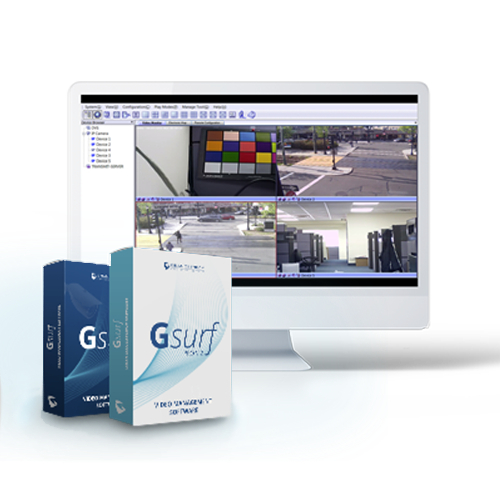
Quick Product Information
Grandstream
GSurf Pro V2
PC-based video management software
Up to 72 compatible channels
Monitoring, recording, indexing, search, playback, and storage control
Free download; infrastructure and services are project dependent
Windows compatibility must be confirmed before deployment
Solution review, quotation, equipment matching, and delivery coordination
A Practical Control Centre for Business Surveillance
A video surveillance project becomes difficult to manage when cameras are treated as separate devices. Security staff may need to open several browser windows, search recordings one camera at a time, remember multiple addresses, and move between interfaces when an incident occurs. GSurf Pro brings compatible Grandstream cameras into one PC-based working environment so authorised users can view live video, organise camera groups, search recorded footage, respond to alarms, control supported pan-tilt-zoom functions, and manage files from a more coordinated screen.
The software is especially relevant to organisations that already use Grandstream IP surveillance products or plan to standardise a new camera deployment around the brand. It can support up to 72 channels, which gives small and medium businesses room to move beyond a four-camera or eight-camera starter installation. The value is not simply the channel number. A larger deployment needs a method for arranging views, assigning operator access, creating recording schedules, locating footage, monitoring alarms, and deciding where files will be stored. Those operational questions determine whether a surveillance system remains useful after installation.
Client/server architecture helps separate viewing, transfer, and file-management tasks. A transmit server can act as a controlled source for live video, reducing the need for every viewing station to request streams directly from individual cameras. A file server provides a central route for recorded-video management and remote retrieval. Electronic maps can help operators understand where a camera or alarm event is located within a building or site. Multi-panel layouts make it possible to watch several areas at once, while patrol viewing can cycle through selected cameras or predefined positions when continuous manual switching is impractical.
For Africa-based buyers, the most important point is that software capability must be matched to the real operating environment. Camera quantity, resolution, frame rate, recording hours, network quality, available disk capacity, power reliability, operator skill, and incident-retention policy all influence the final design. A free application does not remove the need for a dependable PC, suitable graphics capability, reliable network adapters, storage planning, user permissions, and protected power. FourTeck helps buyers review these connected requirements so the system is built around daily security operations rather than only a software feature list.
The platform can fit reception monitoring, office security rooms, retail loss-prevention desks, school administration, warehouse supervision, hotel operations, clinic facilities, and multi-location oversight. It is most suitable when the selected Grandstream camera models and the planned Windows environment have been checked before rollout. FourTeck can also help identify cameras, PoE switches, storage, displays, racks, cabling, and UPS equipment needed to turn the application into a complete working solution.
Key Business Benefits
The strongest reason to consider GSurf Pro is not that it adds another application to a computer. Its business value comes from giving security teams a more organised way to watch, record, investigate, and respond across a compatible camera estate. The following benefits show how technical functions translate into more useful daily operations.
◆ Centralised visibility
Operators can bring multiple compatible camera feeds into one organised workspace. This reduces time spent moving between individual device pages and makes it easier to watch entrances, sales floors, corridors, loading zones, parking areas, server rooms, and other monitored spaces from a common interface.
◆ Faster incident review
Search tools allow recorded footage to be located by time, device, disk, channel, or alarm event. A structured investigation process can save staff from manually browsing long periods of video, helping them move more quickly from an incident report to relevant evidence.
◆ Flexible recording control
Scheduled and alarm-triggered recording options help organisations decide when primary streams should be written to storage. This gives administrators more control than an unplanned always-on arrangement and supports storage decisions based on risk, opening hours, activity, and retention requirements.
◆ Bandwidth-aware viewing
Configurable primary and secondary streams can support different local and remote viewing conditions. Lower-bandwidth display streams may help remote operators preserve network capacity, while higher-quality streams can be reserved for recording or investigation when the camera and deployment design permit.
◆ Better operator awareness
Electronic maps, alarm pop-ups, event displays, and multi-panel views can give security staff more context during daily monitoring. Instead of seeing an isolated camera name, an operator can organise devices by location and respond with a clearer understanding of where activity is occurring.
◆ Easier administration
User management, configuration import and export, operational logs, system-status information, and device-management tools help administrators maintain a more disciplined environment. These controls are useful when several staff members share monitoring duties or when settings need to be documented and restored.
◆ Scalable project planning
Support for up to 72 channels gives growing businesses a path beyond small starter systems. The correct server, network, and storage design remains essential, but a planned channel framework can help organisations add monitored areas without replacing the management application too early.
Product Highlights That Matter in a Real Deployment
GSurf Pro combines live monitoring, recording, file access, alarm handling, and operator tools in a single Windows-based environment. It supports H.264 and MJPEG video from compatible Grandstream cameras and encoder or decoder products, with resolutions that include full HD and lower profiles supplied by the connected device. The practical benefit is flexibility: an administrator can choose view layouts for one, four, six, eight, nine, sixteen, twenty, twenty-five, thirty-six, or seventy-two channels depending on workstation capacity and the monitoring task.
Multi-screen support can extend the monitoring desk across as many as four displays when suitable hardware is available. Full-screen viewing, regional zoom, snapshots, image-fluency adjustment, and panel rearrangement help operators adapt the interface to changing priorities. A reception team may emphasise entrances and visitor areas, while a warehouse security desk may give more screen space to loading bays, perimeter cameras, and stock movement routes.
The replay environment includes play, pause, stop, slow forward, fast forward, frame forward, mute, and snapshot functions. Search can be performed using time, device name, storage disk, channel, or alarm-event type. Recorded H.264 files can be converted to AVI for portability where the provided utility and file conditions support that workflow. These features are important when footage needs to be reviewed by managers, exported for an investigation, or shared through an approved evidence process.
Alarm functions can respond to motion detection and supported digital input or output arrangements, although external alarm hardware is not included. Configured events can trigger pop-up video, play a warning sound, display a blinking location on an electronic map, or support relay-related actions. PTZ control and automatic patrol to predefined positions are also available when connected hardware supports those functions.
Maintenance tools include user control, logs, automatic logon options, configuration import and export, system lock, device grouping, status views, time synchronisation, and selected firmware-management capabilities. Multi-language support includes English, Chinese, Russian, French, Spanish, and Portuguese. Exact behaviour can depend on software version, camera firmware, operating system, and hardware, so FourTeck recommends a compatibility review and controlled pilot before a large rollout.
Technical Specifications
| Specification | Details |
|---|---|
| Brand and model | Grandstream GSurf Pro V2 |
| Product category | Free PC-based video management software |
| Supported scale | Up to 72 compatible Grandstream camera or encoder/decoder channels |
| Architecture | Client/server design with transmit server and file-sharing server functions |
| Core functions | Live monitoring, recording, indexing, search, playback, storage management, alarm handling, device control, and e-Map support |
| Video formats | H.264 and MJPEG, subject to connected device support |
| Resolution support | Resolutions supplied by compatible Grandstream cameras or encoders, including up to 1080p full HD on supported devices |
| View layouts | 1, 4, 6, 8, 9, 16, 20, 25, 36, and 72 panels |
| Multi-display support | Up to four display screens with suitable supporting hardware |
| Recording options | Manual, scheduled, and alarm-triggered recording; storage can be local or on supported network locations |
| Playback and search | Playback controls plus search by time, device, storage disk, channel, or alarm-event type |
| Alarm capabilities | Motion events, supported digital I/O integration, warning audio, pop-up video, and e-Map notification; related hardware may be required |
| Camera control | PTZ control, predefined positions, switching, and automatic patrol when supported by the camera |
| Streams | Primary and secondary stream selection for different local and remote viewing conditions |
| Administration | User and log management, device groups, configuration import/export, system status display, and operational controls |
| Languages | English, Chinese, Russian, French, Spanish, and Portuguese |
| Server computer guidance | Configuration dependent. Official documentation lists an Intel Core-class processor, several gigabytes of RAM, discrete graphics, suitable disk capacity, and a Gigabit network adapter as planning references. |
| Operating system | Windows-based. Official documents reference legacy Windows editions and Windows 10 in later guidance; confirm current compatibility before purchase or deployment. |
| Licence | Software is offered as a free download by Grandstream |
| Warranty and support | Software support conditions and hardware warranty vary by product, source, country, and selected deployment components |
| Availability | Software download availability and related hardware supply should be confirmed for the current project |
How to interpret the specifications
The listed computer requirements should be treated as historical vendor guidance rather than a universal guarantee for every seventy-two-channel installation. Actual resource demand depends on channel count, camera resolution, frame rate, codec, simultaneous viewing, recording schedules, retention period, monitor quantity, network design, and whether server functions are combined on one machine. A small office watching eight cameras has very different storage and graphics needs from a security room displaying dozens of full-HD feeds. FourTeck can help develop a current bill of materials and proof-of-concept plan before the system is placed into daily service.
Configuration and Buyer Guidance
A successful GSurf Pro deployment begins with the surveillance objective, not the maximum channel number. Buyers should first list the areas that must be monitored, the risk level of each area, the hours during which recording is needed, the staff who will watch live feeds, and the number of days footage must remain available. This creates a foundation for camera quantity, storage capacity, network bandwidth, user access, and display planning.
1. Define the camera workload
Share the number of cameras, expected resolution, frame rate, day or night activity, and whether operators will display many live feeds at once. These factors affect CPU, graphics, memory, and network demand.
2. Calculate retention
Recording capacity depends on bitrate, recording hours, motion activity, channel count, and required retention days. Storage should include operating headroom and a clear policy for overwrite, export, and evidence protection.
3. Confirm compatibility
Verify the exact Grandstream camera models, firmware levels, stream profiles, PTZ functions, alarm connections, and Windows environment. A controlled test with representative cameras is valuable before a wide rollout.
4. Design operator access
Decide who can view live video, search recordings, export files, change settings, or manage devices. Use named responsibilities and documented permissions rather than sharing one unrestricted account across all staff.
5. Protect the platform
The workstation or server needs dependable power, controlled physical access, operating-system maintenance, adequate cooling, and a protected network. Surveillance evidence is only useful when the recording platform remains stable.
6. Plan future expansion
Allow for additional cameras, higher resolutions, longer retention, more displays, and remote operators. Expansion affects switch ports, PoE capacity, uplinks, disk space, backup power, and workstation performance.
Buyers should also decide whether the application will run on a dedicated computer or share resources with other business tasks. A dedicated platform is usually easier to control, maintain, and troubleshoot. It reduces the risk that unrelated software, user downloads, or office work competes with recording and live display. For larger projects, separating viewing, transfer, and file functions may provide a cleaner operational design.
FourTeck can review a site schedule, camera list, network drawing, storage target, display plan, and delivery location before preparing a quote for related equipment or services. This approach helps identify missing components such as PoE switches, surveillance drives, monitors, racks, patch leads, network uplinks, UPS units, or installation labour before the order is finalised.
Ideal Business Use Cases
GSurf Pro is suitable for organisations that need a central Windows-based view of compatible Grandstream cameras and are prepared to plan the supporting computer, network, storage, and operating procedures. The following examples show where its functions can provide practical value.
Corporate offices
A facilities or reception team can watch entrances, lifts, corridors, parking areas, meeting-room zones, server rooms, and after-hours activity. User permissions can separate daily monitoring from administrator control, while event search helps management review reported incidents.
Retail and supermarkets
Live layouts can combine entrances, tills, aisles, storerooms, receiving areas, and parking views. Scheduled recording and searchable footage support loss-prevention reviews, customer incident checks, staff safety, and verification of activity around valuable stock.
Warehouses and logistics
Security teams can organise cameras around gates, loading bays, dispatch points, high-value storage, perimeter areas, and internal movement routes. Electronic maps and patrol views help operators understand a large site without keeping every camera at full size on screen.
Schools and training centres
Administrators can coordinate monitoring around gates, reception, corridors, libraries, laboratories, parking, and shared facilities while applying controlled access to recordings. Retention and privacy policies should be documented before cameras are commissioned.
Hotels and hospitality
A hotel security desk may combine lobby, reception, service entrances, car parks, corridors, back-of-house areas, and loading points. Multi-screen operation can help staff maintain awareness while file search supports follow-up on guest, vehicle, delivery, or safety incidents.
Clinics and healthcare facilities
Facilities teams can monitor public entrances, waiting areas, medicine stores, external walkways, and restricted operational zones. Access to footage must be governed carefully, with clear responsibilities and privacy controls appropriate to the organisation.
Manufacturing and workshops
Cameras can be grouped around production entries, tool stores, material handling, loading areas, and safety-sensitive zones. Recorded video can support incident review and operational investigation, while live monitoring provides an additional view alongside established safety procedures.
Multi-site oversight
Client/server functions and remote access can support authorised review from a central office when network design, cybersecurity, and bandwidth are suitable. Each branch still needs reliable local connectivity, camera configuration, power, and a clear escalation process.
The software should not be used as a substitute for physical security procedures, trained personnel, reliable doors and locks, lighting, access control, incident reporting, or lawful privacy practices. It is one part of a broader facility-protection plan. FourTeck can help buyers coordinate the technology components while the organisation defines operational and legal responsibilities for its surveillance environment.
Grandstream GSurf Pro Centralised Monitoring and Recording
Centralisation is the foundation of a useful surveillance desk. When a business has many cameras, the operator needs more than live pictures. The system must provide a logical device tree, camera groups, view layouts, event information, recording control, and a repeatable way to retrieve footage. GSurf Pro brings these tasks into one interface, reducing dependence on individual camera web pages and making daily monitoring more consistent.
The transmit-server function can provide a controlled source for video to multiple viewing points. This matters where several authorised users need to see the same live stream. Direct connections from every client to every camera can increase traffic and processing load. A planned transfer architecture can make distribution more manageable, although the final result still depends on the server, network topology, stream bitrate, user count, and remote connection quality.
Recording design requires equal care. Primary streams can be recorded according to schedules or alarms, and files can be placed on local or supported network storage. Administrators should define which cameras require continuous recording, which can use event-based schedules, and which areas need longer retention. They should also determine how full disks are handled, who can export evidence, and how critical files are protected from accidental deletion or automatic overwrite.
For business buyers, the benefit is operational discipline. A central interface allows security procedures to be documented around one working method: who logs in, which layouts open at shift start, how alarms are acknowledged, where recordings are searched, and how incidents are escalated. FourTeck can help map these procedures to suitable computer, storage, network, and display components so the software has an environment capable of supporting the expected workload.
Grandstream GSurf Pro Alarm, e-Map, and PTZ Control
Video becomes more actionable when the operator can connect an event to a physical location. Electronic maps allow cameras and alarm points to be placed within a visual representation of a site. When an event is configured, the interface can display a blinking location and open associated video. This is useful in buildings with many similar corridors, entrances, storage rooms, or perimeter zones where a camera label alone may not provide enough context during a fast response.
Alarm handling can include motion events and supported digital input or output integration with third-party devices. Configured actions may include pop-up video, warning audio, map indication, or relay-related control. External sensors, alarm interfaces, speakers, and supporting devices are not automatically included with the application, so a buyer should identify the desired event workflow before selecting hardware. An alarm feature only improves operations when staff know what it means, who should respond, and how false or repeated events will be handled.
PTZ support can help operators follow activity or inspect a wider area through supported cameras. Predefined positions and automatic patrol routines can move a camera through selected viewpoints. This can be valuable for gates, yards, parking zones, warehouses, or large public areas, but it should not be treated as equivalent to fixed-camera coverage. A PTZ unit can only view one direction at a time, and manual movement may leave another area unwatched. Many projects combine PTZ devices with fixed cameras for continuous scene coverage.
FourTeck can help buyers review motion-detection goals, PTZ use, alarm I/O, e-Map layout, operator displays, and required accessories. The review should include camera placement, lighting, network latency, response procedures, and the difference between a visual alert and a formally monitored alarm service. This prevents the project from depending on features that have not been connected to a realistic operating process.
Grandstream GSurf Pro Storage, Search, and Remote File Access
Recorded video consumes significant storage, and the required capacity rises quickly as cameras, resolution, frame rate, bitrate, and retention days increase. GSurf Pro can manage recording files on local PC storage or supported network locations, but the application does not remove the need for proper disk planning. Buyers should calculate expected data volume, leave operating headroom, choose storage designed for sustained workloads where appropriate, and protect critical systems with reliable power.
The file-sharing server helps authorised clients search and download recordings remotely. Search criteria include time, device name, stored disk, channel, and alarm-event type. This gives investigators several routes to locate relevant footage. A well-maintained camera naming standard is important: labels such as “Camera 01” are less useful than clear names linked to locations, directions, or operational zones. Time synchronisation is equally important because inconsistent device clocks can complicate an investigation.
Replay tools provide normal and variable-speed controls, frame-by-frame movement, mute, and snapshots. A conversion utility can make selected H.264 recording files portable in AVI format under supported conditions. Organisations should create an evidence-handling process that records who exported a file, when it was copied, why it was required, where it was stored, and who received it. Video files may contain sensitive information, so access and sharing should follow internal policy and applicable law.
Remote access should be designed securely. Avoid exposing surveillance services directly to the public internet without proper protection. Use controlled network paths, strong authentication, firewall rules, secure remote-access methods, and documented administrator responsibility. FourTeck can help connect storage, networking, firewall, and backup-power requirements so remote file access is useful without creating an avoidable security weakness.
What Buyers Should Check Before Purchase
Before requesting a quote, buyers should confirm the complete operational requirement rather than submitting only the software name. GSurf Pro is free, but the surrounding camera, computer, network, storage, display, power, and installation components determine whether the solution performs reliably. The most useful quotation request explains the site, the number of cameras, existing equipment, desired retention, operator locations, remote-viewing needs, and the delivery country.
Correct model selection
Provide the exact camera models and firmware versions. Confirm that required features such as full-HD streams, audio, PTZ, motion events, digital I/O, and secondary streams are supported by the selected devices and software version.
Windows compatibility
Official documents reference older Windows platforms and later guidance includes Windows 10. Do not assume support for a current operating system without testing. Confirm installation, security updates, drivers, display hardware, and application behaviour.
Storage and retention
State the number of recording days, hours per day, camera resolution, frame rate, and event pattern. Ask for usable capacity rather than raw disk size, and decide whether evidence exports need separate protected storage.
Network readiness
Check PoE switch ports, power budget, uplink capacity, VLAN design, remote links, firewall policies, and cabling condition. Several high-resolution streams can place sustained demand on weak or poorly segmented networks.
Display and operator needs
Specify how many operators and screens are required, which cameras must remain visible, and whether a video wall or ordinary monitors will be used. Graphics capacity and interface layout should match the viewing workload.
Required accessories
A complete system may need cameras, lenses, brackets, junction boxes, PoE switches, surveillance disks, monitors, racks, patch panels, network cable, UPS protection, keyboards, mice, and alarm interfaces. Include these items in the project discussion.
Deployment and support
Clarify whether the requirement includes remote consultation, installation, camera configuration, storage setup, operator training, documentation, maintenance, or troubleshooting. Support scope can vary by location and project size.
Warranty expectations
The application is free, while camera and infrastructure warranties depend on the supplied products and source. Ask how hardware warranty claims, replacements, software questions, and installation issues will be handled.
Share the camera count and models, site type, floor plan or camera schedule, existing network equipment, recording period, number of viewing screens, remote-access requirement, power conditions, installation location, required delivery date, and whether the project is new, an expansion, or a replacement. This information supports a more accurate equipment and service recommendation.
Africa Availability and Service Support
FourTeck supports surveillance-software and related equipment enquiries across Africa with assistance for requirement review, camera matching, computer and storage sizing, network planning, quotation, delivery coordination, and warranty guidance for supplied hardware. Availability can vary according to camera model, selected accessories, order quantity, project timing, supplier position, and destination.
Because GSurf Pro is distributed as free software, the commercial discussion normally focuses on the complete solution: compatible Grandstream cameras, PoE switching, storage drives, monitoring computers, displays, racks, cabling, UPS protection, installation, configuration, and support. A buyer who already owns compatible cameras may only need help assessing the workstation, network, and storage. A new-site buyer may require a full camera schedule, equipment bill, and deployment plan.
FourTeck can review regional delivery requirements and help identify whether equipment should be supplied as a single package or phased by site. Warranty guidance is based on the specific hardware offered and the applicable supply route. Software version, operating-system compatibility, and camera firmware should be confirmed before a final rollout decision.
Africa Country and Regional Coverage
Businesses across Africa, including Kenya, Uganda, Nigeria, Ghana, Tanzania, Rwanda, Ethiopia, South Africa, Zambia, Botswana, Senegal, and nearby regional markets can contact FourTeck for product availability, system guidance, and quotation support. The team can help buyers review compatible camera choices, server or workstation requirements, surveillance storage, network switching, display needs, power protection, and project quantities.
Regional conditions can affect the design. Internet quality may influence remote viewing; power stability can make UPS protection essential; long delivery routes may favour ordering spare accessories; and multi-site organisations may need consistent camera naming, configuration records, and operator procedures. FourTeck helps bring these practical concerns into the purchasing conversation so buyers can plan a supportable solution for their operating environment.
GCC, Middle East and Africa Availability
FourTeck Africa can support product enquiries for organisations operating across Africa while connected FourTeck regional platforms can guide selected procurement requirements for GCC and Middle East markets. This is useful for businesses whose head office, purchasing team, project manager, or finance function is located in a different region from the surveillance site.
Requirements may involve delivery coordination for projects in African markets as well as UAE, Saudi Arabia, Qatar, Oman, or Bahrain. Availability, warranty handling, taxes, documentation, shipping arrangements, and support scope can differ by destination, product type, selected configuration, supplier status, and order quantity. No branch-stock position should be assumed until the current request has been reviewed.
Buyers can begin with FourTeck Africa, use the Kenya support platform, contact the Uganda support platform, or review FourTeck UAE for Gulf-linked procurement coordination. Share the destination, camera schedule, required project date, and preferred support scope so the appropriate team can guide the next step.
Other Options Buyers May Consider
GSurf Pro is one component of a surveillance solution. Buyers may also need to review compatible cameras, network equipment, storage, displays, power protection, and services. The following cards provide useful FourTeck navigation points for building the surrounding system or comparing an alternative deployment approach.
Grandstream camera options
Ask FourTeck to review current Grandstream indoor, outdoor, dome, bullet, and facility-management camera models that fit the required scenes and software compatibility.
CCTV solution planning
Review camera placement, lens coverage, recording days, night performance, mounting, network paths, operator needs, and installation scope as one coordinated project.
PoE networking
Managed PoE switches, uplinks, VLANs, rack accessories, and structured cabling can provide the reliable transport and power foundation required by IP cameras.
Surveillance storage
Consider storage drives, network storage, retention calculations, evidence export, capacity headroom, and protected power before setting recording schedules.
Monitoring workstations
A dedicated Windows computer, graphics capability, network adapter, monitors, and suitable peripherals should be sized for the number of live and recorded streams.
UPS and power protection
Protect the computer, storage, switches, and cameras from short interruptions and unstable power with a correctly sized backup plan.
Why Buyers Choose FourTeck
A surveillance application can be downloaded in minutes, but a dependable business system requires connected decisions. FourTeck helps buyers consider the entire path from camera selection to daily operation. The goal is to reduce wrong model choices, underestimated storage, weak network design, missing accessories, unclear installation scope, and unrealistic expectations about what free software includes.
Translate site risks, camera count, retention, displays, and operator workflow into a practical requirement.
Match cameras, workstation resources, storage, PoE, uplinks, and power protection to the intended workload.
Prepare a clearer commercial request for related hardware, accessories, installation, and project services.
Review destination, quantity, timing, documentation, and supply-route factors for regional projects.
Clarify the support and warranty position for supplied cameras, computers, storage, switches, and accessories.
Identify alternatives when a requested camera, accessory, or infrastructure component does not fit the project.
FourTeck supports small businesses, larger organisations, resellers, project contractors, IT managers, procurement teams, and facility operators. The conversation can begin with a single replacement camera or a multi-site surveillance schedule. For project enquiries, drawings and camera lists help the team provide more useful guidance than a request based only on channel count.
No claim is made that every item is always available or that every deployment can be supported in the same way. Product supply, delivery, installation, and warranty handling depend on the destination and selected scope. FourTeck focuses on clear pre-sales communication so buyers understand what is included, what remains configuration dependent, and what information is needed before an order proceeds.
Frequently Asked Questions
What is Grandstream GSurf Pro used for?
It is a Windows-based video management application for compatible Grandstream surveillance devices. It can centralise live viewing, recording, indexing, search, playback, alarm handling, file management, electronic maps, and selected camera controls. Businesses use it to organise several cameras within one operator interface instead of opening each device separately.
How many cameras can the software manage?
The vendor positions GSurf Pro V2 for up to 72 compatible Grandstream camera or encoder/decoder channels. Reaching that scale depends on the computer, graphics hardware, storage, network, camera stream settings, simultaneous display load, and recording design. Buyers should size the platform around the real workload rather than assuming one minimum specification fits every 72-channel system.
Is GSurf Pro free?
Yes. Grandstream offers the application as free video management software. The complete surveillance solution is not cost-free because it may require compatible cameras, a suitable Windows computer, recording storage, monitors, PoE switches, cabling, racks, UPS protection, installation, configuration, and support. FourTeck can quote the related products and services required for the project.
Can it record video to network storage?
The vendor documentation states that recordings can be stored on a local PC or other supported network locations, and the file-server function supports centralised management for local and remote clients. The exact storage design should be tested with the selected Windows environment, permissions, network path, disk system, bitrate, and retention requirement before production use.
Does it support remote viewing?
Client/server functions can support local or remote viewing and recorded-file access when the network is designed correctly. Remote access should use controlled, secure connectivity rather than exposing surveillance services directly to the public internet. Bandwidth, stream selection, firewall policy, authentication, latency, and user permissions all affect the experience and security of remote monitoring.
Will it run on Windows 11?
Current official product information should be checked before deployment. Available vendor documents reference legacy Windows editions, and later manual guidance includes Windows 10. Because Windows 11 is not clearly established in those published requirements, buyers should not assume compatibility. Use a controlled test on the intended hardware and operating-system build before ordering a large camera system.
Can FourTeck help calculate storage?
Yes. Provide the camera quantity, resolution, codec, frame rate, estimated bitrate, recording hours, motion pattern, and required retention days. FourTeck can help develop a practical capacity estimate and identify suitable storage options. The design should include operating headroom, overwrite policy, evidence export, disk performance, and power protection rather than relying only on a simple raw-capacity figure.
Does the software include cameras or alarm hardware?
No. The application is software. Cameras, lenses, mounts, PoE switches, storage, computers, monitors, alarm input or output devices, audio hardware, cabling, racks, and backup power are separate project components. Required accessories depend on the site and selected camera models. FourTeck can help prepare a complete bill of materials when those details are provided.
Is the product available for business projects across Africa?
FourTeck accepts enquiries from businesses across Africa for GSurf Pro guidance and related surveillance equipment. Software download access, camera availability, delivery options, warranty handling, and support scope can vary by destination, model, supplier status, order quantity, and project timing. Contact the team with the delivery country and technical requirement for a current review.
What should I include in a quote request?
Send the number and model of cameras, site type, recording days, required resolution, operator and monitor count, existing network equipment, remote-access needs, power conditions, installation location, delivery destination, and required services. Mention whether the project is new, an expansion, or a replacement. This gives FourTeck enough context to recommend related equipment and identify missing components.
Need Help Planning the Right Video Management Solution?
FourTeck can help review compatible cameras, channel count, Windows platform, storage retention, network capacity, displays, alarm integration, power protection, delivery requirements, and project support for your business location.