

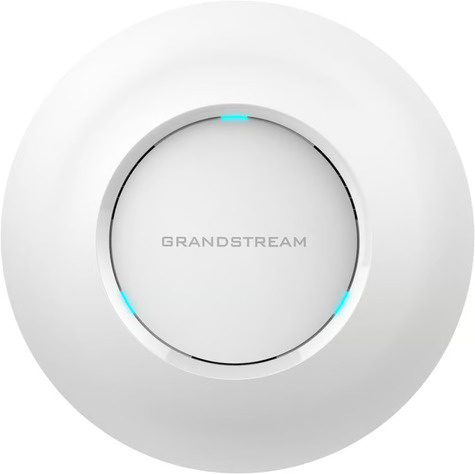
Quick Product Information
Grandstream
GWN7660
Indoor dual-band Wi-Fi 6 access point
Medium deployments with medium-to-high device density
IEEE 802.11ax with backward compatibility
PoE 802.3af or PoE+ 802.3at
Embedded controller, GDMS Networking, or GWN Manager
Contact FourTeck for current options
A Practical Wi-Fi 6 Platform for Modern Business Networks
Wireless access is now part of the operating fabric of almost every organization. Staff laptops, mobile phones, handheld scanners, payment terminals, printers, voice handsets, meeting-room devices, cameras, tablets, and guest equipment may all compete for airtime in the same building. A consumer router can provide basic connectivity, but it may become difficult to manage when the number of users increases, the office expands, or business applications require more predictable performance. The Grandstream GWN7660 is designed to address that gap with a business-focused access-point architecture rather than an all-in-one home routing design.
The unit operates across both 2.4 GHz and 5 GHz bands and uses 2×2:2 MU-MIMO together with downlink and uplink OFDMA. In practical terms, these Wi-Fi 6 technologies help the access point coordinate radio resources more efficiently when many compatible devices are active. The result is not a guarantee that every client will receive the maximum headline rate; actual performance always depends on client capability, channel conditions, interference, distance, building materials, network design, internet bandwidth, and configuration. The value for a business is better airtime use, improved support for mixed device populations, and a clearer path away from crowded legacy wireless infrastructure.
The GWN7660 provides two autosensing Gigabit Ethernet interfaces and accepts standardized PoE or PoE+ power. This makes ceiling or wall installation more practical because a separate electrical socket is not normally required beside the access point. An appropriate PoE switch or injector can carry data and power through the Ethernet cable, provided the cable distance, quality, switch budget, and standards are suitable. Buyers planning several units should calculate the full PoE requirement, include headroom, and verify that the switching platform can support every connected access point under expected load.
Management flexibility is another important reason to consider this model. A smaller site can use the controller embedded in a GWN access point, while organizations with broader requirements can select Grandstream’s cloud-based GDMS Networking platform or deploy GWN Manager on premises. This gives an IT team several ways to organize wireless settings, monitor devices, and expand coverage without being locked into one management style from the first day. The embedded controller can manage a local group of GWN access points, which is useful for a single office or building, while centralized alternatives are better suited to larger estates or multi-location administration.
For buyers across Africa, successful deployment involves more than ordering an access point by model number. Building construction, available cabling, power conditions, desired coverage, local radio rules, user count, roaming expectations, and the existing router or firewall all affect the final design. FourTeck helps procurement teams review these factors, identify required accessories, check alternative Grandstream models, and prepare a quotation aligned with the intended business environment.
Key Business Benefits
The most useful way to assess a wireless access point is to connect its technical capabilities to daily business outcomes. The following benefits explain where the GWN7660 can add value and where buyers still need careful design work.
◆ More Efficient Shared Airtime
OFDMA and MU-MIMO help organize communication with multiple compatible clients more effectively than older wireless methods. This is valuable in busy offices and public-facing spaces where many devices send small bursts of traffic instead of one device consuming the channel alone.
◆ Flexible Management Choices
Organizations can begin with the embedded controller and move to cloud or on-premise management as requirements change. This supports staged growth, distributed administration, and different security policies without forcing every buyer into the same management architecture.
◆ Simpler Power and Placement
PoE support allows one network cable to carry both power and data. Installers can place the unit on a ceiling or wall for better radio positioning rather than locating it near an electrical socket, subject to correct cable runs and an adequate PoE source.
◆ Support for Real-Time Traffic
Advanced quality-of-service controls can prioritize latency-sensitive applications such as voice and interactive collaboration. Proper end-to-end configuration is still required, because the wireless layer cannot correct congestion or poor policy elsewhere in the network.
◆ Scalable Multi-AP Coverage
Mesh support and centralized management options help organizations expand beyond one unit. A well-planned multi-access-point network can reduce dead zones, improve roaming, and distribute clients more evenly across a floor or building.
◆ Business Security Foundations
WPA3 support, enterprise authentication options, secure boot, signed control protections, per-device credentials, VLAN capability, and guest access features provide a useful foundation for segmented wireless design. Security strength depends on how these controls are configured and maintained.
These benefits are strongest when the access point is integrated into a complete network plan. Buyers should avoid estimating coverage only from a maximum range figure. Radio signals change as they pass through reinforced concrete, metal shelving, glass partitions, dense walls, equipment rooms, lift shafts, and neighboring wireless networks. A measured site plan, sensible AP placement, clean channel design, and correctly sized backhaul usually matter more than a single headline specification.
Product Highlights That Matter in Deployment
The combined radio capability supports modern business applications, while real user speeds depend on client radios, signal quality, channel width, interference, and wired backhaul.
Dual wired interfaces offer installation flexibility and can support network design requirements where an additional Ethernet connection is useful.
This is a manufacturer maximum under suitable conditions, not a guaranteed radius in every building. A site survey should guide real placement and quantity.
Association capacity is not the same as high-performance capacity. Application mix, airtime demand, radio conditions, and per-user service expectations determine practical density.
The access point supports IEEE 802.11a/b/g/n/ac/ax standards, allowing organizations to introduce Wi-Fi 6 while continuing to serve many older wireless clients. It provides 32 SSIDs in total, split across the two radios, and supports network functions such as 802.1Q VLANs, 802.1X authentication, IPv4, IPv6, traffic prioritization, and wireless multimedia controls. These features help IT teams build separate networks for staff, guests, voice devices, operational equipment, and other groups, provided the router, firewall, switches, and authentication services are configured consistently.
The unit contains two internal dual-band antennas, with published gains of 3 dBi on 2.4 GHz and 4 dBi on 5 GHz. Its wall and ceiling mounting kits are included, and three status LEDs assist with tracking and identification. The maximum stated power consumption is 9 watts, which makes large PoE planning relatively straightforward, though switch budgets should never be calculated without reserve capacity and allowance for other powered devices.
Security provisions include WPA and WPA2 personal and enterprise modes, WPA3, anti-hacking secure boot, digital signatures for critical data and control, a unique security certificate, and a randomized default password for each device. These controls reduce several common risks at the device level, but a secure deployment still requires current firmware, strong administrator access, protected management interfaces, appropriate VLAN separation, safe guest policies, and routine monitoring.
Technical Specifications
| Specification | GWN7660 Details |
|---|---|
| Wireless standards | IEEE 802.11a/b/g/n/ac/ax |
| Radio design | Dual-band 2×2:2 MU-MIMO with downlink and uplink OFDMA |
| Aggregate wireless throughput | Up to 1.77 Gbps aggregate |
| 5 GHz data rate | 802.11ax up to 1201 Mbps under supported conditions |
| 2.4 GHz data rate | 802.11ax up to 573.5 Mbps under supported conditions |
| Frequency bands | 2.4 GHz radio: 2400–2483.5 MHz; 5 GHz radio: 5150–5850 MHz, subject to local regulations |
| Channel bandwidth | 2.4 GHz: 20 and 40 MHz; 5 GHz: 20, 40, and 80 MHz |
| Antennas | Two internal dual-band antennas; 3 dBi at 2.4 GHz and 4 dBi at 5 GHz |
| Coverage | Up to 175 metres under suitable conditions; actual coverage is environment dependent |
| Concurrent clients | 500+ stated association support; practical service capacity depends on traffic and design |
| SSIDs | 32 total, 16 per radio |
| Network interfaces | Two autosensing 10/100/1000 Base-T Ethernet ports |
| Auxiliary features | One reset pinhole and one Kensington lock interface |
| Power | PoE 802.3af or PoE+ 802.3at; maximum stated consumption 9 W |
| Management | Embedded controller for up to 50 local GWN APs; GDMS Networking cloud management; GWN Manager on-premise management |
| Network protocols | IPv4, IPv6, 802.1Q, 802.1p, 802.1X, 802.11e/WMM |
| Security | WEP, WPA/WPA2 personal, WPA/WPA2 enterprise, WPA3, secure boot, signed data/control protection, unique certificate and randomized default password |
| QoS | 802.11e/WMM, VLAN, TOS and related traffic handling |
| Mounting | Indoor wall or ceiling mount; mounting kits included |
| Operating environment | 0°C to 45°C operation; 10% to 90% non-condensing humidity |
| Dimensions and weight | 180.4 × 180.4 × 40.8 mm; approximately 443 g |
| Package contents | Wireless access point, mounting kits, and quick-start guide |
| Warranty and availability | Country, supplier, and order dependent; request current guidance from FourTeck |
How to read these specifications
Published maximums are useful for comparing product classes, but they should not be treated as guaranteed performance in a live building. Wireless throughput is shared and includes protocol overhead. Client devices may support fewer streams, narrower channels, older standards, or lower transmit power than the access point. Coverage is influenced by construction materials, interference, access-point height, orientation, neighboring networks, local channel restrictions, and the number of active users. For a business deployment, the correct question is not only whether the unit can reach a distant room; it is whether every required area can deliver a stable service level to the intended applications at busy times.
Configuration and Buyer Guidance
A reliable wireless project begins with questions, not quantities. Before deciding how many units to buy, define what the network must achieve. A small office with email, cloud applications, and occasional video meetings has a different requirement from a hotel floor, school laboratory, clinic waiting area, retail store, warehouse aisle, or training centre. The same model can serve several of these environments, but access-point placement, channel planning, wired capacity, security policy, and management design will differ.
1. Define users and devices
Count expected staff, visitors, phones, laptops, tablets, scanners, printers, voice devices, and operational equipment. Include peak occupancy rather than an average quiet period.
2. Define application priorities
Identify whether voice, video, cloud desktops, point-of-sale systems, guest browsing, file transfers, or low-bandwidth sensors will dominate. Traffic type affects density and quality-of-service policy.
3. Review the building
Share floor plans, ceiling heights, wall materials, outdoor boundaries, restricted zones, and existing cable routes. Reinforced concrete and metal can change a design dramatically.
4. Check PoE and switching
Confirm switch port availability, Gigabit capability, PoE standards, total power budget, uplink capacity, VLAN support, and any need for redundant links or separate access switches.
5. Select management style
Choose between embedded, cloud, and on-premise administration based on site count, administrator location, security policy, internet dependence, monitoring needs, and internal skills.
6. Plan growth and support
Allow for more users, new rooms, future devices, support ownership, spare units, firmware management, warranty handling, and budget for professional installation where required.
For multi-AP environments, ask whether fast roaming, mesh links, wired backhaul, captive portal access, RADIUS authentication, and segmented SSIDs are needed. Wired backhaul is usually preferred where cabling is practical because it preserves radio capacity and provides more predictable performance. Mesh can help in locations where cable installation is difficult, but every wireless hop consumes airtime and must be evaluated carefully.
FourTeck can review a bill of quantities that includes the access points, compatible PoE switches or injectors, network cabinet requirements, patching, cables, mounting accessories, router or firewall integration, and any suitable alternative models. Providing accurate project information at the quotation stage reduces the risk of ordering too few units, missing power equipment, or selecting a model that does not match the environment.
Ideal Business Use Cases
The GWN7660 is best considered for indoor locations that need structured wireless access and moderate-to-high device density without moving into a higher-radio, multi-gigabit access-point class. The following examples show how the model may fit, subject to a site-specific review.
Office and Shared Workspace
Provide managed wireless access for staff laptops, mobile devices, meeting rooms, printers, and visitors. Separate SSIDs and VLANs can help keep business, guest, and device traffic apart.
Hospitality and Guest Areas
Support guest access in hotel corridors, reception areas, cafés, lounges, and conference spaces. Captive portal capability and centralized management can simplify access control across multiple units.
Education and Training
Connect student devices, instructor systems, collaboration screens, and administrative equipment in classrooms or training facilities, with policy controls matched to the institution’s network design.
Clinics and Professional Practices
Serve staff devices, appointment systems, voice handsets, and controlled guest access. Sensitive environments should apply strong segmentation, enterprise authentication, and documented management practices.
Retail and Customer Service
Connect handheld stock devices, staff terminals, mobile points of service, digital signage controllers, and customer Wi-Fi where the wider wired and security infrastructure supports these functions.
Branch and Multi-Room Sites
Extend consistent access across departments, meeting areas, corridors, and shared spaces. Central administration can help standardize SSIDs, security policies, and firmware across multiple APs.
Voice-over-Wi-Fi is a notable use case because the access point includes advanced quality-of-service features and is designed to work smoothly with Grandstream Wi-Fi-capable IP phones. A successful voice deployment still requires appropriate roaming design, adequate signal overlap, clean channels, suitable handset configuration, low network latency, and prioritization beyond the access point. Buyers should state the number and type of voice devices when requesting a quotation so the wireless design can be assessed against real call requirements.
The model can also serve apartment common areas, small campuses, libraries, training venues, and internal event spaces. It is not a weatherproof outdoor unit. Exposed courtyards, warehouses with harsh environmental conditions, open compounds, and long outdoor links may require a long-range or weather-resistant alternative. FourTeck can help compare indoor and outdoor GWN options when a project crosses different installation zones.
Grandstream GWN7660 Wireless Capacity and Airtime Control
Wi-Fi 6 improves network efficiency by changing how radio time can be divided and shared. OFDMA allows an access point to allocate smaller portions of a channel to multiple compatible devices, which can be especially helpful when many clients exchange modest packets at the same time. MU-MIMO enables simultaneous communication across multiple spatial streams where supported. Together, these technologies can reduce wasted airtime and improve responsiveness in mixed-client environments.
For a buyer, the important distinction is between connection count and service quality. An access point may associate with hundreds of clients, yet the useful number for a particular site depends on how much traffic each client generates. Five hundred devices checking occasional messages present a very different load from one hundred users joining video meetings, synchronizing large files, or streaming media at the same time. Capacity planning should therefore use application demand, active-user ratio, acceptable latency, and per-user throughput rather than client count alone.
Channel design also matters. Wide 80 MHz channels can increase peak rates in a clean environment, but they consume more spectrum and may not be appropriate in dense multi-AP deployments. Narrower channels can create more reusable channel plans and reduce co-channel contention, especially in buildings with many nearby networks. The best setting depends on the local radio environment, number of access points, client capabilities, and service objectives.
The 2.4 GHz band generally offers broader reach and better wall penetration but has fewer non-overlapping channels and often more interference. The 5 GHz band usually provides more channel options and higher potential throughput, though range may fall sooner through dense construction. Band steering, power tuning, minimum data rates, and SSID design should be approached as part of one radio plan. Simply maximizing transmit power can create clients that hear an AP but cannot communicate back reliably.
A FourTeck quotation request can include the expected floor area, user count, application profile, and building type so the proposed quantity is based on capacity as well as coverage. For large or critical deployments, a professional predictive or on-site wireless survey is recommended before final installation.
Grandstream GWN7660 Management, Segmentation, and Visibility
The management approach determines how easily a wireless network can be maintained after installation. The GWN7660 offers three useful paths. The embedded controller is integrated into the web interface and can manage up to 50 local GWN access points. This can suit a single building or compact environment where administrators want local control without deploying separate controller hardware.
GDMS Networking provides a cloud management option for Grandstream networking products. Cloud administration can be useful for distributed sites, remote support, and organizations that want a central view without maintaining a local controller server. GWN Manager provides an on-premise software path for organizations that prefer local hosting or have internal policy requirements. Selecting among these options should consider administrator location, internet reliability, cybersecurity policy, number of sites, change-control procedures, and the skills of the support team.
The access point supports multiple SSIDs and 802.1Q VLAN operation, allowing one physical device to present different wireless networks. An organization might create separate services for employees, guests, voice handsets, point-of-sale devices, building equipment, or contractors. Effective separation requires matching VLAN configuration on the access switch, router or firewall, DHCP services, and any authentication platform. Creating several SSIDs without end-to-end segmentation does not automatically isolate traffic.
Enterprise authentication through 802.1X can provide per-user or per-device access control when a compatible RADIUS service is available. Guest access may use a captive portal and restricted internet-only policy. Administrators should limit management access, change credentials, use secure protocols, document ownership, maintain firmware, back up configurations, and define how failed units are replaced. These operational controls are as important as initial setup.
For project buyers, management choice can affect recurring effort even when the platform itself does not require a separate hardware controller. Discuss how many locations will be administered, who will approve changes, whether remote monitoring is allowed, and what reporting is needed. FourTeck can help align the product selection with the intended operational model and identify when a different GWN access point or management design may be more suitable.
Grandstream GWN7660 Security and Voice-Ready Networking
Wireless security starts with strong encryption and authentication, but it does not end there. The GWN7660 supports WPA3 as well as widely used WPA and WPA2 modes, including enterprise options. WPA3 can improve protection for compatible devices, while mixed environments may still need older modes for legacy clients. Buyers should identify critical devices that cannot use modern security before deployment and decide whether those clients should be upgraded, isolated, or placed on a restricted network.
Device-level protections include secure boot, digital-signature controls for critical data and control functions, a unique security certificate, and a randomized default password. These measures help reduce common risks associated with identical factory credentials or unauthorized firmware. Administrators still need to complete secure commissioning: update the firmware, review release notes, define administrator roles, disable unneeded services, restrict management networks, and monitor the device after deployment.
Quality-of-service support is useful for voice handsets, interactive meetings, and other low-latency traffic. Wireless Multimedia and traffic classification can help prioritize time-sensitive packets over less urgent transfers. For voice over Wi-Fi, AP overlap, roaming thresholds, radio power, channel reuse, switch configuration, DHCP, DNS, call platform reachability, and WAN quality all affect call continuity. A well-configured access point cannot compensate for an overloaded internet link or a poorly designed voice network.
Organizations using Grandstream Wi-Fi-capable phones may value the close ecosystem fit, but compatibility and firmware should still be reviewed for the exact handset models. In mixed-vendor environments, standard wireless protocols allow broad client support, yet features such as roaming behavior can vary by device. Testing a representative set of business clients before a large rollout is a sensible procurement step.
FourTeck can help buyers prepare the technical information needed for a secure quote, including desired SSIDs, authentication method, guest access policy, VLAN plan, voice requirements, router or firewall model, switch capability, and support expectations. This helps turn the access point from a standalone device into a controlled part of the business network.
What Buyers Should Check Before Purchase
Buying by model name alone can lead to missing accessories, poor coverage, insufficient power, or a management design that becomes difficult to operate. Before requesting a quote, buyers should confirm the intended environment, how the access point will connect to the existing network, and what level of support is required after delivery. FourTeck can review these details so the selected equipment matches the project rather than simply matching a budget line.
Configuration Fit
Confirm whether a 2×2 Wi-Fi 6 indoor AP is suitable for the density and application load. Higher-performance GWN models may be better for very demanding spaces, while long-range or weatherproof models may be required outdoors.
Coverage and Quantity
Provide floor dimensions, wall materials, ceiling height, coverage priorities, and expected occupancy. Do not divide total area by the published maximum range; radio planning is not a simple circular calculation.
PoE and Cabling
Check for Cat5e or better cabling in suitable condition, cable lengths within Ethernet limits, available PoE ports, enough power budget, Gigabit switching, and surge or grounding needs where relevant.
Compatibility
Review the router, firewall, switches, VLAN plan, RADIUS service, DHCP scope, client standards, Grandstream voice devices, and any captive portal requirements before shipment.
Management Ownership
Decide who will configure, monitor, update, back up, and troubleshoot the network. Select embedded, cloud, or on-premise management based on that responsibility and the organization’s security rules.
Accessories and Installation
Confirm whether the project needs PoE injectors, switches, patch cords, cabinet hardware, structured cabling, mounting work, ladders, testing, labeling, or professional commissioning.
Warranty Expectations
Ask what warranty route applies to the offered unit, which documents must be retained, how faults are assessed, and whether project spares are advisable for business continuity.
Quote Preparation
Share destination country, quantity, required delivery timing, business use, site count, floor plan, expected users, management preference, accessories, and installation scope to receive a more accurate proposal.
Long-term cost should include more than the access point. Consider the PoE switching platform, cable installation, administrator time, monitoring method, replacement strategy, internet bandwidth, and future expansion. A lower initial device count may create poor coverage and expensive rework, while an oversized design can waste budget and increase channel contention. The objective is a balanced plan that meets the required service level with room for sensible growth.
Bulk and project orders should also account for consistent model selection, firmware baselines, labeling, staging, configuration templates, spare units, phased delivery, and documentation. FourTeck can help compare the GWN7660 with related indoor and outdoor access points so buyers can use different models where the building requires different radio or environmental characteristics.
Africa Availability and Service Support
FourTeck supports business inquiries across Africa with assistance for product selection, deployment review, quotation preparation, delivery coordination, and warranty guidance. Availability can vary by supplier status, quantity, destination, and the exact accessories requested. For that reason, the page does not present an unverified stock promise or a fixed local delivery date. Buyers receive more useful guidance when they share the project scope and destination before the quotation is prepared.
For this access point, FourTeck can help review whether the indoor model fits the site, how many units may be required, whether a long-range or higher-capacity alternative should be considered, and what PoE equipment is needed. Support can also cover related Grandstream switches, network gateways, Wi-Fi phones, cabling requirements, mounting considerations, and management choices. Installation services depend on the project location and scope, so they should be requested explicitly.
A clear inquiry should include the organization type, number of locations, approximate floor area, device count, main applications, existing network equipment, required delivery destination, and expected project timing. This information helps the sales and technical teams identify configuration risks before the order is placed. Warranty terms should be confirmed on the quotation because they can depend on sourcing route and destination.
Africa Country and Regional Coverage
Businesses in Kenya, Uganda, Nigeria, Ghana, Tanzania, Rwanda, Ethiopia, South Africa, Zambia, Botswana, Senegal, and other regional markets can contact FourTeck for product availability, configuration guidance, and quotation support. The team can help procurement managers, resellers, system integrators, schools, hospitality groups, healthcare organizations, retailers, and enterprise IT departments review the model against practical deployment needs.
Regional supply planning may involve differences in shipping routes, import procedures, voltage environment for supporting equipment, local wireless regulations, warranty handling, and project lead time. The access point itself uses standardized PoE, but the wider bill of materials may include locally appropriate power cords, PoE switches, surge protection, cabinets, and installation components. Buyers should state the final destination and whether the equipment will be deployed at one site or distributed across several locations.
FourTeck’s regional approach is designed to keep country references inside one practical coverage discussion rather than creating repetitive location pages. Use the Africa contact form to provide the quantity, project location, accessory needs, and required support level.
GCC, Middle East and Africa Availability
FourTeck Africa can support product inquiries for organizations across Africa while guiding wider regional technology requirements through selected FourTeck platforms serving GCC and Middle East markets. Businesses planning deployments in the UAE, Saudi Arabia, Qatar, Oman, Bahrain, or mixed regional estates should identify each destination at the inquiry stage because availability, delivery options, warranty routes, and supporting accessories may differ by country.
A multi-country wireless rollout benefits from a standardized design document covering access-point models, firmware, SSIDs, VLANs, authentication, management ownership, labeling, spare equipment, and acceptance testing. However, radio settings and regulatory channel availability may need local adjustment. Procurement teams should avoid assuming that one configuration can be copied unchanged across every market without review.
Regional buyers may explore FourTeck Africa, FourTeck Kenya, FourTeck Uganda, and FourTeck UAE for the most relevant inquiry route. The final proposal should identify the destination, quantity, accessory requirements, delivery expectations, and support scope for each site.
This regional support model is useful for companies with branch offices, hotel groups, education networks, retail chains, and system-integration projects that need a coordinated product family while preserving local deployment flexibility.
Other Grandstream Options Buyers May Consider
The right access point depends on radio capacity, environmental rating, client density, backhaul, and management requirements. These related options can help buyers build a complete Grandstream network or select a model for a different zone of the same project.
Grandstream GWN7664
Consider for indoor spaces requiring a higher-performance Wi-Fi 6 radio platform and greater density than a 2×2 access point may comfortably serve.
Grandstream GWN7660LR
A long-range, weather-resistant Wi-Fi 6 option for outdoor or exposed coverage areas where an indoor unit is not appropriate.
Grandstream GWN7665
A tri-band Wi-Fi 6E access point for projects that can use the 6 GHz band and need additional spectrum, subject to client and regulatory support.
Grandstream GWN7801P
A managed PoE switch option that may support access-point power and VLAN connectivity in a compact deployment, subject to total power and port requirements.
Grandstream GWN7002
A multi-WAN Gigabit VPN router for selected small or branch-network designs where routing and security functions are also required.
Wireless Access Point Range
Browse indoor, outdoor, long-range, and high-density wireless products for offices, campuses, hospitality, education, and commercial projects.
A mixed deployment may use the GWN7660 in standard office zones, a higher-capacity model in conference areas, and a weatherproof unit outdoors. Model selection should be based on each zone rather than forcing one access point to serve every environment.
Why Business Buyers Contact FourTeck
Technology procurement is easier when the supplier understands the surrounding infrastructure. FourTeck supports buyers who need more than a model number by helping them connect wireless requirements with switching, routing, security, power, cabling, and deployment realities. The aim is to reduce wrong-model selection, missing accessories, unclear warranty expectations, and avoidable changes after delivery.
Assistance for single-unit purchases, branch requirements, reseller inquiries, and structured project bills of materials.
Review of user density, AP quantity, PoE needs, management choices, security requirements, and related models.
Clear quotation preparation based on quantity, destination, accessories, delivery needs, and project scope.
Regional planning that accounts for destination, order size, supplier route, and requested project timing.
Explanation of the applicable warranty route and documents based on the proposed sourcing arrangement.
Identification of suitable switches, routers, access points, accessories, and alternative models for the same project.
FourTeck serves SMB, enterprise, education, hospitality, healthcare, retail, public-sector, reseller, and integration requirements. Support depth can be tailored to the inquiry: some buyers need only a product quote, while others require a full equipment list, deployment discussion, regional coordination, or alternative-model review. Sharing accurate details enables a more useful response.
FourTeck does not rely on unverified claims about permanent stock, universal lead time, or one configuration fitting every site. Availability and warranty are confirmed through the quotation process. This approach helps procurement teams document the actual offer and compare it against the project’s technical and commercial requirements.
Frequently Asked Questions
What is the Grandstream GWN7660 used for?
It is an indoor Wi-Fi 6 access point for business wireless networks. Typical uses include staff and guest connectivity in offices, hotels, schools, clinics, retail spaces, training centres, and multi-room sites. It provides wireless access but does not replace every router, firewall, switch, or internet service function in a complete network.
Is the access point available for delivery in Africa?
FourTeck accepts inquiries across Africa and can coordinate a quotation based on destination, quantity, supplier status, and requested accessories. Availability and delivery timing are confirmed during the quotation process rather than assumed from the product page. Share the destination country and required project date for a relevant response.
Does the GWN7660 need a power adapter?
The access point is designed for PoE 802.3af or PoE+ 802.3at power through Ethernet. It therefore needs a compatible PoE switch or injector with enough available power. Buyers should verify the switch standard, total power budget, cable quality, cable length, and port configuration before installation.
How many users can one unit support?
The manufacturer states support for more than 500 concurrent Wi-Fi clients, but this is not a promise that hundreds of heavy users will all receive high throughput. Practical capacity depends on application demand, client radios, signal quality, interference, channel design, backhaul, and acceptable service level. Capacity planning should use real traffic assumptions.
Can FourTeck help estimate the number of access points?
Yes. A useful estimate requires floor dimensions, wall materials, ceiling height, user count, device types, applications, existing cabling, and coverage priorities. For larger or critical sites, FourTeck may recommend a professional survey rather than relying only on a floor-area estimate or the published maximum range.
Which management option should a business choose?
The embedded controller can suit a local deployment, GDMS Networking can support cloud-based administration, and GWN Manager can provide on-premise management. The best choice depends on the number of sites, administrator location, internet reliability, security policy, monitoring needs, and internal IT skills.
Does it support guest Wi-Fi and separate business networks?
Yes. The unit supports multiple SSIDs, VLAN operation, captive portal functions, and enterprise authentication options. Proper isolation also requires matching switch, router, firewall, DHCP, and authentication configuration. An SSID name alone does not guarantee separation, so the full network policy should be reviewed.
Is the GWN7660 suitable for outdoor installation?
No. It is an indoor wall- or ceiling-mounted access point. Outdoor, exposed, dusty, humid, or long-range environments may require a weather-resistant GWN model such as a suitable LR or ELR variant. Buyers should describe the installation environment so the correct enclosure and range class can be selected.
What warranty support is available?
Warranty terms can depend on the sourcing route, destination, supplier policy, and quotation. FourTeck can explain the applicable warranty guidance before purchase. Buyers should retain invoices, serial numbers, packaging where required, and deployment records, and should clarify the process for fault assessment and replacement.
Can businesses request bulk or project supply?
Yes. For project inquiries, provide the quantity, number of sites, destination, timeline, PoE switch requirements, management preference, accessories, installation scope, and any staging or labeling needs. FourTeck can review related Grandstream models and help structure a bill of materials for phased or multi-location deployment.
Need Help Planning the Right Wireless Deployment?
FourTeck can help review access-point quantity, PoE switching, cabling, management options, related models, availability, warranty guidance, and delivery requirements for your business location.
Reviews
There are no reviews yet.