

Quick Product Information
Grandstream
DP725
DECT cordless HD VoIP handset
DP750, DP752, or DP755
Mobile voice communication within business premises
Offices, retail, warehouses, hospitality, healthcare, education, and operations
Configuration dependent; up to 20 lines per handset with supported system design
Contact FourTeck for current options and delivery coordination
Pre-sales selection, compatibility, quote, and warranty guidance
Frequency version and final capability depend on destination and paired base station
A Cordless Voice Endpoint Built for Active Workplaces
Business communication does not always happen at a desk. Retail supervisors walk between counters and stock areas. Warehouse teams move between receiving bays, storage aisles, dispatch zones, and offices. Hotel personnel circulate between the front desk, housekeeping areas, meeting rooms, and service corridors. Clinic and care teams need to remain reachable without carrying a laptop or returning to a fixed telephone. The Grandstream DP725 addresses this practical requirement by extending SIP-based business calling into a cordless handset that can move with the user.
The handset operates as part of a Grandstream DECT system rather than as a stand-alone Wi-Fi phone. It pairs with a compatible DP750, DP752, or DP755 base station, which connects the cordless environment to the organisation’s VoIP platform. This separation between handset and base station is useful for businesses because several handsets can share a planned DECT infrastructure. Managers can allocate extensions, lines, call permissions, phonebooks, and telephony features according to the capabilities of the selected base station and PBX.
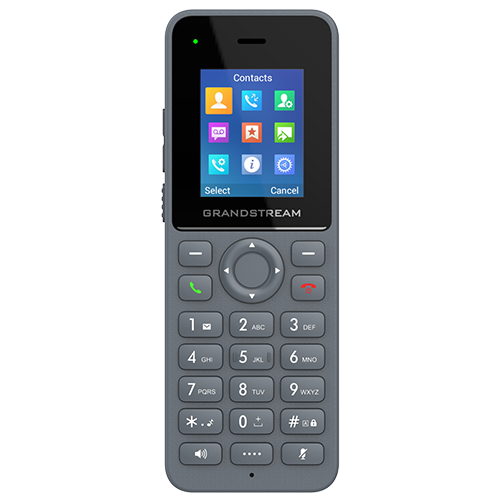
For day-to-day users, the DP725 presents a straightforward working tool. A 1.8-inch colour TFT display gives access to contacts, call information, menus, and status indications. Dedicated call-control keys, side volume controls, a push-to-talk button, full-duplex speakerphone operation, and a 3.5 mm headset connection support different working styles. Staff can handle conventional calls, participate in three-way conferencing, place calls on hold, transfer calls, forward calls, review call logs, use intercom functions, and receive message-waiting indications when supported by the connected system.
Battery endurance is a major business advantage in environments where a handset may be carried throughout a full shift and then shared with another user. The rechargeable 1500 mAh lithium-ion battery is specified for up to 50 hours of talk time and up to 500 hours of standby time under suitable conditions. The supplied charging cradle gives the device a defined resting place, while USB-C offers an alternative charging route and can support non-battery operation. Actual endurance varies with signal conditions, call patterns, audio mode, battery age, and operating temperature, but the design reduces the need for frequent mid-shift charging.
For Africa buyers, the selection process should include more than the handset name. The base station, DECT frequency version, number of users, required lines, building construction, PBX platform, coverage expectations, headset needs, provisioning method, power availability, and future expansion plan all matter. FourTeck assists procurement teams, resellers, integrators, and business owners in reviewing these points so the cordless solution is designed as a complete working system rather than a collection of disconnected components.
Key Business Benefits
A useful business handset should improve responsiveness without making administration difficult. The DP725 brings together mobility, voice quality, battery life, secure DECT communication, and system-level manageability in a format that can be assigned to individual employees, departments, shift teams, or shared operational roles.
◆ Mobility without losing the office extension
Employees can move through a supported premises while remaining connected to the company voice environment. This can shorten response times, reduce missed internal calls, and help customer-facing or operational staff communicate without repeatedly returning to a desk.
◆ Long working endurance
Specified talk and standby times are designed for extended working periods. A team can plan charging around shifts rather than around every short call, helping shared handsets remain useful in warehouses, hospitality, healthcare, security, and service operations.
◆ Clearer conversations
HD audio on the handset and speakerphone helps users understand colleagues and customers more easily when the connected system and codec path support it. Noise-management features contribute to more usable calls in busy indoor environments.
◆ Flexible line access
A handset can access multiple lines and SIP identities according to the paired base station and system configuration. This allows a device to serve a department, supervisor, service desk, shared duty role, or individual user without being limited to a single basic extension.
◆ Secure cordless communication
DECT authentication and encryption help protect the radio link between handset and base station. This is important for businesses that need more confidence than an unmanaged consumer cordless phone can provide, while still requiring simple daily operation.
◆ Faster team coordination
The dedicated push-to-talk key supports quick communication patterns for supervisors, floor teams, maintenance personnel, and service staff. It can complement conventional calling where short, immediate exchanges are more efficient than dialling a full call.
◆ Central provisioning options
Over-the-air updates, handset provisioning, TR-069, XML configuration options, Grandstream UCM Zero Config, and GDMS support can reduce repetitive setup work. The exact method depends on the complete system, but the platform is suitable for structured multi-device deployment.
Product Highlights That Matter in Daily Use
The handset supports up to 50 metres indoors and up to 400 metres outdoors when used with an appropriate compatible base station under suitable conditions. Walls, reinforced concrete, metal shelving, machinery, doors, electrical noise, and site layout can reduce practical coverage, so a survey is recommended for demanding environments.
The 1.8-inch 128 x 160 colour TFT screen is compact but designed to provide clear access to call status, contacts, menus, and soft-key functions. Twenty-seven keys include navigation, dedicated call controls, side volume keys, and the push-to-talk key.
Users can speak through the handset, full-duplex speakerphone, or a compatible 3.5 mm headset. G.722 supports HD audio, while other codec support is provided through the companion base station and connected voice system.
The package includes a charger cradle and universal power supply. USB-C can be used for alternative charging, which is useful when a cradle is not near the user. A removable battery and belt clip also support operational use and serviceability.
Hold, transfer, forwarding, three-way conference, intercom, downloadable phonebook, call waiting, call logs, auto answer, click-to-dial, flexible dial plans, do-not-disturb, and message-waiting features can be used where supported by the PBX, SIP service, and base-station configuration.
DECT frequency bands differ by market. Buyers should not assume that a handset sourced for one region is automatically appropriate for another. FourTeck can help review destination, compliance requirements, base-station version, and procurement documentation before supply.
Technical Specifications
| Specification | Grandstream DP725 Details |
|---|---|
| Product type | DECT cordless HD IP handset for compatible Grandstream base stations |
| Supported base stations | Grandstream DP750, DP752, and DP755 |
| DECT air interface | DECT; frequency band and channel count vary by regional version |
| Range | Up to 400 m outdoors with compatible DP752/DP755 deployment or up to 300 m with DP750; up to 50 m indoors. Real-world range depends on construction and environment. |
| Display | 1.8-inch, 128 x 160 colour TFT LCD |
| Keys and indicators | 27 keys, including two soft keys, navigation/menu keys, dedicated speakerphone, mute, send, power/end keys, side volume keys, dedicated push-to-talk key, and three-colour message-waiting LED |
| Headset and charging | 3.5 mm headset jack; USB-C for alternative charging and non-battery operation; charger cradle included |
| Audio | HD audio on handset and full-duplex speakerphone; G.722 and G.726 on the handset, with additional codecs supported through the companion base station |
| Audio processing | Acoustic echo cancellation, automatic gain control, ambient noise reduction on the microphone, and advanced incoming-audio noise suppression |
| Telephony features | Hold, transfer, forward, three-way conference, push-to-talk, intercom, downloadable phonebook, call waiting, call log, auto answer, click-to-dial, and flexible dial plan, subject to system support |
| Accounts and lines | Up to 20 SIP accounts and up to 20 lines per handset with a suitable DP755-based system; lower limits may apply with other base stations |
| Security | DECT authentication and encryption |
| Provisioning and upgrade | Software Upgrade Over-The-Air, handset provisioning over the air, TR-069 and XML configuration through supported system design, UCM Zero Config compatibility, and GDMS management support |
| Battery | Rechargeable 1500 mAh lithium-ion battery |
| Battery endurance | Up to 50 hours talk time and up to 500 hours standby time under suitable conditions |
| Power supply | Universal AC input 100–240 V, 50/60 Hz; 5 V DC, 1 A output; USB-C connector |
| Dimensions | Handset: 135 x 49 x 15.5 mm; charger cradle: 85 x 85 x 25 mm |
| Weight | Handset: 107 g; charger cradle: 61 g; package: approximately 364 g |
| Operating environment | Operation: -10°C to 45°C; charging: 0°C to 45°C; 10% to 90% non-condensing humidity |
| Package contents | Handset, universal power supply, charger cradle, belt clip, battery, and quick start guide |
| Compliance | FCC, CE, RCM, and IC; confirm the correct regional product version and local requirements |
| Availability and warranty | Country, supplier, order quantity, and product-version dependent. Contact FourTeck for current guidance. |
How to interpret the specification table
The handset specification is only one part of the finished communication system. The paired DECT base station determines how many handsets, SIP accounts, lines, and simultaneous calls the deployment can support. The PBX or hosted voice service then controls extension registration, inbound routes, outbound permissions, voicemail, recording, hunt groups, call queues, and other business functions. Buyers should therefore confirm the required concurrent-call count, not just the number of employees. A warehouse may have ten handsets but only need a few simultaneous external calls, while a hospitality or service operation may require more active conversations during peak periods. Coverage figures are measured under favourable conditions, so large sites, metal structures, cold rooms, concrete walls, multiple floors, and noisy electrical environments may need careful positioning, testing, or a different system architecture. FourTeck can help turn the table into a practical bill of materials that includes compatible base stations, handsets, power, headsets, network connectivity, PBX licensing where applicable, and installation planning.
Configuration and Buyer Guidance
Selecting a cordless handset by model number alone can lead to an incomplete order. The DP725 must be matched to the intended voice platform, base station, number of users, coverage area, and operational workflow. The following questions help procurement and IT teams define a workable requirement before requesting a quotation.
How many people need handsets?
Separate named users from shared shift devices. Include supervisors, reception, maintenance, security, warehouse teams, and spare units. The handset count influences the base-station choice and charging layout.
How many calls happen at once?
Concurrent-call demand is often lower than handset count, but it must still be calculated. Consider internal calls, external calls, intercom use, conferences, and busy-hour activity.
What is the site layout?
Share floor plans, approximate dimensions, construction type, ceiling height, metal shelving, machinery, and outdoor zones. These details affect base-station placement and realistic coverage.
Which PBX will register the system?
Identify the Grandstream UCM, third-party IP PBX, hosted SIP service, or provider platform. Confirm registration method, codecs, network settings, feature support, and any license requirements.
Will users need headsets?
The 3.5 mm port supports compatible wired headsets. Confirm plug standard, cable length, wearing style, microphone requirements, and whether users need hands-free operation for long periods.
How will devices be managed?
Small sites may configure a few handsets manually, while multi-site deployments benefit from structured templates, over-the-air provisioning, firmware policies, naming conventions, and documented extension assignments.
A complete request should include the destination country, number of sites, number of handsets per site, base-station preference if already selected, PBX or service provider, required extensions, expected simultaneous calls, indoor and outdoor coverage, headset requirements, power conditions, installation responsibility, and target delivery period. FourTeck can then review whether the DP725 is the right handset and whether a DP750, DP752, or DP755 architecture is appropriate. Where a different display size, ruggedness level, battery profile, or base-station capacity is needed, a related Grandstream model may be a better fit.
Ideal Business Use Cases
The value of a cordless IP handset is strongest where people, tasks, and calls move across the same premises. The DP725 fits environments that need business telephony features but do not want every employee tied to a desk phone.
Retail and customer service floors
Store managers, stock coordinators, service-desk staff, and floor supervisors can stay reachable while assisting customers or moving between front-of-house and storage areas. Calls can be transferred to the person who is closest to the requirement rather than asking the caller to try again later.
Warehouses and distribution sites
Receiving, dispatch, inventory, picking, and supervision teams can communicate while moving through operational zones. Push-to-talk can support short coordination messages, while conventional SIP calls remain available for suppliers, drivers, offices, and customers.
Hotels, lodges, and hospitality
Front desk, housekeeping, maintenance, events, and guest-service personnel often work in different parts of a property. A shared cordless voice platform can improve response flow when the coverage plan has been designed for the building and outdoor service areas.
Clinics and care facilities
Administrative, reception, support, and non-emergency care teams can receive internal or external calls while moving between rooms. Buyers should review cleaning procedures, privacy rules, coverage, call recording policy, and whether a more specialised rugged or healthcare device is required for particular roles.
Schools, training centres, and campuses
Administrative staff, facilities teams, coordinators, and supervisors can remain connected across offices, corridors, service areas, and selected outdoor zones. Coverage and emergency communication requirements should be assessed separately from routine telephony.
Workshops and light industrial operations
Technicians and supervisors can carry a handset between work areas, parts stores, offices, and receiving points. Environmental temperature, dust, impact risk, noise, and radio conditions should be reviewed to determine whether the standard handset is suitable or a rugged alternative is needed.
Multi-room offices and service organisations
Receptionists, office managers, IT support, facilities staff, and roaming managers can answer calls away from a fixed workstation. Multiple lines and phonebook functions help the handset fit into a structured business calling plan.
Security and facilities coordination
Patrol, reception, maintenance, and building teams can use calls, intercom, and push-to-talk for daily coordination. The handset can also interact with supported Grandstream GDS facility-access solutions, subject to complete system design and security policy.
Grandstream DP725 Range and Mobility
Coverage is the reason many buyers choose a DECT handset, but quoted distance should never be treated as a guaranteed radius around the base station. The DP725 is specified for up to 50 metres indoors and as much as 400 metres outdoors with a suitable DP752 or DP755 deployment under favourable conditions. With the DP750, the published outdoor figure is lower. These values provide a useful planning reference, yet every building shapes radio performance differently.
Open outdoor space generally allows the strongest range. Indoors, signals pass through walls, doors, ceilings, glass, furniture, stock, and equipment. Reinforced concrete, metal cladding, lift shafts, server rooms, cold rooms, warehouse racking, dense shelving, machinery, and electrical installations can create attenuation or dead zones. A base station mounted in a convenient office corner may not cover a loading yard or basement even when the straight-line distance appears small. Conversely, careful central placement can give good coverage across a normal office without additional hardware.
The practical design process starts by mapping where users actually walk and where calls must remain stable. Mark desks, reception, storage aisles, stairways, corridors, work bays, outdoor service points, and any restricted areas. Identify where network connectivity and power are available for the base station. Then consider whether employees need seamless calling across one building, occasional outdoor use, or coverage between separated structures. The DP725 is not a cellular phone and does not provide unlimited roaming beyond its registered DECT system.
For critical deployments, FourTeck recommends a site assessment and controlled testing before a large rollout. Begin with a representative base station and handset, test during normal working conditions, note weak areas, and verify voice quality rather than relying only on the signal indicator. This approach is especially valuable in warehouses, manufacturing sites, hospitals, hotels, campuses, and multi-floor buildings. It also helps the buyer decide whether the DP725 and selected base station are sufficient or whether another DECT architecture is required.
Grandstream DP725 Battery and Shift Readiness
A cordless handset becomes difficult to manage when users must constantly search for a charger. The DP725 uses a removable 1500 mAh lithium-ion battery and is specified for up to 50 hours of talk time and up to 500 hours of standby time. This profile is suitable for many full-shift workflows, shared-duty devices, and low-to-moderate call environments where the handset may remain away from the cradle for long periods.
Battery figures are measured under defined conditions and should be viewed as maximums rather than guaranteed results. Actual endurance changes with call volume, speakerphone use, headset use, signal strength, distance from the base station, screen activity, push-to-talk patterns, battery age, temperature, charging habits, and firmware. A handset that continually searches for a weak signal can consume more energy than one operating in a well-designed coverage area. Frequent speakerphone calls may also reduce runtime compared with normal handset use.
The included cradle creates a simple charging routine: return the handset to a known location at the end of a shift or during idle periods. USB-C provides an alternative charging option and can support operation without the battery, giving organisations more flexibility when a cradle is not immediately available. The manufacturer also states that a short ten-minute charge can provide up to four hours of talk time under suitable conditions, which can help when a device was not docked as planned.
For shared handsets, establish a clear ownership and charging policy. Label the device, assign a cradle location, keep the power adapter connected to a stable outlet, and include battery checks in routine maintenance. High-use sites may wish to hold a small number of spare batteries or complete spare handsets, depending on the importance of voice availability. Replacement battery planning should consider product lifecycle, storage conditions, and procurement lead time.
FourTeck can help buyers estimate the number of handsets, cradles, spare units, and accessories required for each shift pattern. This is more effective than buying exactly one device per current user without allowing for charging, breakage, maintenance, new employees, or project expansion. A small operational reserve can protect continuity without creating unnecessary surplus.
Grandstream DP725 Voice, Security, and Management
Voice quality depends on the entire path from handset to base station, network, PBX, SIP provider, and the other party’s endpoint. Within that chain, the DP725 supports G.722 for HD audio and G.726 for narrowband audio, while additional codecs are handled through the companion DECT base station. Acoustic echo cancellation, automatic gain control, ambient noise reduction on the handset microphone, and incoming-audio noise suppression are intended to make conversations easier to follow in normal business conditions.
Users can choose the handset earpiece, full-duplex speakerphone, or a compatible 3.5 mm headset. The speakerphone is useful for short hands-free conversations, while a wired headset can support employees who need to enter information, inspect goods, or perform light tasks during calls. In loud or safety-sensitive workplaces, buyers should confirm whether the selected headset provides adequate hearing protection, microphone directionality, and physical durability. A standard office headset should not be treated as certified protective equipment.
DECT authentication and encryption protect communication between the handset and its registered base station. This is an important distinction from inexpensive consumer cordless devices, but organisations must still secure the wider network. SIP credentials, PBX administrator passwords, firewall rules, firmware, VLAN design, remote access, call permissions, and fraud controls remain part of the overall security posture. The handset cannot compensate for weak credentials or an exposed voice platform.
For administration, the platform supports software upgrades over the air and handset provisioning over the air. Automated options can include TR-069 and XML configuration, while Grandstream UCM systems can provide Zero Config workflows. GDMS can support centralised management of compatible Grandstream devices. These methods are particularly useful where many handsets must receive consistent settings, firmware policies, extension names, contacts, and feature assignments.
Before deployment, define who is allowed to change settings, how firmware is approved, how lost handsets are handled, whether directories contain sensitive information, and how extensions are reassigned when staff leave. FourTeck can assist with the pre-sales design and product selection, while the customer’s IT team or appointed integrator should maintain documented access, backup, and change-control procedures for the live system.
What Buyers Should Check Before Purchase
Before requesting a quote, buyers should confirm the complete communication requirement rather than selecting a handset only because its headline features look suitable. A well-prepared request helps avoid wrong regional versions, insufficient base-station capacity, missing power accessories, unrealistic coverage expectations, and PBX compatibility problems.
Correct model selection
Confirm that the DP725’s screen size, keypad, battery, headset connection, and standard housing match the user’s role. Staff exposed to impacts, water, heavy dust, or extreme noise may need a different handset category.
Base-station fit
State whether a DP750, DP752, or DP755 is already installed. If not, provide handset count and concurrent-call requirements so the base station can be selected as part of the same design.
Regional compatibility
DECT frequency bands vary by region. Provide the destination country and do not mix base stations and handsets intended for incompatible markets. Local compliance and importer requirements may also affect supply.
PBX and SIP service
Identify the PBX model, firmware, hosted platform, or SIP provider. Confirm extension registration, codec policy, dial plan, voicemail, call transfer, directories, and any licensing or provider restrictions.
Coverage expectations
Share building dimensions, number of floors, construction materials, outdoor zones, and obstacles. Request a site survey or pilot test for large, complex, or mission-sensitive environments.
Accessories and spares
List wired headsets, belt clips, spare batteries, spare handsets, charging points, surge protection, and labelling requirements. Confirm what is included in the standard package and what must be ordered separately.
Warranty and support expectations
Ask how warranty handling works for the destination, what proof of purchase is required, who performs configuration, and which party supports the PBX, network, SIP service, and physical handset.
Project and bulk supply
For multi-site or bulk orders, provide a site-by-site quantity schedule, required delivery sequence, configuration standard, labelling plan, acceptance process, and target rollout dates.
The most useful quotation request states both the current requirement and likely expansion. For example, a buyer may need twelve handsets now but expect another eight within a year. That information can change the preferred base station and management approach. It is also important to distinguish between a replacement handset for an existing system and a new deployment. A replacement may need only model and regional-version confirmation, while a new deployment requires base station, network, power, PBX registration, call routing, and coverage planning. FourTeck can review these details and suggest a complete supply scope, suitable alternatives, or a phased rollout plan.
Africa Availability and Service Support
FourTeck supports product inquiries across Africa with assistance for handset selection, base-station planning, compatibility review, quotation, delivery coordination, and warranty guidance. Availability can vary according to the regional DECT version, selected base station, order quantity, supplier status, import process, and delivery destination. For that reason, the page does not claim fixed stock or a universal delivery time.
A useful inquiry should state whether the requirement is for a single replacement handset, an expansion to an existing Grandstream system, or a completely new cordless voice deployment. Replacement buyers should provide the installed base-station model and regional version. New-system buyers should provide user count, expected concurrent calls, site layout, PBX details, and coverage objectives. Project buyers should also provide a quantity schedule and preferred rollout period.
FourTeck can help identify compatible related products, prepare a bill of materials, clarify which accessories are included, and coordinate a quote that reflects the destination and order scope. Warranty handling depends on the supply channel, product version, country, and applicable terms. Buyers should request written warranty guidance with the quotation and retain serial numbers, invoices, and packaging records required for support.
Africa Country and Regional Coverage
Businesses across Africa, including Kenya, Uganda, Nigeria, Ghana, Tanzania, Rwanda, Ethiopia, South Africa, Zambia, Botswana, Senegal, and nearby regional markets can contact FourTeck for availability guidance, system matching, and quote assistance. The team can help buyers review whether the handset will be added to an existing Grandstream DECT installation or supplied as part of a new voice project.
Country-level requirements can affect frequency version, compliance documentation, import arrangements, delivery method, taxes, warranty route, and lead time. Project quantities may also require staged delivery or consolidated supply. FourTeck therefore prepares quotations around the actual destination and deployment scope rather than assuming one standard route for every market.
For faster review, provide the city and country of delivery, quantity, installed base station if any, PBX platform, preferred currency, company details, and expected purchase period. Buyers with multiple sites should include a simple location-and-quantity schedule. This helps the sales and technical teams distinguish between immediate replacements, planned expansion, pilot units, and a larger rollout.
GCC, Middle East and Africa Availability
FourTeck Africa can support product inquiries for organisations across Africa while also guiding regional technology requirements through selected FourTeck platforms serving GCC and Middle East markets. Businesses with operations in the UAE, Saudi Arabia, Qatar, Oman, Bahrain, and African countries may need consistent product families but different regional versions, delivery routes, documentation, warranty handling, or commercial terms.
A cross-border project should not assume that every handset and base station can be moved between countries without review. DECT frequency allocations and certifications differ. The correct approach is to define quantities by destination and confirm the appropriate product version for each location. Configuration templates, extension naming, dial plans, firmware standards, and accessories can still be harmonised where the platform allows, helping a multi-country organisation maintain a common operating model.
Regional buyers can use the FourTeck Africa platform, the FourTeck Kenya platform, the FourTeck Uganda platform, or FourTeck UAE according to the project location. Availability, delivery options, warranty route, and configuration support remain dependent on country, quantity, supplier position, and selected system design.
Other Grandstream Options Buyers May Consider
The right alternative depends on whether the buyer needs a base station, a different handset class, greater display size, a lower-capacity deployment, or integration with an IP PBX. The following related products can be reviewed as part of the same project. Final suitability depends on the required capacity, features, regional version, and deployment environment.
Grandstream DP755
Consider this base station for larger DP725 deployments that need support for more handsets, accounts, lines, and simultaneous calls than smaller DECT base options.
Grandstream DP752
A suitable base-station option for smaller cordless deployments where the required handset and concurrent-call capacity fits its supported system limits.
Grandstream DP735
Review this related handset when users need a different display, battery, sensor, or feature profile within a compatible Grandstream DECT solution.
Grandstream DP722
This established cordless handset may suit deployments with different capacity, battery, or compatibility requirements. Compare the complete base-station and user requirement.
Grandstream UCM6302
Consider a Grandstream UCM IP PBX when the project requires an on-premises unified communications platform with structured extension and call-flow management.
A related model should not be chosen simply because it has a larger screen or a lower purchase cost. Compare user role, battery requirement, base-station compatibility, number of lines, coverage, audio accessories, system capacity, expected product life, and support needs. FourTeck can help prepare a side-by-side requirement review without making unsupported claims about which model is universally better.
Why Business Buyers Contact FourTeck
Business technology purchasing often involves details that are not visible in a model name. A cordless handset may look simple, yet a successful deployment depends on base-station capacity, regional frequency version, PBX registration, network readiness, call routing, user assignments, accessories, coverage, warranty route, and delivery planning. FourTeck approaches the request as a business system requirement rather than only a unit sale.
Assistance in identifying the requested model, correct regional version, related base station, and required accessories.
Pre-sales review of handset count, concurrent calls, PBX environment, coverage, management method, and expansion requirements.
A quotation prepared around destination, quantity, product scope, supply route, and project timing rather than an unsupported universal price.
Support for discussing delivery destination, documentation, order consolidation, and multi-site quantities across regional markets.
Clarification of the applicable warranty route, documentation expectations, and responsibilities before purchase.
Help reviewing related Grandstream models when display, capacity, ruggedness, battery, or deployment needs point to another option.
FourTeck supports small and medium businesses, enterprise procurement teams, resellers, system integrators, hospitality operators, healthcare organisations, education institutions, retailers, logistics companies, and project buyers. The level of technical service included with a supply quotation should be confirmed in writing, especially where installation, remote configuration, on-site testing, PBX changes, or user training are required. This keeps the purchase scope clear and helps each party plan the work needed to bring the equipment into service.
Frequently Asked Questions
What is the Grandstream DP725 used for?
It is a cordless DECT IP handset for users who need to make and receive business VoIP calls while moving within a supported workplace. Common environments include offices, retail stores, warehouses, hospitality properties, clinics, schools, workshops, and service facilities. It works with a compatible Grandstream DECT base station and does not operate as a stand-alone SIP phone.
Which base stations support the DP725?
The handset is supported by Grandstream DP750, DP752, and DP755 DECT VoIP base stations. Capacity differs between these models. The selected base station determines the supported number of handsets, SIP accounts, lines, and simultaneous calls, so buyers should choose the handset and base station as one system rather than treating them as unrelated products.
How far can the handset work from the base station?
Published figures reach up to 50 metres indoors and up to 400 metres outdoors with a suitable compatible base-station deployment under favourable conditions. Walls, floors, metal shelving, machinery, doors, electrical interference, and building layout can reduce practical range. Large or complex sites should perform a survey or pilot test before a full rollout.
How many SIP accounts and lines can one handset access?
A DP725 can access up to 20 SIP accounts and 20 lines in a suitable DP755-based system. Lower system limits may apply when the handset is paired with another compatible base station. The PBX and SIP provider must also support the required registrations and call features. FourTeck can help confirm the full system capacity before quotation.
Is the DP725 available for businesses in Africa?
FourTeck accepts Africa inquiries for the handset and related Grandstream DECT components. Availability varies with regional frequency version, order quantity, supplier position, destination, and project timing. Provide the delivery country, quantity, installed base station if any, and required purchase period so the team can review current options and prepare an appropriate quotation.
Can FourTeck help with configuration planning?
Yes. FourTeck can assist with pre-sales review of handset count, base-station choice, concurrent-call demand, PBX compatibility, coverage considerations, accessories, provisioning approach, and project quantities. The exact installation or configuration service included in a quotation should be confirmed in writing, particularly for on-site surveys, network changes, PBX programming, and user training.
Does the handset include a charger and battery?
The standard package includes the handset, universal power supply, charger cradle, belt clip, rechargeable battery, and quick start guide. Package contents can vary by supply channel or regional packaging, so buyers should request confirmation on the quotation. Headsets, spare batteries, spare cradles, base stations, and PBX equipment may need to be ordered separately.
What warranty guidance is available?
Warranty terms depend on the product version, supply route, seller, destination, and applicable manufacturer or distributor conditions. FourTeck can provide the relevant guidance with the quotation. Buyers should keep the invoice, serial number, packaging, and delivery records, and should clarify who is responsible for troubleshooting the handset, base station, PBX, network, and SIP service.
Can businesses request bulk or multi-site supply?
Yes. For bulk or multi-site requirements, provide quantities by location, base-station needs, desired rollout dates, regional destinations, PBX details, configuration standard, labelling requirements, and any staged-delivery plan. This information helps FourTeck prepare a more accurate scope and identify whether the same regional product version is appropriate for every site.
How do I request a quote?
Use the FourTeck contact page and include your company name, delivery country, quantity, existing or preferred base station, PBX or hosted voice platform, expected concurrent calls, coverage area, accessory needs, and purchase period. For replacements, include a photograph or label details from the current base station and handset to help confirm compatibility.
Need Help Planning a Cordless Voice Deployment?
FourTeck can help review product availability, regional version, compatible base station, handset quantity, PBX environment, coverage expectations, accessories, warranty guidance, and delivery requirements for your business location.
Reviews
There are no reviews yet.