

Quick Product Information
Grandstream
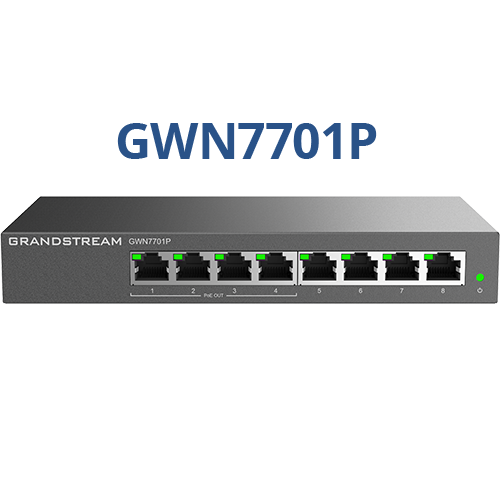
GWN7701P
Unmanaged Gigabit PoE+ switch
8 Gigabit RJ45 ports; ports 1–4 provide PoE+
Up to 30W per PoE port; 60W total budget
Desktop or wall mounting
Small offices, branches, retail, education and hospitality
Country, quantity and supplier-status dependent
Model review, quotation, delivery and warranty guidance
A Practical Network Foundation for Small Business Sites
A small network often grows one device at a time. A company may begin with a router, two computers, and a printer, then add an IP phone system, a wireless access point, a reception camera, a time-attendance terminal, or a door intercom. Without enough Ethernet ports and a sensible power plan, these additions create clusters of adapters, extension leads, and unmanaged cabling. The Grandstream GWN7701P provides a clean way to connect up to eight wired devices while supplying standards-based PoE power to as many as four compatible endpoints.
This model is an unmanaged switch, which means it is built for immediate use rather than policy-based network administration. A buyer connects the supplied power adapter, links one port to the router or upstream network, and attaches endpoint devices to the remaining ports. Auto-negotiation allows each interface to determine whether the connected equipment communicates at 10, 100, or 1000Mbps. Auto MDI/MDIX removes the normal concern about straight-through versus crossover Ethernet cables. For straightforward networks, this reduces setup time and removes the need for specialist switch configuration.
The switch is especially relevant where four powered endpoints are enough for the site. A typical branch could connect two PoE IP phones, one PoE wireless access point, and one PoE camera, while using the other four ports for the router uplink, a desktop computer, a network printer, and a local recorder or file device. The actual combination depends on the power requirement of each endpoint and the overall 60W PoE budget. Devices drawing close to the 30W per-port maximum will consume the available budget more quickly than low-power phones or sensors.
For Africa-based procurement teams, the model offers a useful balance between compact size, Gigabit capacity, metal construction, and reduced installation complexity. It is not intended to replace a managed switch in networks that require VLAN segmentation, link aggregation, access-control policies, central monitoring, or advanced troubleshooting. FourTeck can help evaluate whether an unmanaged switch is appropriate, review the number and power draw of connected devices, identify cabling and mounting requirements, and guide buyers toward a managed Grandstream model when the project needs deeper control.
Key Business Benefits
A useful switch should do more than increase the port count. It should simplify the physical network, support the devices the business already uses, and leave enough capacity for realistic growth. The following benefits explain how this compact model can contribute to a well-organised small-site deployment.
◆ One Cable for Data and Power
Four PoE+ ports can deliver network traffic and electrical power over compatible Ethernet cabling. This can reduce nearby plug requirements for phones, access points, cameras, and other supported endpoints, helping installers produce a neater and easier-to-maintain workspace.
◆ Fast Deployment
Because the switch does not require a management profile, businesses can expand a basic wired network without spending time creating VLANs, administrator accounts, or cloud policies. It is suited to projects where the network design is intentionally simple and rapid installation is valuable.
◆ Gigabit Access for Eight Devices
Eight 10/100/1000Mbps ports provide enough connection points for a compact office or branch. Gigabit links help prevent the switch from becoming an unnecessary bottleneck when users transfer files, access cloud applications, print over the network, or communicate through IP endpoints.
◆ Controlled PoE Budget
The 60W total budget gives buyers a clear framework for planning connected powered devices. When demand exceeds available power, the switch applies port-priority behaviour to protect higher-priority connections. Careful pre-sales power calculations remain important for reliable operation.
◆ Flexible Physical Placement
The metal enclosure can be positioned on a desk, shelf, counter, communications board, or wall. This is useful in reception areas, small equipment cupboards, classrooms, shops, clinics, and satellite offices where a full rack installation would be unnecessary.
◆ Broad Ethernet Compatibility
Auto-negotiation and 10/100/1000Mbps support allow older Fast Ethernet devices and modern Gigabit devices to share the same switch. This helps organisations modernise gradually rather than replacing every endpoint solely because network speeds differ.
◆ Sensible Cost Control
An unmanaged design avoids paying for sophisticated controls that a small, flat network may not use. The real value comes from matching the model to the environment: simple sites gain a clean connection point, while more demanding projects should move to a managed switch from the start.
Product Highlights That Matter in Daily Use
The GWN7701P combines eight copper Gigabit interfaces with PoE+ support on ports 1 through 4. Each powered port supports IEEE 802.3af and IEEE 802.3at endpoints and can provide up to 30W, subject to the switch’s total 60W allowance. This arrangement is particularly useful when only part of the network requires power. The remaining ports can connect ordinary Ethernet devices without dedicating PoE capacity to them.
Supports full-duplex Gigabit forwarding across the eight-port design under normal deployment conditions.
Provides address-learning capacity appropriate for compact offices and small business network segments.
Allows larger Ethernet frames where connected equipment and the complete path are configured to use them.
Auto-negotiation and Auto MDI/MDIX help the switch adapt to device speed and cable wiring automatically.
The design also includes MAC address auto-learning and ageing, IEEE 802.3x flow control, traffic-priority support through 802.1p/DSCP behaviour, and IGMP functions that can assist with multicast traffic handling. These capabilities operate without a user-facing management console. That simplicity is an advantage for basic installations, but it also means the buyer cannot build custom traffic policies or inspect the switch through a web dashboard.
Per-port link and activity LEDs provide quick visual confirmation of connections, while the device power indicator confirms that the switch is receiving power. The compact metal chassis measures approximately 190 × 100 × 28mm and weighs about 0.44kg, making it easy to position close to endpoints. Its external power adapter should remain accessible and properly ventilated, and the selected mounting location should stay within the documented temperature and humidity limits.
Technical Specifications
| Specification | Grandstream GWN7701P Details |
|---|---|
| Product class | Unmanaged Gigabit Ethernet switch with PoE+ |
| Copper ports | 8 × 10/100/1000Mbps RJ45; auto-negotiation; Auto MDI/MDIX |
| PoE ports | Ports 1–4 support IEEE 802.3af/at PoE+ |
| PoE output | Up to 30W per PoE port; 60W total power budget; overload protection with port-priority behaviour |
| Network standards | IEEE 802.3i, 802.3u, 802.3ab and 802.3x; PoE models support 802.3af and 802.3at |
| Switching capacity | 16Gbps |
| MAC address table | 8K entries |
| Jumbo frame | 9KB |
| Traffic features | MAC auto-learning and ageing, IEEE 802.3x flow control, 802.1p/DSCP priority support, unlink clear FDB and IGMP functions |
| Indicators | Per-port link/activity LEDs and device power LED |
| Enclosure and mounting | Metal chassis; desktop or wall mount |
| Power adapter | External 48–53.5VDC / 1.22A |
| Base-system consumption | Approximately 3W, excluding PoE output power |
| Operating environment | 0°C to 40°C; 10% to 90% relative humidity, non-condensing |
| Storage environment | −20°C to 60°C; 10% to 90% relative humidity, non-condensing |
| Dimensions | Approximately 190 × 100 × 28mm |
| Weight | Approximately 0.44kg; packaged weight approximately 0.92kg |
| Package contents | Switch, external power adapter and quick installation guide |
| Compliance | FCC, CE, RCM, IC and UKCA |
The most important selection point is the difference between physical port count and PoE capacity. Although all eight ports can carry Gigabit Ethernet traffic, only ports 1 through 4 provide power. A buyer planning six PoE cameras, for example, should not select this model merely because it has eight RJ45 sockets. That project would require a switch with more powered ports or a combination of PoE injectors and another suitable switch. The total wattage also matters: four endpoints can be connected to powered ports, but their combined demand must remain within 60W.
Buyers should also confirm that the connected endpoints use standard IEEE 802.3af or 802.3at power. Passive PoE equipment can use different voltages and wiring arrangements and should not be assumed compatible. When the network requires segmentation, remote administration, custom quality-of-service policies, link aggregation, spanning-tree configuration, or detailed security controls, request a managed switch recommendation instead. FourTeck can review the endpoint list and suggest a model that fits both present requirements and expected expansion.
Configuration and Buyer Guidance
The switch itself needs no software configuration, but the purchase still benefits from careful planning. Start by listing every device that will connect to it, including the upstream router or firewall. Eight ports can disappear quickly once one is used as the uplink. A site connecting a router, four PoE endpoints, two computers, and one printer would use all available interfaces. Any near-term addition would then require another switch or a larger model.
1. Count Every Connection
Include the uplink, desktop devices, printers, recorders, access points, phones, cameras, controllers, and any spare port desired for maintenance or growth.
2. Calculate PoE Wattage
Add the maximum or stated power demand of each powered endpoint. Keep the combined figure within 60W and allow practical headroom rather than planning at the absolute limit.
3. Confirm PoE Standards
Verify that devices accept IEEE 802.3af or 802.3at. Do not treat every product marked “PoE” as automatically compatible with standards-based power delivery.
4. Decide on Management
Choose unmanaged switching only when a flat, simple network is appropriate. VLANs, central monitoring, access controls, or advanced resilience call for a managed alternative.
Cabling quality is equally important. Gigabit Ethernet normally requires correctly terminated Category 5e or better cabling, while PoE performance depends on conductor quality, run length, termination, and heat conditions. Copper-clad aluminium cable can create voltage drop and reliability problems in powered installations; procurement teams should specify compliant solid-copper cabling from a reputable source. Patch panels, wall outlets, connectors, surge protection, and grounding practices should match the building and local electrical environment.
Finally, plan where the switch and its external adapter will be placed. The enclosure should have ventilation, protection from moisture and dust, and access for maintenance. Wall mounting can keep the unit away from desks and public contact, while desktop placement can simplify small temporary deployments. Share the installation environment, endpoint models, cable distances, required quantity, and delivery destination with FourTeck so the quotation can include appropriate guidance and related accessories.
Ideal Business Use Cases
This switch fits compact networks where operational simplicity is more important than granular control. It can serve as a small access-layer device near users and endpoints, but it should be used within a properly designed network that includes a router or firewall for internet access and security.
Small Office Connectivity
A growing office can connect computers, a shared printer, IP phones, and a wireless access point through one compact switch. The unmanaged design is appropriate when all devices belong to the same trusted network and no local traffic segmentation is required.
IP Telephony Extension
Up to four compatible PoE desk phones can receive data and power from the switch. The remaining interfaces can link workstations, a PBX appliance, an upstream router, or other devices, subject to the complete network design and port count.
Compact Camera Deployment
A reception, storeroom, small shop, or office entrance may need a limited number of PoE cameras. The switch can power up to four standards-compliant devices while connecting a recorder or router on non-powered ports. Camera wattage and recording traffic must be checked first.
Wi-Fi Access Point Support
Small hospitality, education, clinic, and office spaces can use PoE to position wireless access points where radio coverage is needed rather than where electrical sockets happen to exist. Coverage design and access-point power requirements should be reviewed separately.
Retail and Front-Desk Networks
A shop or service counter may need a point-of-sale terminal, receipt printer, IP phone, camera, wireless access point, and staff computer. A compact wall-mounted switch can centralise these connections while keeping the installation visually organised.
Branch and Remote Sites
Small branch offices can use the device as a simple local access switch behind the organisation’s router or firewall. IT teams should confirm whether remote troubleshooting and VLAN separation are required; those needs may justify a managed model instead.
The GWN7701P is not designed as a core switch for a large campus, data centre, or heavily segmented network. It has no SFP uplinks, stacking, or user-configurable management platform. Its best role is a deliberate one: providing straightforward Gigabit and limited PoE capacity at the edge of a small business network.
Grandstream GWN7701P PoE+ Power Delivery
PoE is the most valuable feature of this model, but it needs to be understood as a shared resource. Ports 1 through 4 can each deliver up to 30W to a compatible endpoint, while the complete switch provides a 60W budget. This does not mean every powered port can deliver 30W simultaneously. If four devices each require 15W, the combined demand reaches the budget. If one access point requires 25W and three phones require 7W each, the total becomes 46W and remains within the stated allowance.
The practical planning method is to check the endpoint’s maximum input requirement rather than its typical idle consumption. Wireless access points and cameras can draw more power when radios, infrared lighting, heaters, motors, USB accessories, or other features become active. Using only an observed low reading can create failures later. A safe design leaves headroom for startup demand, environmental changes, and device replacement.
Port priority becomes relevant if the connected load exceeds available power. The switch is designed to cut power from the lowest-priority port first, with priority running from port 4 toward port 1. Critical devices should therefore be assigned thoughtfully. For example, an essential access point or main reception phone may be placed on a higher-priority port, while a less critical endpoint uses a lower-priority one. This mechanism is protective, not a substitute for correct sizing.
A buyer should also distinguish active IEEE-standard PoE from passive power delivery. The GWN7701P is intended for 802.3af/at endpoints that negotiate power. Passive devices may use proprietary voltages or pin assignments and require dedicated injectors or different switches. FourTeck can review the exact endpoint model numbers before purchase, which is particularly useful when a project combines Grandstream phones, access points, third-party cameras, intercoms, or access-control devices.
Grandstream GWN7701P Plug-and-Play Gigabit Switching
An unmanaged switch reduces the number of decisions required during installation. Each port automatically negotiates the appropriate Ethernet speed with the connected device. A Gigabit workstation can operate at 1000Mbps while an older printer uses 100Mbps on another port. Auto MDI/MDIX means the switch adjusts transmit and receive pairs automatically, removing a common cabling concern from older network designs.
The 16Gbps switching capacity reflects the aggregate full-duplex design of eight Gigabit interfaces. For ordinary office traffic, this provides a capable local connection point. Users can access shared resources, communicate through IP telephony, and reach internet or cloud services through the upstream router. Actual application performance still depends on the router, broadband connection, endpoint capability, server speed, cable quality, and traffic generated by all connected devices.
Support for an 8K MAC table allows the switch to learn the locations of connected network addresses and forward traffic efficiently. IEEE 802.3x flow control can help manage temporary congestion between compatible full-duplex devices. IGMP-related functions assist with multicast forwarding, which can be useful in environments carrying multicast video or other group traffic. These behaviours are automatic and are not exposed as a configurable policy interface.
That distinction should guide the purchase. Plug-and-play operation is convenient when the desired network is flat, trusted, and easy to understand. It becomes restrictive when an IT team needs to separate guests from staff, isolate cameras, create voice VLANs, mirror ports for diagnostics, control loops, or monitor switch health remotely. In those environments, a managed Grandstream switch offers a more appropriate operational model. FourTeck can help buyers compare the cost of simplicity today with the likely management needs of the site over its full service life.
Grandstream GWN7701P Compact Metal Deployment
The physical design supports locations that do not justify a rack. At approximately 190mm wide, 100mm deep, and 28mm high, the switch can sit on a shelf, under a counter, beside a small router, or on a communications board. Wall mounting can improve cable routing and keep the equipment away from accidental contact. The metal enclosure provides a more robust structure than a lightweight plastic desktop unit, although it should still be protected from impact, water, excessive dust, and obstructed ventilation.
The external adapter supplies the voltage required for the switch and its PoE output. Buyers should plan an appropriate mains outlet and consider how the adapter will be secured. In regions with unstable utility power, a correctly sized UPS or power-protection solution can help preserve network availability and reduce interruptions to powered endpoints. The switch’s own base draw is modest, but a UPS calculation must include the actual PoE load, router, modem, access point, phones, cameras, recorder, and any other equipment sharing the backup source.
The documented operating range is 0°C to 40°C with non-condensing humidity from 10% to 90%. Small cabinets can become much hotter than the surrounding room, especially when several power supplies and network devices are enclosed together. Installers should avoid sealed boxes exposed to direct sun or roof heat. Cable bend radius, strain relief, and access to port LEDs should also be considered so maintenance does not require dismantling the entire installation.
For project orders, physical planning includes more than the switch. Wall fasteners, patch cords, structured cable, labelled outlets, surge protection, UPS capacity, cable management, and technician access can determine whether a deployment remains serviceable. FourTeck can help prepare a practical equipment list based on the site layout and connected devices, reducing the risk that a switch arrives without the accessories or infrastructure needed for a professional installation.
What Buyers Should Check Before Purchase
Before requesting a quote, confirm that the exact model number is GWN7701P. Similar names in the same family represent materially different products. The GWN7701 has eight Gigabit ports but no PoE output. The GWN7700P has five Gigabit ports with four PoE+ ports. The GWN7701PA provides PoE on all eight ports and a substantially larger power budget. Selecting by a partial model name can therefore result in the wrong number of powered ports, the wrong enclosure, or an inadequate power allowance.
Configuration Fit
State the total port count, number of PoE devices, wattage per endpoint, upstream connection, desired spare capacity, and whether any device requires more than Gigabit speed.
Compatibility Check
Provide endpoint model numbers and confirm IEEE 802.3af/at support. Include cable category, estimated run lengths, router or firewall model, and any existing managed-network requirements.
Availability and Warranty
Ask for current supplier status, expected delivery coordination, country-specific commercial terms, and warranty-handling guidance. Availability can change by quantity and destination.
Quote Preparation
Share the required quantity, delivery country and city, project timetable, installation setting, endpoint list, and whether cabling, UPS, access points, phones, cameras, or setup services are also needed.
Consider the network’s future state, not only today’s connection count. An eight-port switch with one uplink leaves seven endpoint ports. If six are required immediately, only one remains for growth. A larger switch can cost less over time than purchasing, powering, and interconnecting a second small switch shortly after deployment. Conversely, oversizing a very small site with a complex managed platform can introduce unnecessary cost and administration.
Check whether any business policy requires separation between voice, surveillance, guest Wi-Fi, payment systems, administration, or building-control devices. An unmanaged switch cannot create or enforce VLANs. It may pass tagged traffic, but it does not provide the controls expected from a managed access switch. Network security must therefore be addressed by the overall design, including the router, firewall, wireless system, endpoint settings, and physical access to cabling.
Long-term cost includes power protection, replacement adapters, structured cabling, installation labour, and the operational impact of limited remote visibility. For a single local site, the simple design may be exactly right. For many branches managed by a central IT team, a cloud-manageable switch may reduce support travel and speed troubleshooting. FourTeck can review these trade-offs and recommend the correct option rather than selecting only by the lowest initial equipment cost.
Africa Availability and Service Support
FourTeck supports networking-product inquiries across Africa with assistance before and during procurement. The process can begin with a simple device list or a more complete project schedule. The team can help verify whether the GWN7701P matches the required number of Ethernet and PoE ports, review the expected power demand, identify related Grandstream equipment, and prepare a quotation based on quantity and destination.
Availability is not represented as permanent or identical in every country. It may vary according to supplier status, order quantity, product revision, selected accessories, transport route, and project timing. Buyers should request a current confirmation rather than planning around an unverified online stock statement. For multi-site requirements, include a location schedule and expected delivery sequence so supply and coordination options can be reviewed more accurately.
FourTeck can also provide warranty guidance by clarifying the commercial documentation, product identification, and support route associated with the proposed supply. Warranty conditions can depend on source, country, seller terms, and manufacturer policy. Customers should retain invoices, serial-number records, packaging details, and deployment information to make future support requests easier.
Configuration support for an unmanaged switch focuses on correct product selection, physical deployment, PoE planning, cable compatibility, upstream network design, and endpoint readiness rather than switch programming. This practical review can prevent common errors such as ordering the non-PoE variant, exceeding the 60W power budget, or expecting VLAN controls that the model does not provide.
Africa Country and Regional Coverage
Businesses across Africa, including Kenya, Uganda, Nigeria, Ghana, Tanzania, Rwanda, Ethiopia, South Africa, Zambia, Botswana, Senegal, and nearby commercial markets can contact FourTeck for product availability, model guidance, project quotation, and delivery coordination. The same product may involve different lead times, transport requirements, taxes, documentation, and warranty procedures depending on the destination, so each inquiry is reviewed against its actual delivery location and order scope.
For a single office, buyers can share the number of connected devices and delivery address. For a regional rollout, procurement teams should provide a site schedule, quantities per location, required accessories, target dates, and the technical standard expected across all branches. This supports more consistent product selection and helps identify whether one switch model can serve every site or whether different locations require different port counts and PoE budgets.
Use the FourTeck Africa technology platform for regional product guidance, or contact the team directly for a commercial response. Country mentions indicate inquiry coverage, not a claim of permanent local stock or identical service terms in every market.
GCC, Middle East and Africa Availability
FourTeck Africa can support product inquiries for organisations operating within Africa while selected FourTeck regional platforms can guide technology requirements that extend into GCC and Middle East markets. This is useful for businesses seeking consistent equipment standards across branch offices, hospitality properties, retail sites, education facilities, clinics, warehouses, or project locations in more than one region.
Regional requirements may involve Africa, Kenya, Uganda, Nigeria, Ghana, Tanzania, Rwanda, Ethiopia, South Africa, UAE, Saudi Arabia, Qatar, Oman, and Bahrain. Availability, delivery methods, warranty handling, commercial documentation, and configuration support can vary by country, supplier route, quantity, and product type. Buyers should therefore provide a clear location list rather than assuming that one quotation or delivery condition applies everywhere.
For localised support pathways, buyers may review FourTeck Kenya, FourTeck Uganda, or the FourTeck UAE platform where relevant to the project. These links help procurement teams reach the appropriate regional context while keeping the technical specification consistent.
A cross-regional inquiry should include the bill of materials, model numbers, endpoint list, required quantity per destination, preferred deployment dates, and any need for standardised cabling, power protection, or related network equipment. FourTeck can then help review whether the same compact switch is suitable at every site or whether some locations need managed switching, additional PoE capacity, or faster uplinks.
Other Grandstream Options Buyers May Consider
The correct alternative depends on why this model is not enough. Buyers may need fewer ports, more powered ports, a larger PoE allowance, managed controls, optical uplinks, or a higher-speed access layer. The following options illustrate common directions rather than a one-size-fits-all upgrade path.
Grandstream GWN7700P
Consider this smaller unmanaged option when five Gigabit ports and four PoE+ outputs are sufficient. It suits very compact endpoint clusters with a similar 60W PoE requirement.
Grandstream GWN7701PA
Choose this family member when all eight Gigabit ports need PoE+ and the project requires a much larger total power budget. Its rack-mountable format also suits more structured installations.
Grandstream GWN7702P
A sixteen-port platform can be a better fit when a site is already close to using eight connections. Its higher port count supports broader wired expansion while retaining PoE capability on selected ports.
Grandstream GWN7801P
Consider a managed Grandstream switch where VLANs, remote administration, traffic policies, security controls, and SFP uplinks are required. Model and PoE configuration should be confirmed for the project.
Grandstream GWN Access Points
PoE switches are often purchased with wireless access points. Coverage, user density, radio generation, indoor or outdoor placement, and power requirement should guide access-point selection.
Business Network Switches
Review the broader switching category when the requirement involves stacking, fibre uplinks, multi-Gigabit access, Layer 3 routing, enterprise monitoring, or significantly larger port counts.
Model names and requirements should be checked at quotation stage. Product families can change over time, and similar units may differ in PoE port count, total wattage, mounting method, uplink type, or management capability.
Why Business Buyers Contact FourTeck
Technology procurement works best when the product name is connected to the real operating requirement. FourTeck helps buyers move from a general request for “an eight-port PoE switch” to a more complete review of endpoint count, PoE standards, total wattage, uplink requirements, management expectations, physical placement, delivery destination, and future growth. This reduces the risk of choosing a model that looks suitable in a brief listing but does not fit the complete deployment.
Guidance for individual devices, branch upgrades, multi-site requirements, and structured project bills of materials.
Review of port count, PoE budget, compatible endpoints, cables, mounting, power protection, and managed-switch alternatives.
Commercial quotation based on current sourcing conditions, required quantity, delivery market, and requested accessories.
Support for reviewing destination details, project timing, transport considerations, and regional order structure.
Clarification of documentation, product records, seller terms, and the support route applicable to the proposed supply.
Assistance selecting routers, firewalls, access points, IP phones, cameras, UPS systems, and cabling that fit the network plan.
FourTeck serves SMB, enterprise, education, hospitality, healthcare, retail, government, reseller, and system-integration inquiries without assuming that every buyer needs the same solution. A small independent office may value a fast plug-and-play installation, while a multi-branch organisation may place greater value on central visibility and standardised managed switching. The recommendation should reflect those different operational realities.
The team does not need a perfectly written specification to begin. Buyers can submit photographs of the existing installation, endpoint model numbers, a port list, a simple floor plan, or a description of the problem to be solved. Providing more detail improves the quotation and helps identify missing accessories before dispatch. Use the FourTeck contact page to start the review.
Frequently Asked Questions
What is the GWN7701P used for?
It is used to add eight Gigabit Ethernet connections to a small network and to provide standards-based PoE+ power on four of those ports. Typical endpoints include computers, printers, IP phones, cameras, wireless access points, intercoms, and other Ethernet devices. It is intended for simple plug-and-play environments rather than networks that need user-configured VLANs or central switch management.
How many PoE devices can the switch power?
Ports 1 through 4 provide PoE+, so up to four compatible powered devices can be connected. The combined load must remain within the 60W total PoE budget, and no individual powered port should exceed its supported maximum. Buyers should add the maximum power requirements of all endpoints and leave reasonable headroom for startup and peak operation.
Does every Ethernet port provide PoE?
No. The switch has eight Gigabit RJ45 ports, but only ports 1 to 4 provide PoE output. Ports 5 to 8 carry network data without powering endpoints. Buyers who require power on all eight ports should consider the GWN7701PA or another appropriately sized PoE switch after confirming the required total wattage.
Does this switch need software configuration?
No switch configuration is required for basic operation. Connect the power adapter, attach an uplink to the router or existing network, and connect the endpoints. The unmanaged design automatically learns addresses and negotiates link speeds. Router, firewall, access-point, phone, or camera settings still need to be configured separately according to the complete network design.
Can it create VLANs for phones, cameras, or guests?
No. This is an unmanaged switch and does not provide a user interface for creating VLANs or assigning access and trunk ports. A project requiring traffic segmentation, voice VLANs, surveillance isolation, guest separation, or central policy control should use a managed switch. FourTeck can help identify a suitable Grandstream managed model based on the port and PoE requirement.
Is the switch available for delivery in Africa?
FourTeck accepts product inquiries from business buyers across Africa. Current availability, lead time, delivery coordination, and commercial terms depend on destination, quantity, supplier status, and order timing. Submit the delivery country, city, required quantity, and project date to receive an up-to-date response rather than relying on a permanent stock assumption.
Can FourTeck check compatibility with my devices?
Yes. Provide the manufacturer and model number of each IP phone, access point, camera, intercom, or other powered device. FourTeck can review the published PoE standard, maximum wattage, port requirement, and broader network context. Final compatibility may also depend on firmware, cabling, device configuration, and the endpoint manufacturer’s requirements.
What happens if the connected devices exceed 60W?
The switch includes overload behaviour that removes power from the lowest-priority powered port when demand exceeds the available budget. This protects the system but may interrupt an endpoint. Correct sizing is therefore essential. Move to a higher-budget switch or reduce endpoint demand rather than designing a permanent installation that routinely operates at or above the limit.
Can businesses request bulk or project supply?
Yes. For bulk supply, include quantities per site, delivery destinations, desired timeline, endpoint list, and any requirement for consistent accessories or documentation. FourTeck can review whether one model is suitable across every location and can identify larger or managed alternatives where some sites have higher port counts, PoE loads, or administration requirements.
How do I request a commercial quote?
Use the FourTeck contact page and provide the product model, quantity, delivery location, company details, and required timeline. Include the planned PoE endpoints and any related needs such as access points, phones, cameras, routers, UPS systems, or cabling. The added information helps the sales team prepare a more relevant quotation and flag configuration concerns early.
Need Help Choosing the Right PoE Switch?
FourTeck can review port requirements, PoE device wattage, cabling, mounting, warranty expectations, current availability, and delivery needs before you place an order. Share your endpoint list and project location for practical buying assistance.
Reviews
There are no reviews yet.