

FortiExtender FEX-202F Cellular Gateway in Africa
Build a more resilient branch connection with an indoor Fortinet cellular gateway designed for dual-modem LTE operation, wired WAN flexibility, controlled failover, and centralised management. The FEX-202F gives businesses a practical way to add carrier diversity where internet availability directly affects payments, communications, cloud applications, security monitoring, and remote support.
Request QuoteCheck Africa Availability
Quick Product Information
Product Overview
The FEX-202F is built for networks where a single fixed-line connection is not enough. In a typical branch, the main fibre, cable, microwave, or DSL circuit may carry normal business traffic, while cellular service waits as an independent path. If the primary circuit becomes unavailable, the gateway can provide an alternative route according to the design and policies configured by the network team. It can also be deployed as the primary internet service for temporary locations, kiosks, remote sites, pop-up operations, and buildings where a wired circuit is delayed or impractical.
Its defining strength is the dual-modem architecture. Rather than relying on one cellular radio, the appliance contains two LTE CAT7 modem modules. Each module supports two Micro-SIM positions, enabling network designers to consider multiple carrier relationships, active and standby arrangements, traffic separation, failover policies, and data-plan controls. The theoretical cellular rates are up to 300 Mbps downlink and 150 Mbps uplink per CAT7 module under supported radio conditions. Actual results depend on the carrier network, spectrum, signal quality, tower load, antenna placement, subscription, local approvals, and surrounding environment.
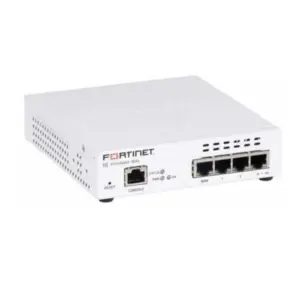
Five Gigabit Ethernet interfaces give the gateway a useful role beyond a simple USB modem. It provides one wired WAN and four LAN connections, with one LAN interface supporting IEEE 802.3af/at PoE power input. This allows an installer to place the unit closer to a window or another location with stronger cellular reception while using an Ethernet cable for both data and power. The design can reduce dependence on long RF antenna cables, which may introduce signal loss and complicate installation.
For Fortinet environments, the gateway can be managed through a compatible FortiGate or FortiExtender Cloud, depending on the deployment architecture and software support. That integration helps network teams treat the cellular path as a managed WAN component rather than an isolated consumer router. Businesses considering this model should still confirm firmware interoperability, management licensing, support entitlement, mobile-carrier bands, SIM provisioning, and accessories before purchase. FourTeck can review these dependencies so the quoted solution matches the intended branch design.
Key Business Benefits
Cellular gateways are valuable when they solve an operational risk, not merely when they add another box to the network. The following benefits explain how the architecture can support real business requirements.
◆ Greater WAN Resilience
A cellular path can keep essential services reachable when the primary fixed circuit fails. This is particularly important for payment terminals, cloud applications, communications, remote monitoring, and branch security systems that cannot wait for a carrier repair window.
◆ Carrier Diversity
Two modem modules and multiple SIM positions give designers more freedom to use separate mobile providers. Choosing carriers with different radio infrastructure can reduce the risk that one operator issue disconnects the entire site.
◆ Flexible Placement
PoE power input supports placement away from the firewall or equipment cabinet, using Ethernet to reach an area with better signal. This can be more practical than extending cellular antennas over long, lossy RF cables.
◆ Faster Site Activation
A correctly provisioned mobile service can provide connectivity while a permanent circuit is being installed. Project teams can open a branch, kiosk, temporary office, or project site sooner, then retain LTE as the backup path after fixed broadband arrives.
◆ Centralised Visibility
Fortinet management options can place cellular connectivity within the same operational workflow as the wider branch network. Administrators gain clearer status information and can apply a consistent policy approach across distributed locations.
◆ Better Remote Recovery
An independently routed cellular connection can support out-of-band access when the normal WAN path is unavailable. This may allow engineers to investigate a fault, check remote equipment, or restore service without travelling immediately to the site.
These advantages depend on sound design. A second SIM from the same operator may not provide true carrier diversity, and an LTE gateway placed inside a metal cabinet may perform poorly. Data-plan limits, public or private addressing, carrier-grade NAT, VPN behaviour, antenna positioning, electrical protection, and failover testing all influence the outcome. FourTeck can help buyers turn the hardware capability into a workable deployment plan.
Product Highlights
Two Internal LTE CAT7 Modems
The dual-modem design supports active/active and high-availability concepts that a single-radio gateway cannot provide. Each modem is designed for up to 300 Mbps downlink and 150 Mbps uplink in suitable network conditions.
Multiple Micro-SIM Choices
Two SIM slots are associated with each modem module. The deployment can therefore be planned around multiple operator services, failover priorities, data costs, geographic coverage, and service-level requirements.
Rich Wired Connectivity
One Gigabit WAN and four Gigabit LAN ports enable wired broadband, local devices, firewall pairs, or branch equipment to be connected according to the selected architecture.
PoE or External DC Power
The unit can receive standards-based PoE through the designated LAN port or use a suitable external adapter. The power accessory is region specific and should be included in the order if PoE is not available.
GPS/GNSS and Bluetooth
GNSS antenna support and Bluetooth-assisted configuration features add operational flexibility. Exact use depends on the deployment, software version, permissions, and management method.
Compact Indoor Form Factor
At approximately 38 × 158 × 158 mm and 0.41 kg without antennas, the gateway fits desktop and wall-mounted branch deployments while remaining easy to position for cellular reception.
The appliance also includes a USB 2.0 Type-A port, an RJ45 console interface, external SMA antenna connections, link and signal indicators, and a reset control. The exact box contents and accessories should be checked against the supplied regional package. SIM cards and mobile subscriptions are not included, and the correct Micro-SIM format must be obtained from the chosen carrier.
Technical Specifications
| Specification | FortiExtender FEX-202F Details | Buyer Note |
|---|---|---|
| Brand / Family | Fortinet FortiExtender | Confirm regional hardware and current lifecycle status |
| Model | FEX-202F; FEX-202F-EA for EMEA/APAC carrier environment | Carrier bands and approvals must be checked for the destination country |
| Cellular Modems | Two internal LTE CAT7 modem modules | Supports resilient and active/active design concepts |
| Rated Cellular Speed | Up to 300 Mbps downlink and 150 Mbps uplink per module | Real throughput varies with carrier, spectrum, signal, congestion, and plan |
| SIM Support | Dual Micro-SIM slots per modem module; four positions in total | SIM cards and service plans are purchased separately |
| Ethernet | One 10/100/1000 WAN and four 10/100/1000 LAN ports | Architecture and port role depend on selected configuration |
| PoE Input | Designated LAN port supports IEEE 802.3af/at PoE powered-device operation | Use a standards-compliant source and proper grounding |
| Other Interfaces | USB 2.0 Type-A, RJ45 console, Bluetooth, GPS/GNSS antenna support | Feature use can depend on software and management mode |
| Antennas | Six external SMA cellular antennas, with GNSS provisions | Verify included antenna kit and site positioning |
| Management | Standalone options, compatible FortiGate management, or FortiExtender Cloud | Confirm firmware, account, and service requirements |
| Mounting | Desktop or wall mount; indoor use | Place where LTE reception is strongest and temperature is controlled |
| Dimensions | Approximately 38 × 158 × 158 mm, excluding antennas | Allow clearance for six antennas and Ethernet cables |
| Weight | Approximately 0.41 kg | Use the supplied mounting method on a suitable surface |
| Power | PoE 802.3af/at or suitable 12V external adapter | Regional adapter may be sold separately |
| Power Consumption | About 7.55 W average and 9.40 W maximum | Include gateway and upstream PoE budget in the power plan |
| Operating Environment | 0°C to 40°C; 5% to 95% humidity | Indoor specifications; avoid unprotected outdoor installation |
| Support / Warranty | FortiCare term and local warranty handling are selected separately | Confirm entitlement duration and return process in the quotation |
The correct configuration starts with the destination country and intended mobile operators. A gateway can only deliver reliable service when its radio bands, carrier certification, SIM profile, and data plan align with the local network. Buyers should then define whether LTE will be the primary WAN, a standby path, an active/active service, or a dedicated management channel. That decision affects SIM quantity, firewall policy, data usage, addressing, VPN design, and monitoring.
The power method also matters. PoE can simplify placement, but the upstream injector, switch, or FortiGate port must meet the applicable IEEE standard and provide adequate power. When DC power is preferred, the correct regional adapter should appear on the bill of materials. For controlled support, include the required FortiCare term and confirm which team will register, configure, test, monitor, and renew the cellular services.
Configuration and Buyer Guidance
A resilient cellular design begins with questions, not with a purchase order. First determine how many business services must remain available during an outage. A small branch may only require payment traffic, voice, and remote management, while another location may expect every user to continue video meetings and cloud work. This changes the required data plan, traffic priority, and acceptable monthly operating cost.
1. Define the WAN Role
State whether the gateway is for primary connectivity, automatic backup, active/active transport, temporary site activation, or out-of-band management.
2. Select Carriers Carefully
Compare signal quality at the actual premises, not only national coverage maps. Diverse operators are preferable when continuity is the objective.
3. Check Addressing and VPN
Confirm whether the carrier uses public addressing, private addressing, or carrier-grade NAT, and assess how this affects inbound access and site-to-site VPNs.
4. Plan Data Control
Document monthly allowances, overage rules, traffic priorities, application restrictions, and alerts so backup operation does not create an unexpected bill.
5. Confirm Management Fit
Provide the FortiGate model, FortiOS version, management platform, and desired topology so interoperability can be reviewed before shipment.
6. Test the Failure Scenario
A deployment is incomplete until the team proves failover, failback, DNS, VPN, application access, monitoring, and alerting under controlled conditions.
Site conditions should be included in the design. Confirm indoor temperature, available wall space, cable distance, lightning and surge protection, grounding, and whether the gateway can be placed near a window without being exposed to rain, direct heat, theft, or accidental damage. Include the required mounting kit, PoE source or DC adapter, Ethernet cables, SIM cards, support entitlement, and any external electrical protection in the project scope.
For multiple branches, create a repeatable standard covering device naming, SIM assignment, carrier account ownership, configuration templates, change control, monitoring contacts, and spare strategy. FourTeck can help turn these details into a consistent bill of materials and quote rather than treating every site as an unrelated purchase.
Ideal Business Use Cases
Retail and Payment Locations
Stores, fuel stations, restaurants, ticket offices, and service counters can use cellular backup to protect payment authorisation, cloud POS, inventory updates, and remote support when the fixed WAN becomes unavailable.
Branch Offices
Distributed offices can add a second transport path for email, business applications, voice, VPN, and management. Policy can prioritise essential traffic and restrict less important services during failover.
ATMs, Kiosks, and Self-Service Systems
Unattended endpoints often require reliable backhaul and remote visibility. A managed cellular gateway can provide the network path, while the wider security architecture controls application access and administration.
Clinics and Community Facilities
Sites relying on cloud records, appointment systems, telehealth, communications, or remote support can use LTE continuity to reduce disruption when local fixed infrastructure is unstable.
Temporary Projects and Pop-Up Sites
Construction offices, exhibitions, emergency facilities, seasonal operations, and temporary sales locations can become connected before a permanent circuit is delivered. The gateway may later remain as the backup service.
Remote Technical Access
IT teams can plan a cellular path for troubleshooting firewalls, switches, servers, environmental monitors, and other branch equipment when the normal WAN path cannot be reached.
The FEX-202F is an indoor device, so it should not be selected for exposed vehicle, outdoor, or harsh industrial deployment without a suitable protected environment. Fortinet offers other form factors for demanding locations. FourTeck can help compare models when the site has wide temperature ranges, dust, vibration, weather exposure, specialised power, or vehicle installation requirements.
FortiExtender FEX-202F Dual-Modem LTE Resilience
The strongest reason to choose this model is not simply that it accepts a SIM card; it is that two cellular modem modules can be incorporated into a deliberate continuity design. A single-modem router can switch between SIM profiles, but only one radio path is active at a time. A dual-modem platform can support two simultaneous cellular links, subject to configuration, carrier support, and the selected network architecture.
This capability is useful when the business wants to separate traffic types. One modem may carry normal branch data while the second supports a dedicated service, backup path, or different carrier. It can also help designers reduce transition time between links and create a more robust response to coverage problems. However, resilience is only as strong as the independence between the services. Two SIMs purchased from different brands may still share the same underlying mobile network, tower infrastructure, backhaul, or regional outage. Buyers should ask each provider who operates the radio network and whether both services depend on the same local infrastructure.
The business should also identify which applications must survive. During a broadband failure, an unrestricted branch can quickly consume a cellular allowance through operating-system updates, backups, media streaming, and cloud synchronisation. Network policy should reserve capacity for payment, voice, VPN, monitoring, and critical business systems. Alerts should indicate when failover occurs, how much data is being used, and whether the primary path has returned.
FourTeck can help buyers document the desired failover logic, carrier pairing, SIM assignment, traffic priorities, and testing procedure. This gives technical teams a measurable continuity outcome rather than an appliance installed without a proven recovery plan.
FortiExtender FEX-202F Signal Placement and PoE Deployment
Cellular performance depends heavily on where the gateway is installed. A device hidden in a basement rack, metal cabinet, concrete core, or room with coated glass may receive a weak or unstable signal even when outdoor coverage appears good. The FEX-202F supports a practical alternative: place the gateway where reception is stronger, then connect it to the network through Ethernet.
The PoE-powered-device interface can receive electrical power and network connectivity over the designated Ethernet link when the upstream equipment complies with IEEE 802.3af/at and the installation is correctly grounded. This allows a high-quality Ethernet cable to extend from the firewall or switch area to a wall or desk position closer to a window. Ethernet runs are generally easier to test and maintain than long cellular antenna extensions, and the gateway remains accessible as a managed network device.
Placement should be decided through measurements. Installers can compare signal indicators and, where available, radio values such as RSRP, RSRQ, and SINR across candidate locations. A strong signal level alone does not guarantee good throughput if interference or tower congestion is high. Testing should be repeated at relevant business hours, because network conditions can change during peak periods.
The final position must remain indoors, ventilated, secure, and within the stated operating range. Allow room for six antennas and cable bends. Avoid direct contact with hot surfaces, water, excessive dust, and areas where staff may move or damage the antennas. When DC power is used instead, include the correct adapter and local plug. FourTeck can help review the site sketch, cable length, upstream PoE capability, and mounting requirements before the final bill of materials is approved.
FortiExtender FEX-202F Fortinet Management Integration
A cellular gateway creates more value when it can be operated within the same processes as the rest of the branch network. In compatible Fortinet deployments, FortiExtender can appear as a managed WAN interface associated with the FortiGate environment. Network teams can then coordinate routing, security policy, health checks, application priority, and failover behaviour through a familiar operational model rather than maintaining an unrelated consumer device.
FortiExtender Cloud offers another management path for organisations that need central visibility across remote gateways. The suitable approach depends on the topology, software release, entitlement, administrative ownership, and whether a FortiGate is present at the location. Before purchase, buyers should provide the firewall model, FortiOS version, planned management platform, number of sites, and current account structure. This avoids discovering after delivery that an upgrade, license, or design change is required.
Management does not replace security planning. The cellular service still needs appropriate firewall policy, secure administration, strong credentials, logging, update procedures, configuration backup, and access control. Remote management should be restricted to approved sources and methods. Public exposure of management interfaces is not recommended. Organisations should also define who receives outage alerts, who owns the carrier accounts, who renews support, and how configuration changes are recorded.
For larger rollouts, FourTeck can assist with a standard deployment checklist covering naming, SIM records, firmware baseline, management registration, configuration templates, test evidence, and handover documentation. Consistency makes multi-site cellular services easier to support and reduces the risk that a future engineer must reverse-engineer every branch.
What Buyers Should Check Before Purchase
Before requesting a quote, confirm that the selected hardware, carrier services, accessories, support, and network design work together. Buying only by model name can leave important items outside the order and delay deployment.
Regional Model Fit
Confirm FEX-202F-EA suitability, supported cellular bands, local approvals, carrier certification, and whether the exact order code remains available for the destination.
SIM and Carrier Plan
State the preferred operators, SIM format, number of services, monthly allowance, public-address requirement, roaming needs, and responsibility for activation.
Power and Accessories
Choose between compliant PoE and external DC power. Check the regional adapter, mounting hardware, antenna kit, Ethernet cabling, surge protection, and grounding plan.
Fortinet Compatibility
Share the FortiGate appliance, software version, management method, and desired WAN topology so integration requirements can be validated in advance.
Installation Environment
Verify that the location is indoor, secure, ventilated, within temperature limits, and positioned for good LTE reception with sufficient antenna clearance.
Support and Lifecycle
Select the FortiCare term, registration owner, renewal process, firmware responsibility, warranty handling route, and replacement strategy for critical sites.
Project Quantity
For multi-site supply, provide the quantity, rollout schedule, country list, shipping destinations, configuration standard, lab-test requirement, and spare-unit policy.
Alternative Model Review
Ask whether a newer LTE, 5G, rugged, vehicle, or Wi-Fi-enabled FortiExtender would better match the expected service life and installation environment.
A useful quote request should include the country, site type, number of users, critical applications, current WAN service, expected LTE role, preferred carriers, firewall details, cable distance, power source, support duration, and required delivery date. For a replacement, include the old model and explain what problem must be corrected. FourTeck can use this information to review the appliance, accessories, service entitlement, and suitable alternatives before commercial approval.
Africa Availability and Service Support
FourTeck supports product enquiries across Africa with assistance for regional model selection, carrier considerations, solution design, quotation, delivery coordination, and warranty guidance. Availability can vary according to the FEX-202F order code, supplier position, current product lifecycle, support term, accessory choice, project quantity, and destination country. For that reason, the gateway should be quoted as a complete requirement rather than assumed to be identical in every market.
Pre-sales support can include a review of the expected WAN role, FortiGate integration, SIM strategy, required power method, mounting arrangement, and rollout scale. FourTeck can also help buyers identify missing items such as a region-specific adapter, compatible PoE source, FortiCare entitlement, Ethernet cabling, or an alternative model for outdoor and vehicle use. Delivery coordination is planned against the confirmed destination and order details; no unverified stock or fixed delivery promise is presented on this page.
For business-critical projects, request a formal quotation and ask for written confirmation of the exact manufacturer part number, included accessories, warranty route, support term, lead time, and commercial validity. This provides procurement teams with a clearer basis for approval and reduces the chance of receiving hardware intended for a different radio region.
Africa Country and Regional Coverage
Businesses in Kenya, Uganda, Nigeria, Ghana, Tanzania, Rwanda, Ethiopia, South Africa, Zambia, Botswana, Senegal, and other African markets can contact FourTeck for availability review, configuration guidance, and quotation support. The team can help compare the intended mobile operators, destination-country requirements, Fortinet environment, accessories, and delivery plan before an order is finalised.
Country coverage does not mean that every carrier, radio band, support service, or accessory is identical across the region. A model that operates with one provider may require additional validation for another network. Procurement teams should therefore state the exact city or site location privately in the enquiry, along with the proposed carrier services and project schedule. For cross-border deployments, FourTeck can assist with a common design while highlighting where the bill of materials, adapter, SIM service, documentation, or logistics may differ.
Regional pages are available through FourTeck Africa, FourTeck Kenya, and FourTeck Uganda for localised business enquiries and related technology requirements.
GCC, Middle East and Africa Availability
FourTeck Africa can support requests from organisations operating across Africa while coordinating wider technology requirements through selected FourTeck platforms serving GCC and Middle East markets. This can be useful for groups with branches, projects, or procurement teams spanning Kenya, Uganda, Nigeria, Ghana, Tanzania, Rwanda, Ethiopia, South Africa, the UAE, Saudi Arabia, Qatar, Oman, and Bahrain.
Regional coordination should still be based on the final destination. Mobile-carrier bands, certification, power accessories, support registration, import procedures, taxes, delivery options, and warranty handling can differ between countries. A cross-border customer should provide a site schedule and separate destination list so each requirement can be checked rather than assuming one part number and one logistics process will fit every location.
For GCC-linked enquiries, visit FourTeck UAE. For continental requirements, use the Africa contact route. FourTeck can help align model selection, support terms, technical standards, and rollout documentation while keeping country-specific commercial details clear.
Other Options Buyers May Consider
The best alternative depends on whether the priority is a newer cellular standard, a built-in security gateway, harsh-environment operation, or a complete Fortinet branch stack. The following FourTeck pages provide useful routes for further discussion.
FortiGate FG-40F-3G4G
Consider when a compact FortiGate firewall with cellular capability is preferred instead of a separate LTE gateway.
FortiGate FG-41F
A compact branch firewall that can pair with a separate FortiExtender when security and cellular placement need independent devices.
FortiGate 50G
Suitable for growing branch requirements where modern firewall performance and coordinated SD-WAN design are important.
FortiSwitch FS-124F-POE
A managed PoE access switch option for branches that also need powered network devices and structured LAN connectivity.
FortiAP FAP-831F
An enterprise Wi-Fi 6 access point for sites building a coordinated Fortinet branch network around firewall, switching, and wireless access.
FourTeck Project Assistance
Use this route when the requirement includes multiple branches, mixed Fortinet products, deployment services, or an alternative gateway recommendation.
For newer deployments, ask whether a current LTE or 5G FortiExtender model offers a stronger lifecycle fit. For outdoor, vehicle, industrial, or extreme-temperature sites, request a model designed for that environment rather than placing an indoor appliance in an unsuitable enclosure without engineering review.
Why Buyers Choose FourTeck
Business technology procurement often fails when a correct product name is paired with an incomplete requirement. FourTeck approaches the enquiry as a solution review. The team can help clarify the regional order code, carrier environment, WAN role, Fortinet compatibility, power option, support entitlement, delivery location, and rollout quantity before issuing a commercial response.
For technical teams, this means fewer gaps between the network drawing and the purchase order. For procurement teams, it provides clearer part numbers, accessory notes, support terms, and assumptions. For project managers, it helps create a repeatable bill of materials across multiple sites. For business owners, it reduces the risk of paying for a device that cannot be used with the intended carrier or power arrangement.
FourTeck can also help match related Fortinet firewalls, switches, access points, support subscriptions, and deployment requirements. This is useful when cellular connectivity is one part of a wider secure branch programme. Assistance is based on the information provided and the current supplier position; availability, lead time, warranty process, and final commercial terms are confirmed in the formal quotation.
The goal is practical: help the buyer select a usable configuration, understand what is and is not included, and prepare the project for installation and testing. Contact the team with a clear requirement and receive guidance aligned to the business environment rather than a generic product-only response.
Frequently Asked Questions
What is the FortiExtender FEX-202F used for?
It provides 4G LTE WAN connectivity for branch networks, retail sites, kiosks, temporary locations, and other indoor business environments. It can be planned as the primary internet path, a backup to fixed broadband, an active/active cellular service, or an out-of-band management route. The suitable role depends on carrier services, Fortinet integration, data policy, and the required continuity level.
Does the gateway support two mobile operators?
Yes. The unit contains two LTE modem modules and two Micro-SIM positions for each module. This gives designers several carrier and failover options. True diversity should be checked carefully because different retail brands can share one underlying mobile network. FourTeck recommends confirming the operator infrastructure, local coverage, SIM plan, addressing, and intended link behaviour before deployment.
Is the FEX-202F-EA the correct version for Africa?
The EA order-code family is intended for EMEA and APAC carrier environments and is generally the version considered for many African deployments. It should not be assumed to work with every operator automatically. The destination country, supported LTE bands, certification, carrier requirements, and current product lifecycle must be checked before the order is confirmed.
Can the FEX-202F be powered through Ethernet?
Yes. A designated LAN interface supports IEEE 802.3af/at PoE powered-device operation. This can simplify placement near a stronger LTE signal. The upstream PoE source must be standards compliant, correctly grounded, and able to provide the required power. Alternatively, a suitable regional 12V adapter can be used and may need to be ordered separately.
Can FourTeck help integrate it with a FortiGate?
FourTeck can review the intended topology, FortiGate model, software version, WAN role, management method, and support requirements before quotation. Final integration work depends on the agreed service scope. Buyers should provide an existing network diagram or a clear description of the firewall, WAN circuits, VLANs, VPNs, and applications that must remain available during failover.
Are SIM cards and mobile data included?
No. SIM cards and carrier subscriptions are normally obtained separately from the chosen mobile operators. The gateway uses Micro-SIM cards. Buyers should confirm activation, data allowance, roaming, public or private addressing, carrier-grade NAT, contract ownership, and renewal responsibility. These service details can affect VPN operation, remote management, failover cost, and overall reliability.
Is it suitable for outdoor or vehicle installation?
The FEX-202F is specified as an indoor desktop or wall-mounted device. It should not be exposed directly to rain, dust, vibration, extreme heat, or other harsh conditions. Fortinet offers rugged and vehicle-oriented alternatives for specialised sites. Share the environment, temperature range, mounting location, power source, and mobility requirement so FourTeck can recommend a more suitable form factor where necessary.
How do I request an accurate quote?
Send the deployment country, quantity, site type, preferred carriers, intended LTE role, FortiGate model, software version, power preference, support term, delivery location, and target schedule. Include any requirement for configuration, installation, testing, or documentation. FourTeck can then review the regional model, accessories, entitlement, alternatives, and current commercial availability.
Can businesses order for multiple branches?
Yes. Multi-site enquiries can be planned around a standard bill of materials, common configuration baseline, carrier strategy, support term, lab validation, documentation, rollout schedule, and spare policy. Country-specific radio, power, logistics, and warranty differences may still apply. Providing a site list and phased quantity helps FourTeck prepare a clearer project response.
Need Help Choosing the Right Cellular Gateway?
FourTeck can help review regional model compatibility, carrier requirements, FortiGate integration, power accessories, support terms, delivery needs, and suitable alternatives for your business location.
Reviews
There are no reviews yet.