

Fortinet FortiADC FAD-400F in Africa
The Fortinet FortiADC FAD-400F is built for organizations that need to distribute application traffic intelligently, maintain service availability, process encrypted connections efficiently, and gain clearer control over how users reach important digital services. It is suited to data-centre and enterprise environments where online portals, APIs, business systems, remote-access services, and internal applications must remain responsive even when demand changes or individual servers become unavailable. FourTeck supports buyers with model verification, lifecycle guidance, configuration review, service-bundle selection, delivery coordination, and alternatives where a newer FortiADC platform is more appropriate.
✓ SSL Processing
✓ High-Availability Planning
✓ Africa Delivery Coordination
Request Quote
Check Africa Availability
Quick Product Information
Fortinet
FortiADC FAD-400F
Hardware application delivery controller
1U rack-mount appliance
L4-L7 load balancing, SSL handling, application availability and traffic control
Enterprise portals, APIs, data centres, hybrid services and critical business applications
Supplier and lifecycle dependent; confirmation required
Selected service entitlement and contract dependent
Africa project coordination and regional inquiry support
Licensing, optics, redundant power, rack accessories and services must be confirmed
Product Overview
Modern business applications rarely live on a single server or serve a predictable number of users. Customer portals may experience sudden traffic peaks, online payment systems must stay reachable during maintenance, and internal applications need reliable access for staff working from offices, branches, and remote locations. An application delivery controller sits between users and application servers, examines incoming connections, applies traffic rules, checks server health, and sends each request to an appropriate resource. This creates a controlled delivery layer that can improve availability, response consistency, and operational visibility.
The FAD-400F was designed for this role in mid-range enterprise and data-centre deployments. Its published platform characteristics include Layer 4 and Layer 7 processing, hardware-assisted SSL capability, 10 Gigabit Ethernet uplinks, multiple Gigabit Ethernet interfaces, virtual domains, local storage, and centralized management options. The appliance can help reduce direct pressure on application servers by handling connection distribution, health checks, persistence rules, encrypted-session processing, and selected acceleration tasks. This is especially useful when a business has multiple web servers, application nodes, API endpoints, or security gateways that must operate as a coordinated service rather than as isolated systems.
The operational value is not limited to raw throughput. A well-designed ADC deployment can support maintenance without a complete service interruption, steer traffic away from unhealthy servers, apply content-aware routing, manage access policies, and provide administrators with a clearer view of connection behaviour. FortiADC software also supports features such as global server load balancing, application-layer controls, automation interfaces, and security functions, although exact capability depends on software release, license bundle, service subscription, and deployment design.
For Africa buyers, the most important purchasing issue is lifecycle fit. The FAD-400F is no longer shown in Fortinet’s newest appliance portfolio, so procurement should not be based on model name alone. Organizations need to confirm whether the requirement is for an existing installed base, a replacement unit, a spare, a renewal project, or a new deployment. FourTeck can help review the technical brief, check current supply channels, assess support expectations, and compare newer FortiADC options where long-term service coverage or higher performance is required.
Key Business Benefits
The value of an application delivery controller is measured by how well it supports business services, not simply by the number of interfaces on the front panel. The following benefits show how the platform can contribute to availability, user experience, security operations, and controlled infrastructure growth.
◆ Better Application Availability
Health checks and traffic distribution can direct users away from failed or overloaded servers. This gives IT teams a practical way to maintain access during routine maintenance, component failure, or uneven demand, provided the backend design includes sufficient redundancy.
◆ More Consistent User Experience
Content-aware routing, connection persistence, compression, and controlled distribution can help applications respond more consistently. This matters for customer-facing portals, transactional systems, and internal platforms where slow or unstable sessions affect productivity and trust.
◆ Reduced Backend Pressure
SSL processing and connection management at the delivery layer can reduce work performed directly by application servers. The result can be better use of existing compute resources and more predictable scaling when encrypted traffic grows.
◆ Controlled Infrastructure Growth
An ADC allows additional application servers to be introduced behind a stable virtual service. This can support phased expansion, workload separation, and capacity planning without requiring users to connect to each backend system individually.
◆ Operational Visibility
Monitoring, logs, alerts, and traffic analytics can help administrators understand server health, client behaviour, response patterns, and service events. Better visibility supports faster troubleshooting and more informed capacity decisions.
◆ Segmented Administration
Virtual domains can separate services, teams, customers, or environments within one appliance. This can be useful for managed-service providers, shared data centres, and enterprises that need administrative boundaries between production, test, or departmental applications.
These benefits depend on sound architecture. The appliance does not create application resilience by itself; it must be paired with multiple healthy backend servers, appropriate network paths, tested failover logic, valid certificates, suitable licenses, and an operating procedure for updates and incident response. FourTeck can help buyers identify the surrounding requirements so the purchase supports a complete service design rather than an isolated hardware order.
Product Highlights
Published performance positions the appliance for substantial enterprise traffic, subject to enabled features, traffic profile, encryption, packet size, software release, and test conditions.
Dedicated acceleration can help handle encrypted sessions while reducing cryptographic work on backend application servers.
Four Gigabit RJ45 ports, four Gigabit SFP ports, and two 10 Gigabit SFP+ ports support mixed copper, fibre, server-side, and uplink requirements.
VDOM capability can separate policies and administration for multiple environments, services, or customers when supported by the selected software and license.
The compact form factor suits standard data-centre racks while leaving room for redundant switches, firewalls, servers, and other supporting infrastructure.
The model should be purchased only after confirming service entitlement, firmware access, spares, support dates, and whether a current-generation replacement offers better long-term value.
Other FortiADC functions may include advanced health checks, persistence, content routing, global server load balancing, scripting, RESTful interfaces, high availability, web application controls, DDoS protection, authentication integration, reporting, and Security Fabric connectivity. Availability of individual functions is not guaranteed by the hardware name alone. Some capabilities are software-version dependent, some require paid FortiGuard or FortiCare services, and some require additional architecture. Buyers should therefore request a quotation that clearly identifies the base appliance, service bundle, contract duration, optics, power options, rack accessories, implementation scope, and renewal responsibilities.
Technical Specifications
| Specification | Published FAD-400F Detail | Buyer Note |
|---|---|---|
| Product type | Application delivery controller / application accelerator | Confirm required software release and services |
| Layer 4 / Layer 7 throughput | 15 Gbps / 12 Gbps | Actual results vary by traffic and enabled functions |
| Layer 4 connections per second | 400,000 CPS | Size for peak new-session rate, not average traffic alone |
| Layer 4 HTTP requests | 1.5 million requests per second | Lab metric; production behaviour depends on request profile |
| Concurrent Layer 4 connections | 12 million | Review persistence, timeout, and long-lived session needs |
| Layer 7 connection rate | 120,000 CPS | Feature mix can reduce practical capacity |
| SSL processing | Hardware-assisted; 15,000 SSL CPS/TPS with 2K keys | Certificate type, key size, cipher, TLS version, and reuse matter |
| SSL bulk encryption throughput | 6 Gbps | Confirm encrypted traffic mix and inspection requirements |
| Compression throughput | 10 Gbps | Application content and policy determine practical benefit |
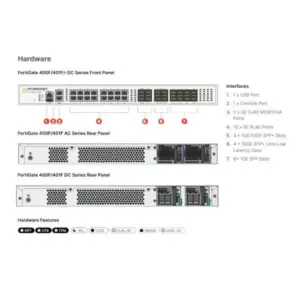
| Network interfaces | 4 × GE RJ45, 4 × GE SFP, 2 × 10 GE SFP+ | SFP/SFP+ optics and fibre type may be separate |
| Memory | 32 GB | Not presented as a field-upgrade item; confirm unit condition |
| Local storage | 120 GB SSD in current reseller listings; older documents may differ | Verify the exact hardware revision and serial-specific configuration |
| Virtual domains | Up to 20 | Validate license and design boundaries |
| Management | HTTPS, SSH CLI, console, SNMP, RESTful API, logs and analytics | Integrations depend on software and external platforms |
| Power | 100–240 V AC; about 114 W average and 137 W maximum | Optional redundant power should be confirmed in the bill of materials |
| Form factor | 1U rack-mount | Allow for airflow, rail compatibility, cabling, and service access |
| Dimensions and weight | 44 × 438 × 416 mm; approximately 9.07 kg | Confirm rack depth and shipping weight |
| Operating environment | 0°C to 40°C; 5% to 95% non-condensing humidity | Use controlled data-centre cooling and clean power |
| Lifecycle status | Earlier generation / not in newest FortiADC appliance line-up | Confirm support dates, entitlement, firmware access, and alternatives |
Performance figures are vendor or reseller-published laboratory values and should be treated as sizing references rather than guaranteed production results. A buyer should evaluate average throughput, peak throughput, new connections per second, concurrent sessions, encrypted-session rate, request size, persistence duration, security inspection, logging volume, high-availability overhead, and expected growth. Applications with many short encrypted transactions can stress connection setup differently from applications that carry fewer long-lived sessions. FourTeck can help convert these workload details into a more useful platform comparison and identify whether the FAD-400F remains suitable or whether a newer 320F, 420F, higher-capacity appliance, virtual edition, or cloud deployment better matches the project.
Configuration and Buyer Guidance
The correct ADC configuration starts with the application, not the appliance. Before asking for a quote, document which services will sit behind the controller, how many users or transactions they support, where the backend servers are located, and what happens when a server or site fails. This information determines the necessary throughput, connection rate, interface design, persistence method, health checks, high-availability mode, and security services.
1. Define the traffic profile
Share current and expected bandwidth, peak requests, new sessions, concurrent users, protocols, encryption level, certificate type, and anticipated growth. Peak values are more useful than monthly averages.
2. Map application dependencies
List web servers, application servers, databases, identity providers, DNS services, firewalls, cloud endpoints, and monitoring platforms. ADC policy must fit the entire service path.
3. Confirm resilience targets
Decide whether the deployment needs one appliance, an active-passive pair, active-active operation, multi-site balancing, or disaster-recovery routing. Hardware redundancy and service redundancy are separate decisions.
4. Select the service bundle
Determine whether base delivery functions are enough or whether the project needs WAF signatures, adaptive learning, IP reputation, antivirus, IPS, credential defence, sandboxing, DLP, bot protection, or enhanced analytics.
5. Include supporting items
Check SFP and SFP+ optics, fibre patch leads, copper cabling, rails, power cords, redundant PSU, rack space, UPS capacity, management network, certificate handling, and implementation services.
6. Validate lifecycle and support
Ask for the exact SKU, serial-status conditions, contract term, support eligibility, firmware access, replacement process, renewal path, and recommended successor model before committing budget.
A precise quotation should state what is included and excluded. Hardware-only pricing can look attractive but may omit the services required for application security, technical support, upgrades, or replacement. Likewise, a bundle price may include capabilities the buyer does not need. FourTeck helps structure the request so procurement, network, security, application, and finance teams review the same scope.
Ideal Business Use Cases
Customer Portals and E-Commerce
Distribute web traffic across multiple application servers, maintain session persistence, monitor backend health, and reduce disruption during maintenance. The design should include sufficient server capacity and tested database resilience.
Financial and Transactional Services
Support encrypted, high-value application sessions where availability, certificate management, controlled routing, and detailed logs are important. Security policy and regulatory requirements should guide bundle selection.
Enterprise APIs and Integration
Direct API traffic to appropriate services, apply health checks, support SSL termination or re-encryption, and maintain consistent virtual endpoints while backend systems change or scale.
Private Cloud and Virtualized Applications
Provide a stable delivery layer for applications hosted across virtual clusters or mixed physical and virtual infrastructure. Automation interfaces can support controlled provisioning when integrated correctly.
Service Provider and Multi-Tenant Environments
Use virtual domains to separate customers or services within a shared platform. Capacity, administrative boundaries, logging, licensing, and customer-level service commitments must be designed carefully.
Disaster Recovery and Multi-Site Access
Global server load-balancing capabilities can direct users between locations based on availability, policy, or response conditions. This requires reliable DNS design, site monitoring, replicated application data, and tested recovery procedures.
The appliance may also fit university portals, healthcare applications, government e-services, logistics platforms, hosted business systems, and secure remote application access. Suitability depends on the exact workload and the organization’s tolerance for lifecycle risk. For a new greenfield project, a current-generation FortiADC model may deliver a better support horizon. For an installed FAD-400F environment, the priority may be compatibility, spare capacity, renewal planning, or controlled migration.
FortiADC FAD-400F Application Performance and Workload Handling
Application traffic is multidimensional. Two environments can each move 5 Gbps and still place very different demands on an ADC. A file-transfer service may carry large streams with relatively few connections, while an online portal can create thousands of short encrypted sessions and many small HTTP requests. The FAD-400F’s published throughput, connection, request, and SSL figures provide multiple sizing indicators so architects can compare the appliance with the actual behaviour of their applications.
Layer 4 processing focuses on transport-level distribution, making it useful for TCP and UDP services where deep content decisions are not required. Layer 7 processing allows more detailed application-aware policies such as routing based on host, path, header, cookie, or other request information. This deeper decision-making consumes more resources but provides greater control. A practical design often uses a mix: simple load balancing for selected infrastructure services and more advanced policies for web applications that need persistence, rewriting, access control, or content-based routing.
The 10 Gigabit SFP+ interfaces can connect the appliance to data-centre switching infrastructure without limiting every flow to a single Gigabit link. The Gigabit copper and fibre interfaces provide flexibility for management, server-side networks, service segments, or existing infrastructure. Interface count alone does not define throughput, however. Architects should plan VLANs, link aggregation, redundancy, switch capacity, firewall paths, asymmetric routing prevention, and cabling standards.
For production sizing, collect monitoring data over normal periods and business peaks. Add expected growth, failure scenarios, and security overhead. A high-availability pair should be sized so one appliance can carry the required service if its peer is unavailable. Where the expected workload is close to the platform ceiling, a newer or larger model is usually safer than relying on ideal laboratory conditions.
FortiADC FAD-400F SSL Delivery and Application Protection
Encrypted traffic is now normal for customer and internal applications, but encryption adds processing work and can reduce visibility for security controls. An ADC can terminate incoming TLS sessions, inspect or route requests according to policy, and then either send clear traffic across a trusted server segment or establish a new encrypted connection to the backend. The correct approach depends on security policy, compliance requirements, network trust boundaries, and certificate-management practice.
The FAD-400F includes hardware-assisted SSL capability and published figures for SSL transactions and bulk encryption. These metrics help organizations estimate whether the appliance can handle their certificate types, cipher suites, key sizes, TLS versions, session-reuse behaviour, and peak login periods. A payment portal that creates many short sessions may be limited by transaction rate, while a media or file service may be more sensitive to bulk encryption throughput. Testing with representative traffic is more reliable than choosing from one headline number.
FortiADC can also support application-layer security functions such as WAF policies, signatures, adaptive learning, IP reputation, intrusion prevention, antivirus, DDoS controls, credential-focused defence, sandbox integration, and data-protection services. These functions vary by bundle and software version. They can add useful protection, but they also change capacity and operational requirements. Security teams need a process for policy tuning, false-positive review, certificate renewal, signature updates, incident response, and log retention.
FortiADC FAD-400F High Availability, Visibility and Management
An application delivery layer becomes part of the service path, so it must be designed to avoid becoming a single point of failure. FortiADC supports high-availability approaches that can pair appliances and transfer service responsibility when a unit becomes unavailable. The exact mode, state synchronization, network topology, heartbeat links, failover triggers, and recovery behaviour should be validated for the selected software release and application type.
Hardware resilience also includes power and network design. Buyers should confirm whether the quoted unit includes a redundant power option, whether both supplies can connect to separate PDUs or UPS sources, and whether upstream and downstream switching paths remain available during maintenance. A pair of ADCs connected through one switch or one power circuit does not provide complete resilience. The service chain must be reviewed from DNS and internet connectivity through firewalls, load balancers, switches, servers, storage, identity, and databases.
Management features such as HTTPS, SSH, console access, SNMP, APIs, logs, reports, and traffic analytics help teams monitor the platform and integrate it with broader operations. Role-based administration and virtual domains can separate responsibilities. Centralized tools may help organizations operating multiple appliances, while external log and analytics platforms can support retention, correlation, and audit needs.
Before deployment, create a management plan covering backups, change control, administrator authentication, time synchronization, monitoring thresholds, alert ownership, firmware review, certificate expiry, capacity reports, and disaster-recovery testing. Lifecycle-sensitive hardware requires extra attention because upgrade paths and support entitlements may be narrower than those of current models.
What Buyers Should Check Before Purchase
A model number does not describe the complete purchase. Before requesting a quote, buyers should confirm the required configuration, usage environment, compatibility needs, warranty expectations, delivery location, and long-term service plan. This reduces the risk of receiving hardware that lacks the right subscription, optics, power arrangement, firmware entitlement, or support horizon.
Correct Model and Revision
Ask for the full manufacturer SKU, bundle code, hardware revision, included storage, power configuration, and service term. Similar product names can hide important differences.
Compatibility Check
Confirm switch interfaces, fibre type, transceivers, VLANs, routing, firewalls, certificates, identity services, logging platforms, rack depth, power feeds, and application protocols.
Support and Firmware Eligibility
Request written clarification on FortiCare eligibility, firmware access, replacement process, subscription start date, renewal options, and any lifecycle restrictions.
Security Bundle Scope
Identify which WAF, IPS, antivirus, reputation, sandbox, credential, DLP, analytics, or bot services are needed and whether they are included for the required term.
Deployment Services
Decide whether the project needs design, staging, policy migration, certificate installation, high-availability setup, testing, documentation, training, or post-deployment support.
Replacement and Migration Plan
Compare the FAD-400F with current 320F, 420F, virtual, cloud, and higher-capacity options. Include migration effort, service continuity, support horizon, and renewal cost.
For a useful quote, provide application names, current traffic data, peak sessions, TLS profile, server count, required uptime, site topology, rack and power details, existing Fortinet products, service bundle preference, contract term, destination country, order quantity, and target deployment date. FourTeck can use this information to prepare a clearer bill of materials and flag missing components before procurement approval.
Africa Availability and Service Support
FourTeck supports product inquiries across Africa with assistance for model selection, configuration review, quotation, delivery coordination, and warranty or service guidance. Availability for the FAD-400F may vary according to supplier status, hardware condition, exact bundle, contract eligibility, requested quantity, and destination. A quotation is therefore prepared after checking the required scope rather than assuming the base appliance is immediately available.
For an existing FortiADC environment, FourTeck can help identify whether the requirement is a like-for-like spare, an additional unit for high availability, a renewal, or a migration. For a new project, the team can compare current-generation alternatives and explain practical differences in throughput, interface density, SSL capability, support horizon, licensing, power design, and deployment effort. This approach helps buyers avoid investing in a legacy platform when a newer model is more appropriate, while still supporting organizations that need compatibility with an installed base.
Delivery planning may include commercial documentation, destination details, order quantity, transport coordination, and confirmation of included accessories. Warranty and support handling depend on the quoted product, supplier route, service entitlement, and country. Buyers should request these terms in writing before purchase.
Africa Country and Regional Coverage
Businesses across Africa, including Kenya, Uganda, Nigeria, Ghana, Tanzania, Rwanda, Ethiopia, South Africa, Zambia, Botswana, Senegal, and nearby regional markets can contact FourTeck for availability checks, configuration guidance, quotation support, and project supply coordination. Requests may come from banks, universities, government institutions, telecommunications providers, healthcare organizations, data-centre operators, system integrators, resellers, and private enterprises.
Regional procurement often involves more than unit price. Buyers may need clarity on lead time, shipping route, taxes or import responsibilities, service eligibility, spare availability, power cords, rack compatibility, optics, contract activation, and documentation. FourTeck helps structure these questions before order placement. For multi-country projects, the team can review whether a common configuration is suitable across sites or whether local network, power, rack, and support conditions require variations.
Availability is not presented as guaranteed stock. It is confirmed against the exact SKU, service term, quantity, and destination. Buyers can use the Africa product assistance form to share their technical brief and receive a response aligned with the intended deployment.
GCC, Middle East and Africa Availability
FourTeck Africa can support product inquiries for organizations across Africa while guiding wider requirements through selected FourTeck platforms serving GCC and Middle East markets. Businesses with operations in the UAE, Saudi Arabia, Qatar, Oman, Bahrain, Kenya, Uganda, and other regional locations may need coordinated model selection, consistent licensing, delivery planning, and technical documentation across several sites.
Regional availability, delivery options, warranty handling, and configuration support can differ by country, product type, supplier route, and order quantity. This is especially important for an earlier-generation appliance. A unit available through one market may not carry the same support eligibility, bundle term, power accessories, or replacement process in another. Buyers should therefore request country-specific commercial confirmation rather than relying on a single global assumption.
For wider regional projects, explore FourTeck Africa, FourTeck Kenya, FourTeck Uganda, or FourTeck UAE. The appropriate team can review the destination, project timeline, and required support structure.
Other Options Buyers May Consider
A related model may provide a better support horizon, performance level, deployment format, or security focus. The right alternative depends on whether the priority is direct replacement, new application delivery capacity, virtual deployment, dedicated web protection, or integration with a broader Fortinet environment.
FortiADC 420F
A current-generation hardware option for organizations seeking a newer platform, higher published performance, modern support planning, and optional redundant power.
FortiADC 320F
A newer mid-range appliance for projects that need current lifecycle coverage and application delivery without moving to the larger 420F class.
FortiADC Virtual Appliance
Suitable where the delivery layer should run within a virtualized or cloud environment and scale according to licensed vCPU and infrastructure resources.
FortiWeb Appliances
Consider dedicated FortiWeb platforms when advanced web application and API protection is the main project requirement rather than general application delivery.
FortiGate Data-Centre Firewalls
A FortiGate may complement the ADC by protecting north-south and east-west traffic, enforcing security policies, and integrating with the Fortinet Security Fabric.
FortiAnalyzer and Management
Central logging, reporting, event analysis, and operational visibility may be needed for a complete application and security management design.
Why Buyers Choose FourTeck
Enterprise application delivery purchases require coordination between procurement, networking, cybersecurity, application owners, data-centre teams, and finance. FourTeck helps connect these requirements so the quotation reflects the intended business service rather than only a hardware code. This is particularly valuable for lifecycle-sensitive products, where service eligibility and replacement planning can matter as much as the appliance itself.
Checks the requested model, bundle, quantity, and destination against available supply channels.
Reviews traffic, interfaces, optics, power, rack, high availability, software, and service requirements.
Structures a bill of materials with clearer inclusions, exclusions, contract terms, and project notes.
Compares current FortiADC hardware, virtual appliances, and related security platforms when appropriate.
Supports destination-specific planning and commercial documentation for regional business projects.
Helps buyers understand quoted support terms, activation conditions, and escalation responsibilities.
FourTeck does not present unverified stock, guaranteed lowest pricing, or unsupported partner claims. The objective is to help business buyers obtain a workable solution with clear commercial and technical expectations. For bulk orders, phased rollouts, multi-site deployments, or migration projects, provide the project schedule and site list so the quotation can account for staging, delivery sequencing, and consistent configuration.
Frequently Asked Questions
What is the FortiADC FAD-400F used for?
It is an application delivery controller that distributes traffic across backend servers, monitors service health, manages encrypted connections, supports application-aware routing, and can improve availability for web applications, APIs, portals, and other business services. The exact functions available depend on the installed FortiADC software release, license bundle, subscriptions, and network design.
Is the FAD-400F currently available in Africa?
Availability must be checked for the exact hardware SKU, service bundle, quantity, and destination. The model is an earlier-generation appliance and is not shown in Fortinet’s newest hardware line-up, so supply and support conditions may be limited. FourTeck can check sourcing options and suggest a current alternative when a new deployment needs a longer lifecycle.
Can FourTeck help size the appliance for my applications?
Yes. Share average and peak bandwidth, connections per second, concurrent sessions, HTTP request rate, TLS profile, application count, backend server count, required uptime, and growth expectations. FourTeck can review these details against the published platform figures and compare newer models if the workload or support horizon makes the FAD-400F unsuitable.
Does the appliance include WAF and security services?
FortiADC supports application and network security capabilities, but entitlement depends on the quoted bundle and active subscription. Buyers should confirm whether WAF signatures, adaptive learning, antivirus, IPS, reputation services, credential defence, sandboxing, DLP, bot protection, analytics, and FortiCare are included, and for how long each service remains active.
What accessories should be included in the quotation?
Depending on the design, the quote may need SFP or SFP+ transceivers, fibre patch leads, copper cables, rack rails, power cords, an optional redundant power supply, UPS capacity, management cabling, certificates, and implementation services. These items are not always included with the base hardware and should be listed explicitly.
Can the FAD-400F be deployed in a high-availability pair?
FortiADC supports high-availability deployment methods, but the design must be validated for the chosen software release, topology, state synchronization, heartbeat links, and application requirements. A resilient solution also needs redundant switches, power feeds, upstream paths, backend servers, and tested failover procedures. Two appliances alone do not eliminate every service dependency.
How do I request a business quotation?
Use the FourTeck contact page and provide the model, quantity, destination country, required service term, traffic profile, interface needs, high-availability requirement, preferred bundle, and delivery timeline. Including this information helps the sales and technical teams prepare a more accurate bill of materials and identify lifecycle or compatibility concerns early.
Which newer model should replace the FAD-400F?
The FortiADC 420F is a natural current-generation model to review, but it is not automatically the correct replacement for every environment. The final choice should consider measured traffic, SSL workload, interface requirements, virtual domains, service bundles, redundancy, rack and power constraints, migration effort, and expected growth. A smaller 320F or larger platform may fit better.
Can businesses request bulk or multi-site supply?
Yes. Organizations, resellers, system integrators, and project buyers can request multi-unit or multi-site quotations. Provide the site list, quantities, preferred configurations, implementation schedule, service terms, and destination details. FourTeck can help coordinate consistent bills of materials, phased delivery planning, related accessories, and suitable alternatives where the requested model cannot meet the full project requirement.
Need Help Choosing the Right Application Delivery Platform?
FourTeck can help review FAD-400F availability, application traffic, SSL requirements, high-availability design, service bundles, support eligibility, accessories, migration options, and delivery requirements for your business location.
Reviews
There are no reviews yet.