
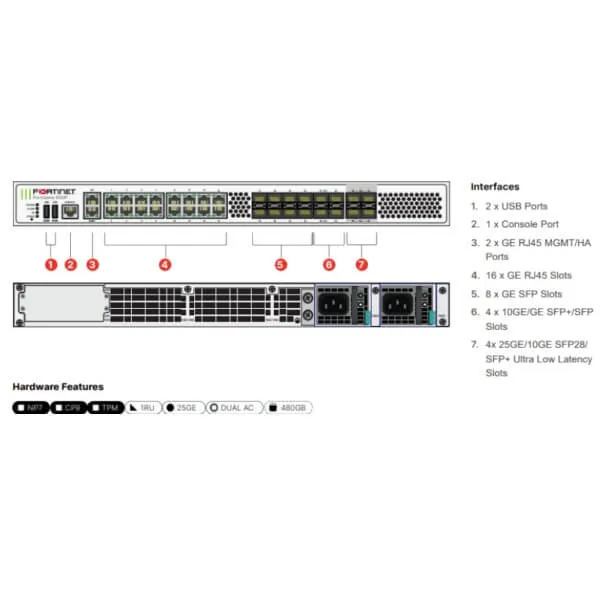
Fortinet FortiNAC FNC-CA-600F Network Access Control in Africa
The FNC-CA-600F is a high-performance FortiNAC control and application server for organisations that need to discover, classify, assess, authorise, segment, and monitor large numbers of connected endpoints. It is designed for medium enterprise environments where employee devices, guests, contractors, printers, cameras, access-control systems, medical equipment, industrial assets, wireless clients, and other connected technology must be handled through consistent access rules rather than open or manually managed network admission.
Request QuoteCheck Africa Availability
Quick Product Information
Fortinet
FortiNAC-CA-600F / FNC-CA-600F
High-performance network control and application server
Medium enterprise and large campus deployments
Up to 30,000 endpoints
1U rack mount
Device visibility, access control, segmentation and automated response
PLUS or PRO endpoint licensing; confirm current order structure
Contact FourTeck for current sourcing and delivery options
Sizing, licensing, deployment planning and warranty guidance
Product Overview
Modern business networks contain far more than laptops and desktop computers. A single organisation may have staff phones, personal tablets, IP cameras, card readers, printers, building systems, wireless sensors, medical instruments, industrial controllers, video-conferencing devices, guest equipment, contractors’ laptops, and cloud-managed endpoints connecting through many switches and access points. Each connection creates a decision: should the device be allowed, where should it be placed, what services may it reach, and what should happen if its behaviour or compliance condition changes?
The FortiNAC FNC-CA-600F Network Access Control platform addresses this decision at enterprise scale. It combines the control-server and application-server roles in a high-performance hardware appliance sized for up to 30,000 managed endpoints. Rather than relying only on a static inventory or occasional manual checks, FortiNAC can help network and security teams discover connected assets, build device context, apply role-aware policy, support onboarding workflows, and coordinate enforcement through compatible infrastructure. This is especially valuable in environments where the number and variety of devices makes spreadsheet-based management unreliable.
The appliance fits into the wider access-security architecture rather than replacing every existing network component. Switches, wireless controllers, firewalls, identity platforms, endpoint tools, directories, and security monitoring systems may still perform their normal roles. FortiNAC helps bring those signals and enforcement points into a clearer operational process. A device can be identified, associated with a user or role where appropriate, checked against policy, placed into the correct network segment, and restricted or isolated when risk is detected. The exact workflow depends on the selected license, supported integrations, network design, and implementation scope.
For African organisations, this can solve practical challenges found in rapidly expanding campuses, multi-branch groups, hospitals, universities, factories, hotels, banks, telecom environments, logistics operations, and public-sector networks. Growth often happens in phases, leaving mixed switching vendors, different generations of wireless infrastructure, inconsistent VLAN design, unmanaged edge devices, and limited visibility at remote sites. A well-planned NAC deployment gives the IT team a structured way to understand what is connected and move toward more consistent access decisions.
FourTeck supports buyers before the quotation stage by reviewing the expected number of endpoints, network-vendor mix, authentication requirements, guest and contractor flows, compliance objectives, required licenses, rack and power needs, high-availability expectations, and deployment resources. This helps the business evaluate the complete solution rather than treating the appliance as a standalone box.
Key Business Benefits
The value of network access control comes from making daily access decisions more visible, repeatable, and defensible. The following benefits explain why the platform matters to procurement leaders, security teams, network administrators, compliance functions, and operational managers.
◆ Clearer Device Visibility
Knowing that a switch port is active is not the same as knowing what is connected. FortiNAC helps teams build a more useful picture of endpoint type, user context, location, behaviour, and policy status. Better visibility supports faster troubleshooting, cleaner inventories, more informed risk decisions, and improved communication between network and security teams.
✓ Consistent Access Decisions
Role-aware policy can reduce dependence on manual port changes and one-off exceptions. Employees, guests, contractors, IoT devices, medical equipment, industrial assets, and unknown endpoints can follow different access paths. Consistency helps reduce accidental over-permission and makes policy easier to review across a large or distributed environment.
⚙ Faster Operational Response
When a device becomes suspicious or non-compliant, a structured response process matters. FortiNAC can support automated or administrator-driven actions such as changing network placement, restricting access, or coordinating with other tools. Reducing the delay between detection and containment can limit disruption and lower the amount of manual work required during an incident.
● Better Segmentation Control
Segmentation is strongest when devices are placed according to identity, type, trust level, and business purpose. NAC can help direct endpoints into appropriate VLANs or access roles so that guest devices do not share the same reach as finance systems, cameras, clinical devices, administrative servers, or production technology.
↗ Scalable Enterprise Capacity
With capacity for up to 30,000 managed endpoints, the appliance gives medium enterprises room to handle significant campus or multi-site growth. Correct sizing reduces the risk of buying an undersized platform and helps the organisation plan endpoint expansion, new branches, wireless growth, IoT adoption, and future access-policy coverage.
🔒 Stronger Audit Readiness
Access-control projects often support governance and audit requirements by creating clearer records of connected devices, authentication events, policy decisions, and response actions. The platform does not replace an organisation’s compliance programme, but it can provide technical evidence and operational control that help teams explain how network access is governed.
◆ Reduced Manual Administration
Large networks become difficult to manage when every new user, device, or guest requires a custom intervention. Automated discovery, policy assignment, onboarding, and event response can reduce repetitive tasks. Administrators can focus on exceptions and design quality instead of spending most of their time identifying devices or moving ports manually.
Product Highlights
Combines the control and application functions required for a FortiNAC deployment in a 1U hardware platform intended for medium environments.
Supports management of up to 30,000 registered, managed, and enforced endpoints when deployed and licensed correctly.
Uses software RAID 1 across two 960 GB SSDs and includes hot-plug 1+1 redundant power supplies for infrastructure continuity planning.
Provides one Gigabit Ethernet RJ45 interface and four interfaces supporting 1GbE SFP or 10GbE SFP+, subject to correct transceiver and network design.
The FNC-CA-600F uses an AMD EPYC 7413 processor with 24 cores and a 2.65 GHz base frequency, supported by 32 GB of DDR4 memory. This hardware profile is designed for the processing demands of endpoint discovery, profiling, access-policy evaluation, authentication workflows, API activity, guest services, integrations, and event handling at medium-enterprise scale. Hardware capability is only one part of successful performance; policy complexity, integration count, authentication sources, agent use, logging design, and actual endpoint behaviour also influence deployment results.
FortiNAC supports a broad visibility and access-control approach. Depending on the selected PLUS or PRO licensing and implementation design, organisations can plan capabilities around network discovery, rogue identification, device profiling, user authentication, captive portals, endpoint assessment, dynamic network steering, access enforcement, and security-event response. The exact feature set should be confirmed against the current Fortinet ordering guide and software release before approval.
Buyers should also note that this SKU is the hardware appliance. Endpoint licensing and the appropriate FortiCare coverage must be planned as part of the bill of materials. A complete quotation may include the appliance, endpoint license quantity, support for the hardware, support associated with perpetual licenses or subscription packs, deployment services, high-availability components, optics, rack accessories, and implementation effort. FourTeck can help organise these elements into a clearer commercial request.
Technical Specifications
| Specification | Details |
|---|---|
| Brand | Fortinet |
| Model / Product SKU | FortiNAC-CA-600F / FNC-CA-600F |
| Appliance Role | High-performance control and application server |
| Target Environment | Medium enterprise environments |
| Managed Endpoint Capacity | Up to 30,000 endpoints |
| Processor | AMD EPYC 7413, 24 cores, 2.65 GHz base frequency |
| Memory | 32 GB DDR4 |
| Storage | 2 × 960 GB SSD |
| RAID | Software RAID 1 |
| Network Interfaces | 1 × GbE RJ45 plus 4 × 1GbE SFP or 10GbE SFP+ |
| Console Access | RJ45 COM port for command-line access |
| Form Factor | 1U rack mount |
| Dimensions | 44 × 437 × 610 mm |
| Weight | 18.6 kg |
| Power Supply | Hot-plug 1+1 redundant power supplies |
| Input Power | 225 W |
| Cooling | Five system fans |
| Operating Temperature | 0°C to 40°C |
| Licensing | FortiNAC PLUS or PRO endpoint licensing; licensing and FortiCare requirements must be matched to the deployment |
| Availability Note | Contact FourTeck for current appliance, license, support, delivery, and implementation options |
Capacity should be assessed using the total number of endpoint devices that will be registered, managed, and enforced, not simply the number of employees. One user may connect a laptop, phone, tablet, desk phone, and other devices. Facilities systems, cameras, printers, sensors, access controllers, laboratory devices, and unmanaged equipment must also be counted. Projects close to the appliance limit should consider growth, seasonal guests, acquisition plans, new branches, wireless expansion, and contingency headroom rather than sizing to the current count alone.
The network interface specification should be reviewed with the rack and cabling design. Required SFP or SFP+ transceivers may not be included with the base hardware and should be confirmed. Buyers should also plan redundant power feeds, UPS capacity, cooling, rack depth, console access, management addressing, time synchronisation, backup, and secure administrator access. Licensing, software version, endpoint-agent use, authentication design, and supported infrastructure should be confirmed before deployment.
Configuration and Buyer Guidance
A NAC project succeeds when the organisation defines its access model before installing the appliance. The first task is to identify what the business wants to control. Some organisations mainly need asset visibility. Others need guest onboarding, contractor access, employee authentication, device compliance, automated VLAN placement, IoT classification, incident containment, or a combination of these. Each objective affects licensing, integration effort, policy design, and the number of teams that must participate.
1. Count Every Endpoint
Include corporate, personal, guest, IoT, OT, medical, building, voice, surveillance, printer, and contractor devices. Add realistic growth headroom.
2. Map Enforcement Points
List switches, access points, wireless controllers, firewalls, and remote sites. Record models, software versions, management access, and network ownership.
3. Define Identity Sources
Confirm Active Directory or other directory services, RADIUS design, certificates, guest sponsorship, contractor records, and administrator roles.
4. Choose License Depth
Compare PLUS and PRO capabilities against the required visibility, control, response, integrations, reporting, and endpoint-compliance functions.
5. Plan High Availability
Consider the business impact if access-control services are unavailable. Review appliance redundancy, power paths, network paths, backup, and recovery procedures.
6. Prepare the Rollout
Start with visibility, validate classification, pilot policies on controlled groups, document exceptions, train support teams, and expand in manageable phases.
Compatibility must be validated in detail. A product family name is not enough; network vendors may support different control methods across model generations and firmware releases. The project team should check SNMP, command access, API capabilities, RADIUS features, VLAN behaviour, wireless integration, switch configuration standards, and any restrictions imposed by managed-service agreements. FourTeck can help structure the questions and coordinate product-side guidance, while the customer’s network owner should approve the final enforcement design.
Ideal Business Use Cases
The appliance is intended for environments where the scale and diversity of connected devices justify dedicated access-control infrastructure. It is not limited to one industry, but the business case is strongest where network access affects safety, compliance, service continuity, confidential information, or operational reliability.
Large Corporate Campuses
Head offices and multi-building campuses can use NAC to manage employees, visitors, meeting-room technology, printers, cameras, phones, wireless devices, and contractors through different access roles. Policy consistency becomes especially important when several network teams manage many wiring closets.
Healthcare Networks
Hospitals and healthcare groups often operate clinical workstations, diagnostic systems, medical devices, guest access, building systems, and administrative technology on the same estate. Visibility and segmentation can help separate sensitive clinical environments from unmanaged or lower-trust connections.
Universities and Education
Universities may have tens of thousands of changing users and devices across residences, classrooms, laboratories, libraries, administration, and guest networks. NAC can support onboarding, classification, role assignment, and control across a highly dynamic environment.
Financial and Regulated Services
Banks, insurers, payment organisations, and other regulated businesses can use access policy to reduce unknown connections, separate critical systems, support stronger authentication workflows, and produce clearer operational evidence for security governance.
Industrial and Operational Sites
Factories, utilities, mining operations, and processing facilities may contain production assets that cannot run a conventional endpoint agent. Network-based discovery and controlled segmentation can improve awareness of these assets while respecting operational constraints and maintenance windows.
Hospitality and Multi-Site Groups
Hotels, retail chains, logistics groups, and distributed service businesses can apply more consistent access policy to staff, guests, point-of-sale systems, cameras, building technology, contractors, and branch administrators across many locations.
Other suitable projects include government networks, airports, telecom facilities, research organisations, data centres, managed service environments, and organisations undergoing merger or network consolidation. In each case, the design should begin with device populations and access risk rather than assuming that every endpoint requires the same treatment. Critical fixed-function devices may need tightly controlled profiles, while employee devices may use identity and compliance checks. Guests may require internet-only access, and unknown devices may be placed into a restricted discovery segment until approved.
FNC-CA-600F Device Visibility and Profiling
Visibility is the foundation of any access-control decision. An organisation cannot apply a reliable rule to a device it does not recognise. FortiNAC can use multiple discovery and profiling methods to develop context about endpoints connected through wired and wireless infrastructure. Depending on the network and license design, information may come from active or passive observation, authentication events, infrastructure data, device behaviour, agents, integrations, and FortiGuard IoT identification services.
The practical value is a richer inventory than a simple IP or MAC address list. Network teams can work toward understanding device categories, ownership, connection location, user association, expected behaviour, and whether a device matches an approved profile. This helps distinguish a corporate laptop from a guest phone, a camera from a printer, or a clinical device from a general-purpose workstation. Accurate classification also improves troubleshooting because support staff can locate the device, identify its access role, and review recent changes without starting from an unknown connection.
Profiling quality depends on the information available and the discipline of the rollout. The implementation team should validate classifications, create rules for unusual devices, and avoid enforcing strict actions before confidence is established. Industrial, medical, and legacy devices may communicate in ways that differ from modern user endpoints. A staged visibility period allows administrators to observe normal behaviour, tune categories, and build exception processes before applying restrictive controls.
For business leaders, the outcome is better decision support. Procurement can see how many device types require management, security teams gain context for investigation, network teams obtain a more dependable asset view, and compliance teams can assess whether unauthorised connections are being identified. FourTeck can help buyers discuss the data sources, endpoint groups, and infrastructure access needed to achieve useful visibility during deployment.
FNC-CA-600F Policy Enforcement and Segmentation
Visibility becomes valuable when it supports a controlled access decision. FortiNAC can help organisations apply policy based on factors such as user role, device type, connection method, location, registration state, compliance condition, and security context. The purpose is not to block everything unfamiliar. The purpose is to give each device the level of access required for its legitimate function while reducing unnecessary reach.
A typical policy model may place corporate laptops into employee networks after authentication, direct guests to internet-only access, assign phones and cameras to dedicated segments, restrict building systems to approved services, and place unknown endpoints into a limited network for assessment. Contractors may receive time-bound access to specific resources rather than the same permissions as employees. Medical or industrial devices may use carefully designed profiles because they cannot tolerate disruptive checks or frequent configuration changes.
Enforcement can involve existing switches, wireless systems, firewalls, and authentication infrastructure. Dynamic VLAN steering is one possible method, but the correct approach depends on the capabilities of each enforcement point and the organisation’s network standards. Teams should test how devices behave during reauthentication, link changes, roaming, failover, and policy updates. They should also define what happens when the NAC service is temporarily unavailable so that essential business functions remain available according to approved risk decisions.
Good segmentation is a business continuity control as well as a security measure. Limiting communication paths can reduce the spread of malware, contain misconfigured devices, protect sensitive systems, and simplify incident investigation. It also creates clearer ownership: the network path for guest devices is distinct from the path for finance systems, production technology, or administrative servers. FourTeck can help buyers identify the licensing, integration, and deployment services required to turn the desired segmentation model into a practical scope.
FNC-CA-600F Automated Response and Security Integration
Network access control becomes more effective when it can respond to changes in risk instead of treating access as a one-time event. A device that was acceptable at the start of the day may later show suspicious behaviour, fail a compliance check, appear on a threat list, or be associated with a compromised account. FortiNAC can support event-driven response by using context from network and security systems and coordinating enforcement through the infrastructure.
Possible actions depend on the selected license, integrations, and policy design. The system may notify administrators, change an endpoint’s access role, move it to a restricted segment, trigger a workflow, or provide contextual information to security monitoring tools. This can shorten the gap between detection and containment. It also gives incident responders a clearer understanding of where the device is connected, who may be associated with it, and what network access it currently has.
Integration planning should be deliberate. The organisation should identify which platforms provide trusted events, which system owns the final enforcement decision, how false positives are handled, and how emergency overrides are approved. Automated isolation can be powerful, but an incorrect action against a critical production, healthcare, or building device can cause business disruption. Pilot testing, severity thresholds, approval rules, logging, and rollback procedures should therefore be built into the response design.
The wider Fortinet Security Fabric can be relevant where the customer already uses FortiGate, FortiSwitch, FortiAP, FortiAnalyzer, FortiManager, FortiSIEM, FortiEDR, or other compatible platforms. Third-party integrations may also be possible depending on the release and supported connector. FourTeck can help procurement and technical teams list the required integrations before quotation so appliance, licenses, services, and implementation effort are aligned.
What Buyers Should Check Before Purchase
Before requesting a quotation, buyers should confirm more than the appliance model. The complete solution depends on endpoint quantity, feature tier, support coverage, network compatibility, implementation effort, infrastructure readiness, and the business impact of access-policy changes. A clear requirement helps FourTeck prepare a useful bill of materials and reduces the chance of missing licenses, optics, services, or resilience components.
Configuration Fit
Confirm current and projected endpoint totals, number of locations, agent usage, authentication volume, guest activity, REST integrations, and whether the environment fits the medium-appliance sizing. Consider growth over the intended service life rather than current counts alone.
License Selection
Determine whether PLUS or PRO is required and match the endpoint-license quantity to the deployment. Confirm whether perpetual or subscription licensing is preferred, the support requirement, and any minimum ordering conditions in the current programme.
Compatibility Check
Provide switch, wireless, firewall, directory, endpoint, monitoring, and service-management details. Include models and software versions. Compatibility should be validated against current product documentation and the planned enforcement method.
High Availability
Assess whether a single appliance meets business-continuity requirements. Review power redundancy, appliance failover, network paths, backup, disaster recovery, and the behaviour of connected infrastructure during a service interruption.
Rack and Environment
Confirm rack depth, rail requirements, cooling, UPS load, dual power feeds, data-centre access, transceivers, cabling, console access, management ports, IP allocation, DNS, NTP, certificates, and secure administrator connectivity.
Deployment Services
Decide whether the organisation needs supply only, remote guidance, professional implementation, policy workshops, integration work, migration support, pilot assistance, administrator training, documentation, or post-deployment support.
Operational Ownership
Identify who will approve access policy, manage exceptions, respond to endpoint events, maintain integrations, review reports, update device profiles, and coordinate changes with network, security, service desk, and compliance teams.
Quote Preparation
Share quantity, destination, required date, endpoint count, license preference, support term, HA need, infrastructure list, deployment scope, billing requirements, and any tender documentation. This allows commercial and technical review to happen together.
Buyers comparing the 500F, 600F, and 700F should focus on endpoint scale and target environment rather than choosing by price alone. The 500F is positioned for smaller environments with up to 15,000 managed endpoints, the 600F for medium environments with up to 30,000, and the 700F for larger environments with up to 50,000. A virtual appliance may be relevant where approved hypervisor or cloud deployment is preferred. FourTeck can help review these options and identify when a different model, additional appliance, or management layer should be considered.
Africa Availability and Service Support
FourTeck supports FortiNAC enquiries across Africa with assistance for requirement review, appliance selection, endpoint-license planning, FortiCare discussion, high-availability preparation, quotation, delivery coordination, and warranty guidance. Availability can vary according to supplier status, selected licensing model, support term, quantity, destination, import requirements, and project schedule. Buyers should request current confirmation rather than assuming that a listed model or service combination is immediately available.
A complete enquiry should include the expected endpoint count, number of sites, current network vendors, switch and wireless models, firewall environment, identity sources, existing NAC platform if any, guest-access requirement, IoT or OT scope, compliance objectives, deployment date, and required support period. These details help distinguish a simple hardware request from a complete access-control project. They also allow the quotation to include appropriate licenses, support contracts, implementation services, optics, and resilience elements where required.
FourTeck can help buyers plan a phased approach. An initial phase may focus on discovery and visibility, followed by pilot onboarding, selected enforcement, broader segmentation, and automated response. This is often safer than enabling restrictive policy across the entire organisation at once. Procurement teams can also request guidance on related Fortinet infrastructure, professional services, and suitable alternative models when the required capacity or deployment architecture changes during review.
Africa Country and Regional Coverage
Businesses across Africa, including Kenya, Uganda, Nigeria, Ghana, Tanzania, Rwanda, Ethiopia, South Africa, Zambia, Botswana, Senegal, and nearby regional markets can contact FourTeck for appliance availability, configuration review, licensing guidance, delivery coordination, and project quotation support. The same regional enquiry can cover a single campus, several branches, a data-centre deployment, or a phased rollout across multiple business locations.
Country-specific requirements may affect shipping, import documentation, tax treatment, support routing, installation planning, and the availability of local technical resources. For this reason, buyers should provide the final destination and deployment scope early in the commercial process. Multi-country organisations should also confirm whether licensing, management, identity, and policy will be centralised or handled independently by each business unit. FourTeck can help structure a consistent bill of materials while leaving room for local rack, power, network, and service needs.
Regional project buyers may use the FourTeck Africa technology platform, the Kenya support route, or the Uganda service route for location-relevant enquiry coordination.
GCC, Middle East and Africa Availability
FourTeck Africa can support enquiries for organisations operating across Africa, GCC, and Middle East markets when a common access-control design must serve regional offices, data centres, campuses, or operational sites. Businesses with requirements spanning Kenya, Uganda, Nigeria, Ghana, Tanzania, Rwanda, Ethiopia, South Africa, UAE, Saudi Arabia, Qatar, Oman, and Bahrain should identify where the appliance will be installed, where licenses will be registered, which team will administer the platform, and how support will be coordinated.
Cross-regional projects often require more planning than a single-site purchase. Identity directories may be hosted in another country, network standards may differ between branches, and the security team may operate from a regional headquarters. The project should therefore address latency, management access, data handling, change approvals, local installation resources, shipping, and the support path for each location. A standard architecture can simplify governance, but enforcement policies may still need to reflect local business roles and infrastructure.
Availability, delivery options, warranty handling, support eligibility, and configuration services can vary by country, supply route, and order quantity. FourTeck can help buyers coordinate the commercial conversation through the appropriate regional platform. Organisations with Gulf-linked procurement may also review the FourTeck UAE procurement desk while maintaining a clear African deployment plan.
Other Options Buyers May Consider
The correct solution may include the requested appliance, a smaller or larger FortiNAC platform, compatible switching and wireless enforcement points, a firewall, identity services, logging, or professional implementation support. The following FourTeck resources can help buyers explore related requirements without treating every project as an appliance-only purchase.
Fortinet Identity Security
Useful when NAC must work with authentication, MFA, directory services, certificates, user identity, or privileged-access controls.
FortiSwitch FS-108F
A compact managed switch option for smaller access environments where Fortinet-oriented switching and policy coordination are being considered.
FortiSwitch FS-424E-POE
Relevant for organisations planning managed access switching, PoE endpoints, VLAN segmentation, and stronger coordination with Fortinet security infrastructure.
FortiGate FG-3500G
A high-capacity firewall resource for data-centre and large-enterprise projects that may use firewall policy as part of a broader segmentation strategy.
FortiAP FAP-433F
A secure wireless access-point option for campus or enterprise WLAN projects where user and device onboarding must extend to wireless connections.
Fortinet Product Catalogue
Browse related Fortinet appliances, switches, access points, firewalls, analysis platforms, and security solutions available through FourTeck Africa.
Why Buyers Choose FourTeck
Enterprise access control is not a simple catalogue purchase. The hardware SKU is only one part of a working solution. Buyers also need to understand endpoint licensing, support contracts, infrastructure compatibility, deployment services, network design, enforcement risk, project phasing, warranty routing, and regional delivery. FourTeck helps bring these questions into the procurement conversation before the order is approved.
Structured assistance for appliance, license, support, accessory, and service requirements.
Discussion around endpoint scale, architecture, integrations, rack needs, and resilience.
Preparation of a clearer request that reflects the actual deployment rather than the model name alone.
Commercial and logistics discussion based on destination, quantity, project schedule, and supply route.
Support-term and warranty-route clarification based on the selected FortiCare and procurement path.
Help identifying suitable Fortinet switching, wireless, firewall, identity, and management components.
FourTeck works with SMB, enterprise, public-sector, education, healthcare, hospitality, industrial, telecom, financial, and project buyers. The support approach is practical: clarify the problem, confirm the environment, identify the correct product and licensing path, prepare the commercial request, and coordinate the next steps. No availability, delivery time, support entitlement, or warranty term should be assumed until it is confirmed for the final configuration and destination.
Frequently Asked Questions
What is the FNC-CA-600F used for?
It is a FortiNAC control and application hardware appliance used to discover connected devices, build endpoint context, support access-policy enforcement, manage onboarding, assist segmentation, and coordinate response actions. It is intended for medium enterprise environments where many wired, wireless, guest, IoT, OT, or user devices must be governed through a consistent network-access process.
How many endpoints can this appliance manage?
Fortinet positions the appliance for up to 30,000 managed endpoints. The count refers to devices registered, managed, and enforced by FortiNAC. Buyers should include every relevant device rather than counting employees only, and should leave capacity for growth, guest activity, new locations, IoT expansion, and future projects.
Does the hardware include all FortiNAC licenses?
The FNC-CA-600F SKU identifies the hardware appliance. Endpoint licensing and the appropriate FortiCare coverage must be planned separately according to the selected PLUS or PRO feature tier, endpoint quantity, licensing model, and support term. FourTeck can help buyers prepare a complete bill of materials before quotation.
Can FourTeck help choose between PLUS and PRO?
Yes. The choice should be based on the required visibility, access control, endpoint compliance, automation, reporting, integration, and response functions. Buyers should describe the intended use cases and current infrastructure so the feature tier can be checked against the latest ordering information and deployment goals.
Will FortiNAC work with an existing mixed-vendor network?
FortiNAC supports a broad integration approach, but compatibility must be validated for the exact switch, wireless, firewall, directory, and security-system models and software versions. The available enforcement method may differ across vendors. A pre-deployment assessment should identify supported control paths, access requirements, and any infrastructure limitations.
Is high availability available?
High-availability planning is possible within FortiNAC architectures, but the required appliance quantity, topology, licensing, network design, and support coverage should be confirmed for the specific project. Buyers should also plan redundant power, network paths, backups, monitoring, recovery procedures, and the behaviour of enforcement points during a service interruption.
Is the appliance available in Africa?
FourTeck can assist with current availability checks, quotation, license planning, delivery coordination, and warranty guidance for African business locations. Availability depends on supplier status, quantity, licensing model, support term, destination, and project schedule, so buyers should request confirmation for the final configuration.
What information is needed for a quote?
Provide endpoint count, projected growth, locations, switch and wireless inventory, firewall platform, identity sources, required use cases, PLUS or PRO preference if known, licensing model, support term, high-availability requirement, destination, quantity, deployment date, and whether professional implementation or training is required.
Can the system control IoT, OT, and devices without agents?
FortiNAC is designed to provide visibility and policy options for many device types, including headless and fixed-function endpoints. Agentless techniques can be important for IoT, OT, medical, and legacy devices. The exact profiling and enforcement method should be validated for each device population and operational environment.
Can businesses request bulk or multi-site supply?
Yes. FourTeck can review multi-site and project requirements, including central or regional architecture, endpoint-license quantities, phased delivery, standard bills of materials, related Fortinet infrastructure, and implementation support. Multi-country projects should identify installation locations, administrative ownership, support routing, and local logistics requirements.
Need Help Planning Your FortiNAC Deployment?
FourTeck can help review endpoint scale, appliance fit, PLUS or PRO licensing, FortiCare, high availability, infrastructure compatibility, deployment services, delivery requirements, and the information needed for a practical business quotation.

Reviews
There are no reviews yet.