

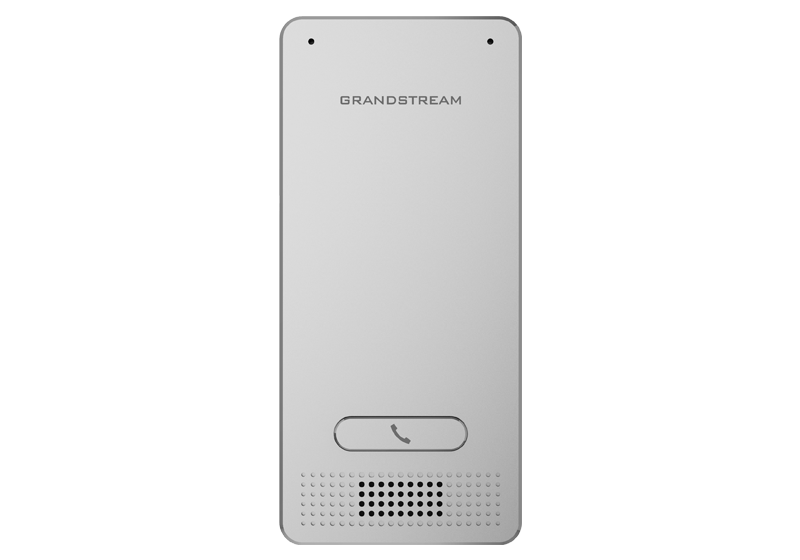
Quick Product Information
Grandstream
GDS3702
HD audio IP intercom and door station
Visitor calling and remote facility access control
10/100 Mbps Ethernet with IEEE 802.3af Class 3 PoE
IP66 weather protection and IK10 vandal resistance
Two relay outputs and two optocoupler inputs
Grandstream GDS Manager and compatible SIP environment
On-wall; in-wall with separately selected mounting kit
Model review, quote assistance, delivery coordination, and warranty guidance
A Focused Audio Entrance Solution for Business Sites
Not every controlled entrance needs a camera, keypad, touchscreen, or complex credential platform. Many organisations simply require a robust way for a visitor to call reception, security, a resident, a facilities team, or another responsible person before a door is released. The GDS3702 answers that requirement with an audio-first design that connects to an IP network and communicates through SIP. It turns a doorway into a managed communications endpoint instead of leaving the site dependent on an isolated bell, analogue handset, or employee walking to the entrance whenever someone arrives.
The built-in microphone captures speech from up to approximately 1.5 metres under suitable conditions, while the integrated 2-watt HD loudspeaker provides audio output up to approximately 3 metres. G.711 and G.722 codec support, acoustic echo cancellation, and noise control functions help create a clearer conversation between the entrance and the receiving endpoint. Practical performance still depends on placement, wind, traffic, reflective walls, enclosure positioning, network quality, endpoint settings, and commissioning, so the installation should be tested at the actual site rather than judged only from a desk setup.
The unit can call compatible IP phones or a SIP platform, allowing an organisation to route visitor calls to the people who already handle reception or security duties. During normal hours, the destination may be a front desk. After hours, a different extension or authorised team can receive the call. A warehouse entrance may ring dispatch; a clinic side door may ring a controlled staff point; a residential lobby may call property management. This flexibility is especially useful where the business already operates a Grandstream UCM environment or another compatible SIP system.
The door station also provides two relay outputs for electric locks, lights, alarms, or other suitable devices, together with two optocoupler inputs for a door sensor, request-to-exit button, or other low-voltage signal. These connections make it possible to design a coordinated visitor communication and door-release workflow. However, the unit should not automatically be treated as the lock power supply. The lock voltage, current, fail-safe or fail-secure behaviour, fire-release interface, emergency override, backup power, relay loading, and local building requirements must be reviewed by a qualified installer. FourTeck helps buyers prepare the correct product and accessory request before that technical installation work begins.
Key Business Benefits
The value of an IP door station comes from the operating process it enables. The following benefits explain how this model can support real facilities, procurement, communications, and security requirements when it is paired with appropriate locks, network services, receiving endpoints, and installation practices.
◆ Clearer Visitor Communication
Two-way HD audio lets staff speak with a visitor before granting access. This improves context at the entrance, reduces repeated trips to the door, and supports a more professional arrival process for customers, contractors, drivers, applicants, residents, and service providers.
✓ Uses Existing SIP Workflows
The device can become another endpoint within a compatible IP communications environment. Calls may be routed to desk phones, departments, security positions, or scheduled destinations, helping the organisation use familiar answering procedures rather than introducing an isolated door-phone system.
⚙ Simplified Network Power
IEEE 802.3af Class 3 PoE carries network data and device power over one Ethernet connection when the switch or injector is suitable. This can reduce the number of cables at the door station, while the electric lock is designed and powered separately according to its own requirements.
🔒 Rugged Entrance Hardware
An IP66-rated metal enclosure and IK10 vandal-resistance rating support deployment at exposed or publicly reachable entrances. Correct sealing, drainage, cable protection, surge planning, mounting height, and weather-aware installation remain essential for dependable long-term use.
● Flexible Door and Alarm I/O
Two relay outputs and two optocoupler inputs provide useful options for electric locks, lights, alarm outputs, exit buttons, and door sensors. The installer can align these connections with the site’s access procedure instead of forcing every entrance into an identical hardware arrangement.
↗ Suitable for Single or Multi-Site Use
A single entrance can be deployed as a focused project, while larger organisations can standardise call routing, cabling, network policies, lock interfaces, and commissioning checklists across branches. Consistency can reduce support effort without ignoring the physical differences between sites.
Product Highlights That Matter During Procurement
Built-in microphone coverage up to about 1.5 metres and 2-watt loudspeaker output up to about 3 metres under suitable installation conditions.
Broad SIP and VoIP compatibility for calling supported IP phones and integrating with a correctly configured communications platform.
G.711 μ-law/A-law and G.722 voice codecs with RFC2833 or SIP INFO DTMF, acoustic echo cancellation, and noise control.
Power through IEEE 802.3af Class 3 PoE or a suitable 12V DC, 1A source. The AC power adapter is not included.
Designed for operation from -30°C to 60°C and 10% to 90% non-condensing humidity, subject to correct enclosure installation.
Supports surface installation, with an in-wall option available when the appropriate separately sold mounting kit is selected.
This model is deliberately focused on audio intercom and door-control connections. It does not provide the same integrated camera, keypad, or built-in RFID functions found on other members of the GDS family. That distinction can be an advantage for projects that already use separate CCTV coverage or that need a straightforward call-and-release entrance point. It can also be a reason to select a different model where visual verification, local PIN entry, or card credentials are mandatory. FourTeck can help buyers compare the requirement before the quotation is finalised.
Technical Specifications
| Specification | Grandstream GDS3702 Details |
|---|---|
| Product category | HD audio IP intercom system and network door station |
| Network interface | 10/100 Mbps auto-sensing Ethernet |
| Power over Ethernet | IEEE 802.3af Class 3 |
| Alternative power | 12V DC / 1A; AC power adapter not included |
| SIP and VoIP support | Supported with broad interoperability; final PBX and endpoint compatibility should be verified |
| Voice codecs and functions | G.711 μ-law/A-law, G.722, DTMF through RFC2833 or SIP INFO, acoustic echo cancellation, and noise control |
| Audio input | Built-in microphone with input range up to approximately 1.5 metres |
| Audio output | Integrated 2-watt HD loudspeaker with output range up to approximately 3 metres |
| Inputs | Two optocoupler inputs, Vin below 15V, for door sensor or another suitable low-voltage device |
| Relay outputs | Two relays rated up to 125V AC / 0.5A or 30V DC / 2A, normally open or normally closed, for suitable electric lock, light, alarm, or related device |
| Weather protection | IP66 under EN60529 |
| Vandal resistance | IK10 under IEC 62262 |
| Operating conditions | -30°C to 60°C; 10% to 90% non-condensing humidity |
| Storage temperature | -35°C to 60°C |
| Mounting | On-wall; in-wall installation requires the correct separately sold mount kit |
| On-wall dimensions | 173 mm × 80 mm × 36 mm |
| In-wall dimensions | 217 mm × 120 mm × 11.6 mm with the applicable mounting arrangement |
| Unit weight | Approximately 672 grams |
| Management | Grandstream GDS Manager and device web configuration; deployment method depends on the selected environment |
| Compliance | CE, FCC, IC, RCM, and UKCA as listed in the manufacturer documentation |
| Availability | Contact FourTeck for current supplier status, project quantity, destination, and delivery options |
How to Use the Specification Table
The specification table describes the door station itself, not the complete access-control installation. The final project may also require a PoE switch or injector, lock power supply, isolation relay, surge protection, UPS, network cable, sealed junction box, exit button, door contact, fire-alarm release interface, compatible SIP phone, IP PBX, mounting kit, and installation services. The correct list depends on the door hardware and operating procedure. Buyers should request a bill of materials that separates included items, required accessories, optional components, and installer-supplied hardware.
Configuration and Buyer Guidance
A successful order starts with the entrance workflow. The buyer, facilities team, security team, IT department, and installer should agree on who approaches the door, who receives the call, how the person is identified, who may release the door, and what happens when no one answers. Those decisions affect the PBX settings, lock arrangement, network design, safety interfaces, backup power, and accessories.
1. Define the Entrance
State whether the unit will serve a lobby, pedestrian gate, office door, warehouse entrance, apartment access point, service door, internal secure room, or another opening. Include the door material, wall type, exposure, cable route, and expected visitor position.
2. Confirm the Call Destination
Identify the receiving phone, extension, ring group, security desk, reception endpoint, or mobile workflow. Confirm whether call routing changes by time of day and whether the selected endpoint can send the intended door-release command.
3. Check PBX Compatibility
Provide the PBX brand, firmware, SIP authentication method, codec policy, network location, and security controls. Broad SIP support does not remove the need to test registration, outbound calling, DTMF, call routing, and remote release in the chosen platform.
4. Size Network Power
Confirm an available switch port, 10/100 compatibility, IEEE 802.3af PoE budget, VLAN, DHCP or static addressing plan, firewall rules, cable distance, surge exposure, remote management path, and backup-power requirement.
5. Review Lock Engineering
Document the lock voltage, current, fail-safe or fail-secure mode, door closer, emergency release, manual override, fire-system interface, relay isolation, power supply, battery backup, and cable path. A qualified installer should approve the circuit.
6. Plan Commissioning
Test speech quality, echo, background noise, call timing, failed calls, door-release duration, sensor state, exit button, power loss, network loss, after-hours routing, authorised administrator access, firmware, logs, and recovery procedures.
This model is audio only. A site that requires visual confirmation should use an appropriate video door station or pair the entrance with a separately designed CCTV view. Likewise, a site that requires card or PIN entry should review another model or a compatible external access platform. FourTeck can help identify whether the GDS3702 is the right fit or whether a GDS3705, GDS3710, GDS3712, current GDS3720-series model, or another facility-access solution better matches the requirement.
Ideal Business Use Cases
An audio door station is most effective where the business has a clear process for answering calls and controlling the entrance. These examples show practical applications without assuming that the same lock, cabling, PBX, or safety design applies everywhere.
Corporate Reception Entrances
Visitors can call reception before entering a controlled office. The receptionist speaks with the visitor, confirms the appointment, and releases the door through a tested endpoint command. After-hours calls can follow a different route if the PBX and security policy permit it.
Warehouse and Dispatch Doors
Drivers, temporary workers, and suppliers can contact dispatch or security without entering the operational area. Rugged construction suits demanding entrances, while relay and sensor connections can support a controlled door workflow when the lock and power design are correct.
Residential and Managed Properties
A lobby or pedestrian entrance can call a property office, concierge point, or compatible resident endpoint. The project should define who answers, how calls are routed, how long the door remains unlocked, and what happens when the responsible person is unavailable.
Schools and Training Centres
A main entrance can remain controlled while parents, vendors, applicants, and visitors speak with an administrator. Safeguarding procedures, emergency release, accessible placement, front-desk coverage, and local requirements must guide the final design.
Clinics and Healthcare Sites
Staff can communicate with visitors at controlled side doors, pharmacies, records areas, treatment entrances, or service access points. The audio intercom helps employees respond without leaving protected areas, while life-safety and accessibility needs remain central.
Hotels and Hospitality Operations
Back-of-house entrances, staff doors, service yards, and managed residences may use the unit to call security or operations teams. Shift schedules, contractor entry, noise, weather exposure, and the property’s communication platform should be considered before deployment.
Retail and Branch Locations
Receiving doors, staff entrances, cash-office corridors, and secure service points can call a manager or central support function. Multi-site buyers can standardise the product and commissioning checklist while adapting lock hardware to each building.
Technical and Utility Rooms
Controlled equipment rooms, communications areas, generator compounds, and utility spaces may use an audio call point to reach operations staff. The solution should complement established security, alarm, safety, environmental monitoring, and access-authorisation procedures.
Grandstream GDS3702: HD Audio and SIP Communication
The core function of this door station is the conversation between the visitor and the person responsible for access. That conversation must be understandable, fast to establish, and integrated with the organisation’s normal communications process. The built-in microphone, 2-watt HD loudspeaker, G.722 wideband codec, G.711 support, acoustic echo cancellation, and noise-control functions provide a capable foundation for that workflow.
Real-world audio depends on more than the codec list. Mounting the unit beside a busy road, inside a reflective metal gate enclosure, near machinery, below a leaking canopy, or too far from the expected speaking position can reduce clarity. The receiving phone volume, PBX transcoding, packet loss, jitter, network congestion, and incorrect acoustic settings can also affect the result. Commissioning should therefore include normal daytime noise, after-hours conditions, different visitor heights, wind, rain, and the actual receiving endpoints.
SIP support allows the call to enter a wider business telephony environment. The organisation can define a single extension, a ring group, a reception queue, a security endpoint, or a schedule that changes the destination. Third-party platforms may work, but registration, authentication, DTMF, codecs, network address translation, firewall traversal, remote unlocking, and failover must be validated. A successful test should include outbound calling from the door station, answer and hang-up behaviour, unanswered calls, rejected calls, repeated button presses, after-hours routing, and door-release commands. FourTeck can help buyers describe the required endpoint environment so the correct commercial and technical questions are addressed before purchase.
Grandstream GDS3702: Relay, Sensor, and Door-Control Flexibility
The two relay outputs and two optocoupler inputs give the installer options for building a practical entrance workflow. A relay may trigger an electric strike, magnetic lock interface, gate controller, light, alarm output, or another suitable device. An input may receive a signal from a request-to-exit button, door contact, or other low-voltage source. The exact use should be documented so that operations staff understand what each connection does and how it behaves during normal, failed, and emergency conditions.
Relay ratings are an electrical limit, not a complete lock-design instruction. The installer must check voltage, current, inrush, inductive load behaviour, isolation, cable size, distance, suppression, power-supply capacity, battery backup, fire-alarm release, emergency break-glass devices, and local safety rules. Some locks require a dedicated controller or isolation relay even when the door station’s output appears to have sufficient nominal capacity. The lock should not compromise the intercom if it draws excessive current or introduces electrical noise.
Door sensors and exit buttons also require planned logic. A door contact can show open or closed state, support an alarm condition, or help identify a door held open, depending on the configured system. A request-to-exit device can enable egress without using the intercom. The project team should define release duration, repeated opening commands, after-hours rules, forced-door response, door-held-open timing, fire-event behaviour, network failure, and manual override. FourTeck can help identify the equipment and questions for the quotation, while the qualified access-control installer remains responsible for the final circuit, safety compliance, and commissioning.
Grandstream GDS3702: Rugged Outdoor Deployment
An entrance device is exposed to conditions that ordinary desk equipment never sees. Dust, driven rain, heat, cold, humidity, impact, vibration, direct sunlight, insects, cleaning chemicals, condensation, unstable power, and cable surges can all affect performance. The GDS3702 uses a metal enclosure with IP66 weather protection and IK10 vandal resistance, providing a strong base for outdoor or publicly accessible installation. Those ratings still depend on correct mounting and do not protect an incomplete cable entry or poorly sealed junction box.
The mounting surface should be firm, level, and appropriate for the device weight. The cable route should avoid standing water and unnecessary exposure. Outdoor Ethernet should be selected and terminated correctly, with surge protection and grounding practices suited to the site. A canopy or rain cover may improve usability where water falls directly across the speaking area. The unit should be positioned so that a visitor can reach the call button and speak naturally without blocking walkways or creating accessibility problems.
Operating temperature extends from -30°C to 60°C, but the microclimate around a metal gate, sun-facing wall, industrial plant, or sealed enclosure may be more severe than the reported ambient temperature. The installer should consider solar loading, airflow, nearby machinery, and power-supply temperature. Maintenance should include cleaning the microphone and speaker openings, checking seals and fixings, verifying the call button, testing the door-release workflow, confirming time and firmware settings, and inspecting cable protection. A rugged rating reduces risk; disciplined installation and maintenance protect the investment.
What Buyers Should Check Before Purchase
Before requesting a quote, buyers should confirm that an audio-only SIP door station matches the actual entrance requirement. A model number alone does not reveal the lock type, network condition, receiving endpoint, safety interface, or installation environment. Clear project information allows FourTeck to prepare a more useful product and accessory proposal and helps the installer avoid missing items.
Configuration Fit
Confirm that audio communication is sufficient. Where staff must see the visitor, record entrance video, use cards, or enter PINs, compare an appropriate video or credential-enabled model rather than adding unsupported expectations after purchase.
Compatibility Check
Provide PBX, phone, firmware, SIP authentication, codec, DTMF, VLAN, firewall, and remote-access details. Ask how the receiving endpoint will answer the call and send the door-release command.
Lock and Power Design
State the lock voltage, current, fail mode, controller, fire interface, exit device, door contact, separate power supply, backup runtime, and emergency release. Do not assume PoE for the intercom also powers the lock.
Mounting Environment
Share photographs, drawings, wall material, door type, sunlight, rain exposure, canopy, cable route, public reach, installation height, and whether surface or in-wall mounting is preferred.
Required Accessories
List the PoE switch or injector, mount kit, lock power supply, isolation relay, surge protector, UPS, cable, junction enclosure, exit button, sensor, phone, PBX, and project spares.
Availability and Warranty
Request written confirmation of the exact product code, included items, supplier status, expected lead time, destination terms, warranty period, handling route, return conditions, and any excluded installation services.
Long-Term Administration
Decide who owns credentials, passwords, firmware updates, configuration backups, call routing, network rules, logs, fault reporting, and annual testing. The device should have a named operational owner.
Quote Preparation
Send the destination, quantity, number of doors, intended use, PBX, receiving endpoint, lock details, power method, mounting type, accessory list, installation responsibility, and target project date.
For replacement projects, include the existing intercom model, wiring, mounting dimensions, lock controller, PBX, and reason for replacement. A physically similar unit may still require different wiring, power, programming, or accessories. For bulk or multi-site projects, provide a site schedule and indicate whether all units need to be delivered together or in phases. FourTeck can also help identify a suitable alternative where the preferred model is unavailable or where the requirement has moved beyond an audio-only entrance design.
Africa Availability and Service Support
FourTeck supports product inquiries across Africa with assistance for model confirmation, quotation, configuration review, accessory planning, delivery coordination, and warranty guidance. Availability may vary according to supplier status, product lifecycle, order quantity, destination, mounting requirements, and the wider bill of materials. The quote should therefore identify the exact unit, included components, accessory quantities, and commercial terms instead of describing the requirement only as a general door intercom.
A request may involve one reception door, a pilot installation, a residential property, several branch entrances, or a coordinated regional deployment. FourTeck can help buyers compare audio and video alternatives, review receiving phones and PBX options, discuss PoE and network needs, identify mounting items, and separate the door station from installer-supplied locks or electrical components. For project orders, a structured list can reduce delays caused by missing mount kits, sensors, relays, power supplies, surge devices, or endpoints.
Delivery timing and warranty handling depend on the selected supply route and destination. Buyers should provide accurate consignee details, quantity, project schedule, and any phased-delivery requirement. FourTeck can guide the commercial process, while the customer’s qualified integrator remains responsible for site survey, door hardware, electrical safety, network configuration, life-safety interfaces, installation, and commissioning.
Africa Country and Regional Coverage
Businesses and project teams across Africa, including Kenya, Uganda, Nigeria, Ghana, Tanzania, Rwanda, Ethiopia, South Africa, Zambia, Botswana, Senegal, and nearby markets can contact FourTeck for product availability, specification discussion, quotation support, accessory guidance, and delivery coordination. Requests may come from end users, system integrators, resellers, property managers, schools, healthcare organisations, contractors, hospitality groups, logistics operators, and multi-site enterprises.
Regional procurement should account for import requirements, voltage and power design, local installation capability, warranty route, customs documentation, environmental exposure, and project phasing. A multi-country organisation may benefit from a standard technical baseline covering approved door stations, PBX settings, mounting practices, network policies, lock interfaces, documentation, spares, and commissioning tests. Each site can then adapt the baseline for its building, climate, safety rules, and operating process. Use the FourTeck Africa technology platform or the Africa sales contact page to share your project details.
GCC, Middle East and Africa Availability
FourTeck Africa can support product inquiries for organisations operating across Africa while wider regional requirements may be coordinated through selected FourTeck platforms serving GCC and Middle East markets. Companies with sites in the UAE, Saudi Arabia, Qatar, Oman, Bahrain, and African countries often want a consistent door-communication standard but may need different delivery routes, warranty arrangements, currencies, taxes, installation partners, and import processes.
A regional rollout should define an approved product list, PBX compatibility, network-security policy, lock-interface standard, mount method, power and backup approach, administrator ownership, firmware policy, spares strategy, and commissioning checklist. That common baseline helps support teams maintain the system, while each country adapts the design for local doors, electrical conditions, weather, building regulations, and emergency procedures.
Availability, delivery options, warranty handling, and configuration support vary by country, product status, quantity, and selected supply route. Buyers can review the FourTeck UAE platform, FourTeck Kenya platform, or FourTeck Uganda platform where relevant. The final quotation should state the supplying entity, destination, currency, tax treatment, shipping terms, warranty route, and included services.
Other Options Buyers May Consider
Selecting a facility-access product should follow the required entrance workflow. Buyers who need cameras, credentials, or a dedicated control endpoint may prefer another product in the same ecosystem. The options below are useful starting points for comparison, subject to current availability and compatibility.
Grandstream GDS3705
An audio-focused door system with SIP calling, PoE, rugged construction, dual microphones, HD loudspeaker, and an integrated RFID reader for projects that need local card access.
Grandstream GDS3710
A wide-angle HD video door system with SIP video, RFID, PoE, motion detection, and ONVIF Profile S support for buyers who require visual verification and compatible recording workflows.
Grandstream GDS3712
A video intercom option with up to 1080p resolution, hemispheric coverage, SIP streaming, PoE, relays, alarm inputs, and rugged construction for camera-based entrance control.
Grandstream GDS3720 Series
Current smart video models provide broader combinations of 4MP video, credentials, mobile access, QR methods, analytics, and SecureAccess management for more advanced entrance requirements.
Grandstream GSC3570
A touch-screen control station that can support facility communication and door-control workflows in a suitable Grandstream environment where a dedicated answering point is preferred.
Grandstream Phones and UCM PBX
Compatible IP phones, video endpoints, and UCM platforms can provide the call-routing and answering side of a complete entrance solution, subject to tested configuration and security policy.
Why Buyers Choose FourTeck
Facility access sits at the intersection of networking, communications, physical security, electrical door hardware, building operations, procurement, and user administration. A buyer therefore needs more than a product code. FourTeck helps turn the operating requirement into a clearer commercial request that identifies the device, accessories, quantities, compatibility points, destination, and warranty expectations.
Assistance for one-off requirements, branch projects, system integrator orders, property developments, and coordinated regional deployments.
Help reviewing audio versus video, SIP environment, receiving endpoint, PoE, lock interface, sensors, mounting method, and required accessories.
A quotation can separate the door station, mount kit, network power, phone or PBX options, lock-related items, project spares, and excluded installation work.
Pre-sales questions can identify potential PBX, codec, DTMF, VLAN, lock, power, and endpoint issues before the order reaches the installation stage.
Support for destination details, quantity, project dates, accessory consolidation, shipment planning, and phased supply requirements.
Clarification of warranty coverage and handling based on the selected product, source, destination, order terms, and supplier route.
FourTeck does not replace the qualified installer who is responsible for door mechanics, lock power, electrical safety, fire-release circuits, network configuration, cabling, mounting, local compliance, and commissioning. The role is to help procurement and project stakeholders reach the installation stage with a better-defined product choice and a more complete bill of materials. This collaborative approach can reduce avoidable delays caused by omitted accessories, unsupported expectations, unclear supply terms, or a door station selected without considering the full entrance workflow.
Frequently Asked Questions
What is the GDS3702 used for?
It is used as an audio IP intercom and controlled-door communication point. A visitor presses the call button and speaks with a person through a compatible SIP phone or communications platform. The authorised user can then trigger a configured door-release action. It is suitable where clear audio communication is required and an integrated camera, keypad, or card reader is not essential.
Is this an audio-only or video door station?
This is an audio-only model with a built-in microphone and HD loudspeaker. It does not include a camera. Businesses that need visual verification should review an appropriate video door station or use a separately designed CCTV view. FourTeck can help compare audio and video alternatives based on the entrance, PBX, recording, credential, and monitoring requirements.
Can the device call an IP phone?
Yes. SIP and VoIP support allows the unit to call compatible IP phones or a correctly configured SIP platform. The buyer should confirm registration, authentication, codec support, DTMF method, network rules, call routing, and door-release commands with the chosen PBX and endpoint. A practical proof-of-concept is recommended before a large multi-site rollout.
Does PoE also power the electric lock?
PoE powers the door station when the network switch or injector provides IEEE 802.3af Class 3 power. The electric lock may require a separate power supply selected for its voltage, current, duty cycle, fail mode, and backup requirement. A qualified installer should verify relay loading, isolation, surge suppression, emergency release, fire-system behaviour, and manual override.
Can it be installed outdoors?
The metal enclosure carries IP66 weather protection and IK10 vandal resistance, supporting exposed and publicly reachable entrances. Outdoor reliability still depends on sealed cable entry, suitable mounting, drainage, surge protection, outdoor-rated cabling, grounding practices, environmental temperature, and routine maintenance. A canopy or additional weather shield may be appropriate for some locations.
Can FourTeck help with configuration planning?
FourTeck can help buyers review the model, SIP environment, receiving endpoint, PoE, lock interface, sensors, mounting, accessories, quantity, destination, and quotation requirements. Final PBX programming, network security, lock wiring, fire-release integration, installation, and commissioning should be completed by appropriately qualified technical teams responsible for the site.
How is Africa availability confirmed?
Availability is checked when a quotation is prepared because supplier status, product lifecycle, quantity, accessories, destination, and delivery timing can change. Share the required number of units, delivery country, target date, mount type, PBX or phone details, and lock requirements. FourTeck will use that information to review the suitable supply and product path.
What warranty support is available?
Warranty terms depend on the selected supply channel, destination, order conditions, and product source. Request written confirmation of the warranty period, handling process, return conditions, freight responsibility, and excluded damage. Environmental damage, incorrect power, poor installation, unauthorised modification, or unsuitable lock wiring may not be treated as a product fault.
What should I send when requesting a quote?
Provide the destination, quantity, number of doors, intended use, existing PBX, receiving phone, network switch and PoE availability, lock type and voltage, exit button, door sensor, fire interface, mount preference, accessory list, installation responsibility, and project date. Site photographs or drawings can help identify exposure, wall type, cable route, and mounting constraints.
Can businesses request bulk or project supply?
Yes. Organisations, integrators, resellers, property projects, and multi-site operators can request project quantities. The inquiry should include site count, unit quantity, accessory quantities, delivery destinations, preferred schedule, standard configuration, spare-unit plan, and whether shipments should be consolidated or phased. FourTeck can help prepare a structured commercial request for the defined deployment.
Need Help Planning Your Door Intercom Purchase?
Share your entrance type, lock details, PBX or receiving phone, network power, mounting environment, quantity, destination, and project date. FourTeck can help review the product fit, accessories, availability, warranty guidance, and delivery requirements before preparing a tailored quotation.
Reviews
There are no reviews yet.