

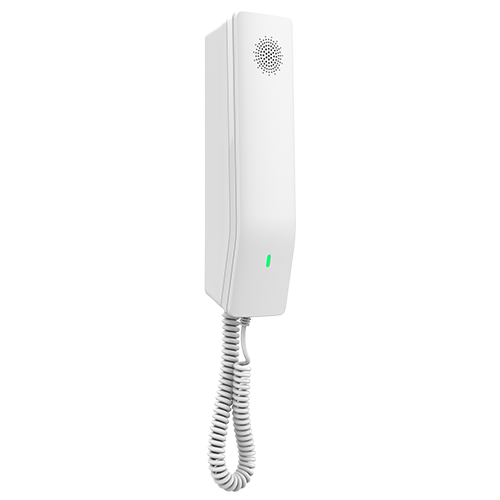
Quick Product Information
Grandstream
GHP610W
Compact Wi-Fi SIP hotel phone
Guest-room and facility voice access
Dual-band Wi-Fi plus 10/100 Ethernet
GDMS and web-based provisioning
Desktop or wall-mounted
Contact FourTeck for current options
Africa and supported regional markets
Confirm hardware revision, PBX and Wi-Fi requirements
Product Overview
A guest-room telephone has a different job from a feature-rich office desk phone. It must be immediately understandable, take up little space, present essential service numbers clearly and remain manageable across dozens or hundreds of rooms. The GHP610W addresses that requirement with a compact handset-led design and a practical set of calling functions. It supports two SIP accounts and two lines, allowing a property to map room calling and service workflows without overwhelming the user with a complex display or large number of controls.
Integrated dual-band Wi-Fi gives installers more flexibility when a room does not have a convenient Ethernet outlet at the bedside, desk or wall location. This can be valuable during hotel renovations, serviced-apartment upgrades and healthcare deployments where pulling new data cabling may add disruption or cost. The phone also includes a 10/100 Mbps network interface with integrated PoE Class 2 according to the current manufacturer datasheet, so the final deployment method can be selected around the available infrastructure and hardware revision. FourTeck recommends verifying the intended power method and supplied accessories for each project rather than assuming every shipment is identical.
For the guest or resident, the experience remains familiar: lift the handset, dial a number, use programmed service keys, redial, hold, mute or activate hands-free calling. Ten digit keys can be configured as speed-dial destinations through the web interface, while three programmable keys can support property-specific functions. A replaceable label and customizable faceplate help the organization present services such as reception, housekeeping, security, emergency assistance or room service in a clear format.
For the IT or operations team, centralized administration is one of the most important advantages. Grandstream Device Management System can support remote configuration, provisioning, monitoring and firmware management across distributed endpoints. This reduces the need to configure every room phone manually and makes the model suitable for new builds, phased renovations, healthcare facilities, student housing and multi-property rollouts. FourTeck supports Africa buyers with product selection, compatibility review, quantity planning, quote preparation, delivery coordination and guidance on warranty handling so the chosen solution fits the actual site.
Key Business Benefits
The value of a hotel telephone is not measured only by the number of keys it has. Buyers should consider installation effort, user simplicity, ongoing administration, voice reliability and how easily the endpoint can be adapted to the property’s service model. The following benefits show how the design can support day-to-day operations.
◆ Flexible Room Placement
Dual-band wireless connectivity can reduce dependence on a data socket in the exact place where the phone is needed. This supports bedside, desk and wall positioning in refurbished or space-constrained rooms, subject to a suitable Wi-Fi design and reliable power source.
✓ Simple Guest Experience
A familiar handset and clearly labeled controls help guests make calls without learning a complicated interface. Programmed service destinations can shorten the path to reception, housekeeping, medical assistance or security and reduce misdialed internal calls.
⚙ Centralized Administration
GDMS support gives administrators a practical way to provision and monitor multiple phones. A controlled configuration process helps standardize extensions, dial plans, firmware and service keys across rooms and properties while reducing repetitive manual work.
● Clear Service Branding
The speed-dial label and swappable faceplate allow the property to present branded instructions and service names. This makes the phone part of the room experience and can help staff communicate services consistently across different room categories.
🔒 Protected Deployment
Secure boot, unique device certificates, encrypted configuration support, SRTP, TLS and 802.1X can contribute to a more controlled voice environment. The correct settings still depend on the PBX, network policy and provisioning design used by the organization.
↗ Multi-Site Scalability
A repeatable endpoint and centralized management platform are useful when a group needs a consistent room-phone standard across many floors or locations. Procurement can plan project quantities while IT maintains a common configuration baseline.
These benefits are strongest when the telephone is treated as part of a complete hospitality voice system rather than as a standalone appliance. Wi-Fi coverage, PBX registration, emergency call rules, VLAN design, quality-of-service settings, power availability and user labeling should be reviewed together. FourTeck can help buyers assemble these requirements before a quote is finalized, reducing the risk of missing accessories or selecting a model that does not match the room infrastructure.
Product Highlights
Two SIP Accounts and Lines
Supports straightforward room calling while giving administrators enough line flexibility for practical hospitality or facility workflows.
HD Handset Audio
Wideband audio support and a broad codec set help the endpoint operate with compatible SIP platforms and deliver clear voice in properly designed networks.
Three-Way Conferencing
Basic three-party audio conferencing can assist staff, guests or care teams when another person needs to join a call without moving to a separate meeting device.
Programmable Service Access
Three programmable keys, web-configurable speed dialing and five dedicated function keys support a clear, property-specific call experience.
Wi-Fi with Revision Awareness
Current documentation lists 2.4 GHz and 5 GHz 802.11 a/b/g/n/ac/ax for hardware version 5.0 and later. Buyers should confirm the revision supplied for a project.
Wall-Mountable Compact Form
The narrow handset-led format can fit locations where a conventional business phone would occupy too much surface area or introduce unnecessary controls.
The model also supports multicast paging, E911 service where configured by the platform and jurisdiction, GDS door opening integration, Layer 2 and Layer 3 quality-of-service methods, flexible dial plans, server redundancy and failover call-out functions. Those capabilities can be valuable in a coordinated Grandstream environment, but they should be validated against the selected PBX, network architecture and local emergency calling requirements. The current datasheet lists English and Chinese interface support, so buyers with other language requirements should confirm how labels, printed instructions and provisioning will be handled. A customized faceplate can address many guest-facing language and branding needs even when the administrative interface remains limited.
Technical Specifications
| Specification | Grandstream GHP610W Details |
|---|---|
| Product category | Compact SIP hotel IP phone, white |
| SIP capacity | 2 SIP accounts and 2 lines |
| Wireless connectivity | Integrated dual-band 2.4 GHz and 5 GHz Wi-Fi; current datasheet lists 802.11 a/b/g/n/ac/ax for hardware version 5.0 and above |
| Wired interface | One auto-negotiating 10/100 Mbps Ethernet port with integrated PoE Class 2 |
| Keys | 23 keys: 3 programmable, 12 standard dialing keys, 5 function keys and 3 volume/control keys |
| Dedicated functions | Flash, redial, hands-free, voice mail and hold; volume up/down and mute with red LED |
| Audio | HD handset with wideband audio support |
| Codecs | G.729A/B, G.711µ/a-law, G.726, G.722, G.723.1, iLBC and full-band Opus |
| Conferencing | Up to 3-way audio conference |
| Telephony functions | Dial, answer, transfer, conference, redial, flash, hands-free, voice mail through server, hold/unhold, mute/unmute, flexible dial plan, speed dial and server redundancy |
| Advanced capabilities | Multicast paging, E911 support, jitter-resilience algorithm and GDS door opening support |
| Management and provisioning | GDMS, TR-069, FTP/TFTP, HTTP/HTTPS and AES-encrypted XML configuration; mass provisioning supported |
| Security | Secure boot, random default password, unique device certificate, administrator passwords, 256-bit AES encrypted configuration, SRTP, TLS and 802.1X |
| Quality of service | Layer 2 802.1Q/802.1p and Layer 3 ToS, DiffServ and MPLS QoS support |
| Installation | Desktop placement or wall mounting with supplied/compatible base, configuration dependent |
| Power adapter | Universal input 100–240 VAC, 50–60 Hz; output 12 VDC, 0.5 A, 6 W for listed regional package |
| Operating environment | 0°C to 40°C operation; 10% to 90% non-condensing humidity |
| Approximate dimensions | 211 mm × 53 mm × 44 mm with handset |
| Package contents | Phone, handset with cord, base, universal power supply for listed Wi-Fi package and quick installation guide; confirm regional contents |
| Warranty and availability | Supplier and region dependent; contact FourTeck for current guidance |
Selecting the correct configuration begins with the network. A buyer should confirm whether each room will use Wi-Fi, Ethernet with PoE or an adapter-powered arrangement. Wireless operation requires adequate signal strength, capacity and roaming design at the exact phone position; a strong signal at the room entrance does not guarantee reliable voice at the bedside. Wired deployment may simplify quality-of-service enforcement but requires suitable cabling and switch power. The SIP platform must support the required registration, dial plan, voicemail, emergency calling and security settings. The organization should also define service-key destinations, faceplate content and whether configuration will be applied through GDMS, another provisioning server or a local web interface. FourTeck can review these inputs and help prepare a quote around the required hardware revision, quantity and deployment model.
Configuration and Buyer Guidance
A model number alone is not enough to define a successful hospitality phone deployment. The first step is to map how calls will flow. Identify the PBX or hosted SIP service, the number of extensions, the need for room-to-room dialing, reception access, outbound calling rules, voicemail behavior and emergency call handling. The telephone can support the endpoint functions, but the platform and dial plan determine what the guest can actually do.
Network Method
Choose Wi-Fi, Ethernet/PoE or an adapter-based layout according to the room design, cabling, switch capacity and local power access.
User Workflow
Define the essential service destinations and keep labels simple enough for guests, patients or residents to understand quickly.
Management Plan
Decide how extensions, firmware, security settings and key assignments will be provisioned and maintained across the estate.
Project Quantity
Include room count, spares, pilot units, phased delivery needs and replacement planning rather than ordering only the exact installed quantity.
For wireless projects, request a coverage review or conduct a site survey. Voice traffic is sensitive to latency, packet loss and interference. Separate guest Internet performance from the operational voice design where appropriate, apply suitable VLAN and quality-of-service policies, and verify that authentication requirements are compatible with the endpoint. Where 802.1X or encrypted Wi-Fi is used, the provisioning process must account for credentials and certificates. Confirm the hardware revision if Wi-Fi 6 support is important, since earlier stock may have a different wireless capability.
Warranty and lifecycle planning also matter. Ask which regional warranty applies, how a failed unit is handled, whether replacement stock should be kept locally and who will own configuration backups. For a multi-property rollout, a pilot in representative rooms can reveal label, audio, mounting, signal or workflow issues before full deployment. FourTeck can help organize these questions into a practical bill of materials and quote request, including phone quantity, compatible PBX components, access points, switches, mounting requirements, power accessories and deployment support where required.
Ideal Business Use Cases
Hotels and Resorts
Place a familiar SIP telephone in guest rooms for reception, housekeeping, room service, security and approved external calling. Custom labels can reflect the property’s service structure while centralized provisioning supports consistent deployment across floors.
Serviced Apartments
Give residents a compact front-desk and emergency contact point without installing a large office phone. Wireless connectivity can help in apartments where data outlets are not positioned near the preferred handset location.
Hospitals and Care Facilities
Support bedside or room calling for patients and care staff, subject to the facility’s clinical, infection-control and emergency communication policies. Simple controls can be easier for occasional users than a complex enterprise handset.
Student Residences
Provide an internal calling point for reception, security or residence support in rooms and shared facilities. Central administration can help a small IT team maintain a large number of similarly configured endpoints.
Senior Living and Assisted Housing
Offer residents a recognizable corded handset with direct service keys. The organization can keep the interface focused and apply labels that reflect local assistance, reception and family-contact procedures.
Retail and Small Facilities
Use the phone in stock rooms, counters, guard points or compact service areas where basic SIP calling, paging and programmed contacts are more important than a large display or advanced desktop features.
The model is best suited to controlled, task-focused calling. It is not intended to replace a high-end executive phone, contact-center terminal or mobile cordless solution. Users who need many visible line appearances, directory browsing, color displays, Bluetooth headsets or advanced call handling should consider another Grandstream series. A hotel or healthcare buyer may also need a black handset, a different key arrangement or a model with a separate base layout; related GHP models can address those preferences. FourTeck can help compare the intended user experience rather than selecting solely by appearance.
GHP610W Wireless Deployment Flexibility
Wireless connectivity is the feature that most clearly separates this model from a conventional room phone. It can help a project team place the handset where it serves the guest rather than where the data outlet happens to be. In an existing building, this may reduce drilling, surface trunking and room closure time. In a new property, it can give the interior design team more freedom, although a planned wired option may still be preferred for maximum predictability.
Wi-Fi should not be treated as an automatic substitute for network design. The phone position must have consistent signal quality on the selected band, and the access-point network must handle the number of endpoints, guest devices and operational applications in the same area. Voice packets require low delay and controlled loss. Channel planning, roaming behavior, airtime use, authentication and interference from neighboring networks can all affect call quality. A site survey and a small pilot are sensible for large or renovated properties.
Current manufacturer documentation lists 802.11ax support for hardware version 5.0 and later. That detail is important because online listings and older stock may describe the wireless radio only through 802.11ac. Buyers should provide a requirement such as “Wi-Fi 6 hardware revision required” when it affects network policy. FourTeck can include that requirement in the sourcing request and help align the endpoint with access points, VLANs, security settings and power arrangements.
GHP610W Guest Service Keys and Custom Presentation
A room telephone is part of the property’s service interface. Guests often use it when they need help quickly, so the labeling and key behavior should be designed with the same care as a reception sign or in-room directory. The endpoint provides three programmable keys and web-configurable speed dialing for the standard digit keys. This allows the property to create direct paths to essential destinations while retaining ordinary dialing where permitted.
The best key plan is usually short and consistent. Reception, emergency assistance, housekeeping and security may deserve direct access, while less urgent services can be routed through reception or an interactive voice menu. Labels should use language that guests understand, not internal department names. For international properties, icons or bilingual wording can improve clarity. The swappable faceplate and speed-dial label make it possible to present those instructions in a branded, room-appropriate format.
Programming must match the PBX dial plan. A key can only deliver the expected experience when the destination, permissions, failover and time-of-day routing are correctly configured. For example, a reception key may need to route differently overnight, and an emergency key must follow local legal and operational requirements. FourTeck can help buyers document the desired key map, faceplate information and extension plan before devices are provisioned. This reduces rework and gives operations teams a clear acceptance checklist during installation.
GHP610W Central Management and Protected Provisioning
A deployment of one phone can be configured manually; a deployment of hundreds should be managed as a system. GDMS support allows administrators to organize endpoints, apply configuration, monitor status and manage firmware through a centralized interface. The current datasheet also lists TR-069, HTTP/HTTPS, FTP/TFTP and AES-encrypted XML configuration methods, giving technical teams several ways to integrate the phone into an established provisioning workflow.
Security controls include secure boot, random default passwords, a unique security certificate per device, administrator-level passwords, 256-bit AES encrypted configuration files, TLS, SRTP and 802.1X. These features provide useful building blocks, but they do not secure a deployment by themselves. Administrators still need a credential policy, trusted provisioning path, firmware process, network segmentation, certificate handling and access controls appropriate to the organization.
Operational ownership should be agreed before installation. Decide who creates extensions, approves firmware changes, monitors offline units, maintains configuration backups and replaces failed handsets. Multi-property groups may benefit from a common template with location-specific variables for room number, extension and service routing. FourTeck can help procurement and technical teams translate the rollout plan into a product and service requirement, including pilot quantities, staging, configuration support and regional delivery coordination.
What Buyers Should Check Before Purchase
Before requesting a quote, buyers should define the environment in enough detail to prevent a technically compatible phone from becoming an operational mismatch. Start with the exact model and color, then confirm whether the project requires a particular hardware revision. This matters when Wi-Fi 6 support is expected, because current documentation links 802.11ax capability to version 5.0 and later. Ask the supplier to identify the revision where possible and record it in the purchase requirement.
Configuration Fit
State the PBX or SIP provider, extension count, dial plan, voicemail behavior, conferencing need, service-key destinations and management platform.
Compatibility Check
Confirm Wi-Fi security, VLANs, 802.1X, codec policy, provisioning method, PoE switch support, local adapter plug and emergency calling rules.
Availability and Warranty
Ask about lead time, regional warranty handling, return conditions, replacement process and whether pilot or spare units should be included.
Quote Preparation
Provide country, delivery location, quantity, required date, deployment phases, preferred power method, faceplate needs and any installation assistance.
Required accessories are another common source of delay. Determine whether every location has a suitable socket, whether PoE will be used, whether a wall base is required and whether the package includes the correct regional power supply. Confirm cabling, switch capacity and access-point coverage rather than assuming the phone is the only item needed. For custom faceplates, allow time for artwork approval, minimum quantities and production. The organization should also decide whether standard labels will be printed locally or supplied as part of the project.
Long-term cost includes more than the handset. Consider provisioning labor, Wi-Fi upgrades, PoE ports, spare stock, configuration maintenance, firmware testing and replacement handling. A low initial unit cost can be offset by repeated room visits if management is not planned. For bulk or multi-site supply, ask for phased delivery and consistent revision control where possible. If the model does not meet the user experience, color, connectivity or key-layout requirement, request guidance on GHP611W, GHP620W, GHP621W or another suitable endpoint rather than forcing an unsuitable design.
A complete quote request should therefore include the property type, number of rooms, PBX platform, network method, power method, service-key list, mounting preference, language or branding requirement, deployment schedule and delivery destination. FourTeck can review these details and help identify missing items before commercial approval.
Africa Availability and Service Support
FourTeck supports inquiries for hospitality telephony projects across Africa with assistance that begins before the purchase order. Buyers can share their room count, PBX platform, connectivity method, delivery location and required timeline so the team can review the likely product fit and prepare a targeted sourcing request. Availability may vary according to hardware revision, supplier status, order quantity, color, regional package and requested accessories.
Configuration guidance can cover questions such as Wi-Fi versus PoE deployment, compatibility with an existing SIP platform, provisioning method, key programming, faceplate requirements and suitable alternatives. For larger projects, a pilot quantity may be recommended before full rollout. This gives the customer an opportunity to test wireless performance, mounting, audio, labels, emergency calling and operational workflows in a representative room.
Delivery coordination is planned around the destination, shipment size and supplier lead time. FourTeck can also provide warranty guidance based on the source and regional terms attached to the quotation. Warranty handling should be confirmed before purchase because coverage and return procedures can differ by supplier and market. No stock or delivery promise should be assumed until the current quotation is issued and accepted.
Africa Country and Regional Coverage
Businesses and project teams across Africa, including Kenya, Uganda, Nigeria, Ghana, Tanzania, Rwanda, Ethiopia, South Africa, Zambia, Botswana, Senegal and nearby regional markets, can contact FourTeck for product availability, configuration review and quote assistance. The requirement may involve a single property, a chain-wide standard, a healthcare campus, serviced residences or a staged refurbishment program.
Regional supply planning should account for destination-specific power plugs, import requirements, delivery routes, warranty procedures and installation resources. A buyer operating in several countries may also need consistent hardware revision, labeling and provisioning templates across sites. FourTeck can help organize one project brief that separates common standards from location-specific requirements, allowing procurement and IT teams to compare options more clearly.
Use the FourTeck Africa technology platform for regional product guidance, or contact the sales team with the countries, quantities and target dates involved. Availability and delivery options remain subject to current sourcing conditions and the final approved quotation.
GCC, Middle East and Africa Availability
FourTeck can support product inquiries for organizations operating across Africa while also guiding regional technology requirements through selected platforms serving GCC and Middle East markets. This is useful for hotel groups, healthcare operators, property companies and integrators that want a consistent room-phone standard across several countries but need country-specific commercial and delivery arrangements.
Requests involving the UAE, Saudi Arabia, Qatar, Oman or Bahrain should identify the required quantities, project locations, hardware revision, power accessories, warranty expectations and deployment schedule. Supplier status, delivery methods and support terms may differ by country. A shared technical specification can help maintain a consistent user experience, while each order is quoted according to its destination and local requirements.
Regional buyers can review FourTeck solutions for the UAE and wider Middle East or use the Africa contact route for coordinated project assistance. FourTeck does not assume local stock or identical warranty terms across markets; those details are confirmed during quotation.
Other Options Buyers May Consider
The right endpoint depends on color, key layout, connectivity, PBX environment and the type of user. Buyers should compare related hotel phones and supporting voice infrastructure before standardizing a property. The following links provide useful starting points for similar requirements.
Grandstream GHP611W
Consider this related Wi-Fi model when the project prefers the alternative handset layout or black finish associated with the GHP611 family.
Grandstream GHP620W
A suitable related series to review when buyers need another compact Wi-Fi hotel-phone format and want to compare design and deployment options.
Grandstream UCM6301 IP PBX
Review a Grandstream communications platform when the project also requires on-premise call control, extension management and unified communications features.
Business IP Phone Range
Browse the broader category when some users require displays, more line keys, cordless mobility or advanced office calling functions.
A related model should not be chosen solely because it looks similar. Confirm whether it supports the same wireless method, power arrangement, provisioning platform, color, labeling and user workflow. FourTeck can help compare the practical differences and prepare an alternative recommendation if the preferred model is unavailable or does not suit the site.
Why Buyers Choose FourTeck
Business technology procurement works best when product selection, technical requirements and commercial planning are connected. FourTeck helps customers move from a model name to a usable project definition. For a hospitality phone deployment, that may include reviewing the PBX, room count, connectivity, power, key programming, faceplates, accessories, rollout phases and warranty expectations before a quotation is prepared.
Guidance for single-site orders, multi-property standards and project quantities.
Help identifying compatibility, power, network and provisioning questions before ordering.
A structured commercial request based on quantity, destination and required options.
Planning around supplier lead time, shipment size and destination requirements.
Clarification of the warranty and return process attached to the selected source.
Alternative model and supporting infrastructure guidance when requirements change.
Pre-sales consultation is especially useful for room phones because a small endpoint can depend on many surrounding systems. A missed adapter, incompatible authentication method or unclear key map can delay installation across an entire property. FourTeck encourages buyers to provide technical and operational information early so these gaps can be identified while the order is still being planned.
Support is available for small and medium businesses, enterprise buyers, hospitality groups, healthcare organizations, resellers and system integrators. Services and availability depend on the project and quotation; FourTeck does not rely on unverified stock, price or authorization claims. The objective is to help the customer select a suitable product, understand what else is required and proceed with a clear purchasing decision.
Frequently Asked Questions
What is the Grandstream GHP610W used for?
It is a compact SIP telephone intended for hotel rooms and similar facilities where users need simple calling, programmed service access and a familiar corded handset. It can also suit serviced apartments, hospitals, dormitories, senior living facilities and compact retail or security points. The model is designed for task-focused voice use rather than advanced executive or contact-center calling.
Does the GHP610W connect through Wi-Fi?
Yes. It includes integrated dual-band 2.4 GHz and 5 GHz wireless connectivity. Current manufacturer documentation lists 802.11 a/b/g/n/ac/ax for hardware version 5.0 and later. Because older hardware or online listings may show a different wireless specification, buyers should confirm the supplied revision when Wi-Fi 6 capability is required.
Can it work with an existing IP PBX?
The phone uses standard SIP and supports a broad set of voice and network protocols, so it can work with many compatible IP PBX or hosted SIP platforms. Compatibility still depends on registration settings, codecs, dial plan, provisioning, security and required features. FourTeck can review the PBX model or service details before a quotation is finalized.
Can FourTeck help with bulk hotel deployment?
FourTeck can assist with project quantities, pilot planning, configuration review, related infrastructure, delivery coordination and quote preparation. For a large rollout, provide the room count, number of properties, PBX platform, network method, target schedule, required hardware revision, mounting preference and service-key plan. Availability and project terms are confirmed through the current quotation.
Does it support centralized management?
Yes. Grandstream Device Management System can support centralized configuration, provisioning, monitoring and firmware management. The datasheet also lists TR-069 and several file or web-based provisioning methods. The best approach depends on the organization’s security policy, number of phones, technical resources and existing management tools.
Can the phone be wall-mounted?
The compact unit is designed for desktop or wall placement and the current datasheet lists a wall-mountable base. Buyers should confirm the supplied mounting components, wall type, cable routing and power location for the regional package. A pilot installation is useful when the property has unusual wall finishes, bedside panels or limited space.
Is the product available across Africa?
FourTeck accepts regional inquiries and can help check current sourcing options, configuration requirements, delivery coordination and warranty guidance. Availability may change according to supplier status, hardware revision, quantity, color and destination. Contact the sales team with the required number of units and project location for a current response.
What should I provide when requesting a quote?
Share the delivery country and location, quantity, required date, PBX or SIP platform, Wi-Fi or wired deployment method, preferred power arrangement, mounting requirement, hardware revision requirement and any faceplate customization. For phased projects, include the pilot and rollout schedule. This information helps FourTeck prepare a more relevant product and accessory proposal.
What warranty support is available?
Warranty coverage and return procedures depend on the source, destination and terms shown on the final quotation. FourTeck can explain the applicable guidance before purchase and help the customer understand the process for reporting a fault. Buyers planning a large deployment may also consider holding spare units to reduce room downtime during assessment or replacement.
Need Help Planning Your Hotel Phone Deployment?
FourTeck can help review product availability, hardware revision, PBX compatibility, wireless or wired deployment, power accessories, project quantities, warranty guidance and delivery requirements for your business location.
Reviews
There are no reviews yet.