

Quick Product Information
Grandstream
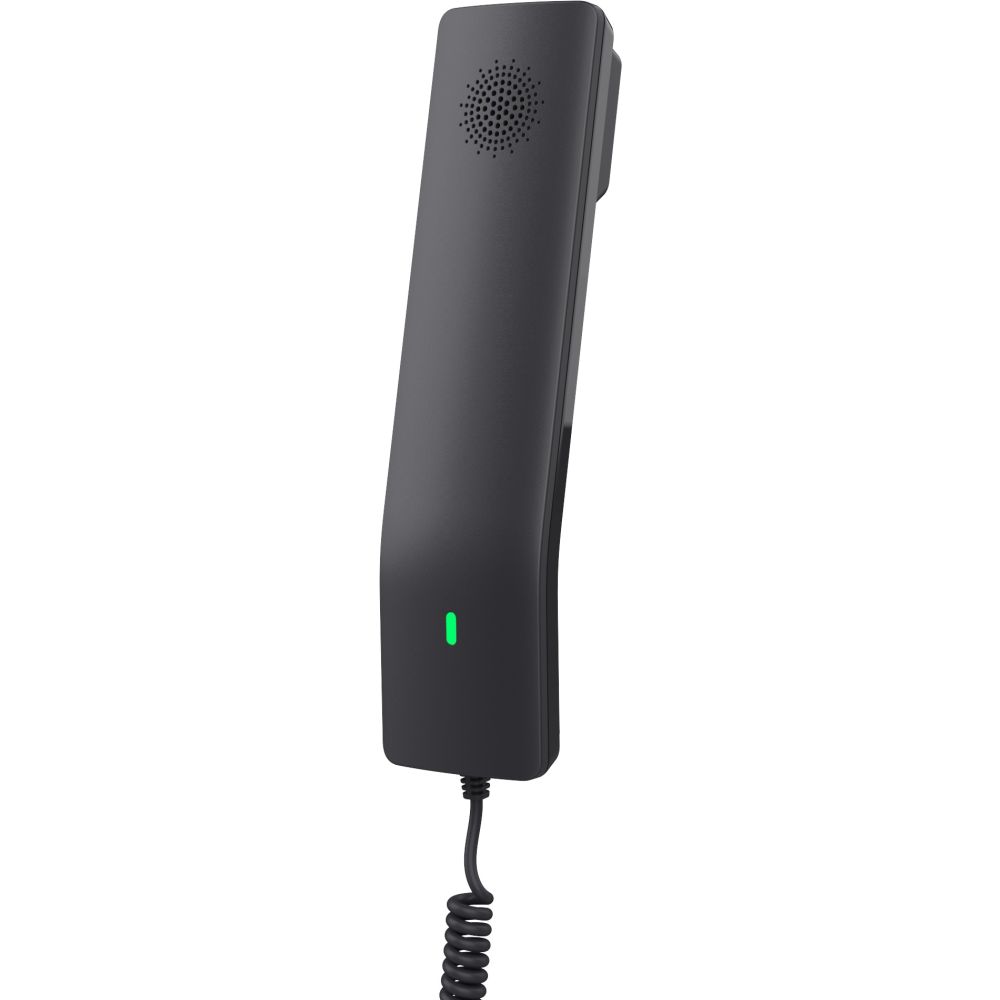
GHP611W, black housing
Compact Wi-Fi SIP hotel phone
Hotels, apartments, hospitals, residences and dormitories
2 SIP accounts, 2 lines, up to 3-way conferencing
Integrated 2.4 GHz and 5 GHz Wi-Fi; revision dependent standard support
Grandstream Device Management System and supported provisioning methods
Universal adapter, 100–240 VAC input and 12 V / 0.5 A output
Desktop or wall-mounted placement
Confirmed during quotation according to country, quantity and supplier status
A Purpose-Built Guest-Room Phone Without Desktop Clutter
Guest-room communication equipment has a different job from a conventional office desk phone. It must be immediately understandable to a visitor, compact enough for a bedside table, simple for housekeeping teams to clean, easy for property staff to label, and manageable across dozens or hundreds of rooms. The Grandstream GHP611W addresses that requirement with a slim handset-led design in which the essential controls are placed directly on the phone rather than around a large display and button panel.
The device supports two SIP accounts and two lines, giving a hospitality property flexibility for room extensions, service routing or secondary call handling according to the IP PBX design. Ten numeric positions can be used for speed-dial configuration, while three programmable keys support property-specific functions. A printed speed-dial label and swappable faceplate allow commonly used services—such as reception, housekeeping, room service, emergency assistance or concierge—to be presented in a format that guests can understand at a glance. The exact button assignments remain part of the PBX and provisioning plan.
Wireless connectivity is a central reason to consider the W variant. Integrated dual-band Wi-Fi can reduce dependence on a dedicated data cable at every bedside or wall position, which may be useful during refurbishment, conversion of older buildings, serviced-apartment projects or deployments where the nearest network outlet is not conveniently located. Wireless deployment still requires proper planning. Signal strength, channel use, security, roaming behaviour, network segmentation and power availability must be reviewed before a large rollout. A phone with Wi-Fi is not a replacement for a stable wireless network; it is an endpoint that depends on that network.
For call clarity, the handset supports wideband audio and a broad set of voice codecs, including full-band Opus on supported systems. Three-way conferencing, redial, transfer, hold, mute, voicemail access and flexible dial plans give the device enough functionality for hospitality and related managed environments without turning the guest interface into a complex office console. Hearing Aid Compatibility supports a more inclusive guest experience, while the antimicrobial casing is arranged for ISO 22196:2011 testing according to the product documentation.
FourTeck helps buyers position this phone within the complete communication environment. That review can include room quantities, Wi-Fi readiness, IP PBX compatibility, SIP account design, faceplate requirements, power-socket availability, wall mounting, VLAN and quality-of-service planning, centralized provisioning and replacement strategy. This approach is valuable for new hotel openings and phased refurbishments because the correct purchase is not simply a box count. It is a coordinated endpoint deployment that must work consistently for guests, front-desk teams, technical staff and property management.
Key Business Benefits
The value of a hospitality telephone is measured by how well it supports the guest journey and how little avoidable effort it creates for the property team. The following benefits connect the device capabilities to practical business outcomes.
◆ Cleaner Guest-Room Layout
A slim handset-based form factor takes less visual space than a conventional office phone. This helps hotels maintain uncluttered bedside tables, compact wall positions and consistent room presentation while preserving direct access to property services.
◆ Flexible Wireless Placement
Dual-band Wi-Fi can support rooms where a dedicated Ethernet outlet is unavailable or inconvenient. It gives refurbishment teams more placement choices, provided the wireless network offers suitable coverage, security and capacity for voice endpoints.
◆ Faster Access to Hotel Services
Programmable and speed-dial keys can direct guests to reception, housekeeping, room service, concierge or emergency assistance with fewer steps. Clear labels reduce uncertainty and can lower the number of incorrectly routed calls.
◆ Centralized Fleet Administration
GDMS support gives administrators a central platform for compatible endpoint provisioning, configuration, monitoring and firmware operations. This is especially useful when a property manages many rooms or when a hospitality group operates several sites.
◆ Consistent Calling Experience
HD handset audio, quality-of-service support and a wide codec set help the phone fit modern SIP deployments. Proper network design remains essential, but the endpoint provides the voice capabilities needed for clear daily communication.
◆ Inclusive and Practical Design
Hearing Aid Compatibility and a straightforward physical interface make the device suitable for a broad range of guests. The handset design avoids forcing visitors to learn a complex screen menu before placing a basic call.
◆ Better Brand and Service Presentation
A swappable faceplate and speed-dial label give the property room to present service names, room information and approved visual elements. This makes the telephone part of the guest communication system rather than an anonymous device.
These advantages are strongest when the purchase is planned as part of a complete voice project. The wireless network must be measured, the IP PBX must support the required SIP behaviour, power outlets must be available, and the property should decide how keys, labels, room numbers and emergency procedures will be standardized. FourTeck can help buyers turn those decisions into a practical bill of materials and deployment brief.
Product Highlights for Hospitality Projects
The GHP611W is deliberately focused. It does not try to reproduce every feature found on a large executive desk phone. Instead, it concentrates on the functions a guest-room or managed-room endpoint is expected to perform reliably: place and receive SIP calls, connect guests to essential services, provide clear audio, support central administration and fit neatly into a compact space.
Two accounts and lines can support flexible room-extension design, service routing or a secondary calling requirement, depending on the PBX configuration.
Three programmable keys and speed-dial positions help properties expose the services guests use most often without navigating a menu.
Supported three-party calls can assist front-desk coordination, interpretation, family communication or service escalation where the PBX permits the call flow.
Integrated 2.4 GHz and 5 GHz Wi-Fi supports flexible placement. Later hardware revisions may support 802.11ax in addition to earlier standards; confirm the supplied revision for a project.
GDMS, TR-069 and encrypted XML provisioning options can simplify deployment when many phones require consistent account, dial-plan and key settings.
Secure boot, unique device certificates, encrypted configuration support, TLS, SRTP and 802.1X are available to support a more disciplined endpoint deployment.
Hardware revision and deployment settings matter. Buyers should not assume that every unit supplied at different times has the same wireless revision or that a generic family specification applies identically to each model. A quotation should identify the exact model, colour, power accessories, intended PBX, wireless requirements and quantity so the project team can validate the proposed supply.
Technical Specifications
| Specification | Grandstream GHP611W Details |
|---|---|
| Brand / Model | Grandstream GHP611W |
| Product Type | Compact black Wi-Fi SIP phone for hotel and managed-room environments |
| SIP Capacity | 2 SIP accounts and 2 lines |
| Wireless Connectivity | Integrated dual-band 2.4 GHz and 5 GHz Wi-Fi; 802.11 a/b/g/n/ac, with 802.11ax support indicated for hardware version 5.0 and above |
| Physical Keys | 23 keys including 3 programmable keys, numeric keypad, 5 function keys and volume / mute controls |
| Speed Dial | 10 configurable numeric speed-dial positions with label and swappable faceplate |
| Audio | HD handset with wideband audio support |
| Voice Codecs | G.729A/B, G.711 μ-law / A-law, G.726, G.722, G.723.1, iLBC and full-band Opus |
| Conferencing | Up to 3-way voice conference |
| Telephony Functions | Dial, answer, transfer, conference, redial, flash, hands-free, voicemail, hold, mute, flexible dial plan, server redundancy and failover call-out support |
| Advanced Functions | Multicast paging, emergency service support where configured, advanced jitter resilience and Grandstream door-opening integration |
| Quality of Service | Layer 2 802.1Q / 802.1p and Layer 3 ToS, DiffServ and MPLS QoS support |
| Security | Secure boot, random default password, unique device certificate, administrator passwords, AES-encrypted configuration, SRTP, TLS and 802.1X |
| Management / Provisioning | GDMS, TR-069, encrypted XML configuration and firmware upgrade through supported FTP, TFTP, HTTP and HTTPS methods |
| Power | Universal power adapter; 100–240 VAC, 50–60 Hz input; 12 V / 0.5 A, 6 W output |
| Mounting | Desktop placement or wall-mountable base |
| Operating Environment | 0°C to 40°C operation; 10% to 90% non-condensing humidity |
| Dimensions | Approximately 211 × 53 × 44 mm with handset |
| Unit Weight | Approximately 350 g for US package variant or 360 g for world variant |
| Package Contents | Phone, corded handset, base, universal power supply and quick installation guide |
| Final Supply Notes | Hardware revision, regulatory package, warranty route and availability are confirmed for the requested destination and quantity |
How to Interpret the Specification Table
A buyer should treat the model number as the start of the selection process, not the complete deployment specification. Wireless capabilities can differ by hardware revision, and the supplied regulatory package may vary by market. The property should also confirm whether the intended SIP platform supports the selected codecs, provisioning method, emergency-call design, paging behaviour and programmable-key functions.
For a multi-room project, request written confirmation of the exact model, colour, included power adapter, hardware revision, quantity, lead time and warranty route. FourTeck can review these details together with the IP PBX and wireless environment so the purchase aligns with the practical installation plan rather than relying on a family-level specification alone.
Configuration and Buyer Guidance
A hospitality phone rollout succeeds when the endpoint, wireless network, call platform and room operating procedures are designed together. Before requesting a quotation, create a short requirement document that explains how the property expects the phone to work. This reduces confusion between purchasing, the installer, the PBX administrator and the hotel operations team.
1. Confirm the Call Platform
Identify the IP PBX, hosted SIP service or property communication platform. Share the model, software version, SIP registration method, codec policy and any hospitality integration requirements. Compatibility is broader than basic registration; key functions, voicemail, emergency routing and room-state workflows may require additional systems.
2. Map the Wireless Environment
Provide access-point models, coverage information, SSID design, security method, VLAN plan and estimated endpoint count. Guest-room walls, bathrooms, lift shafts and service areas can affect signal quality. A coverage survey is preferable to assuming that guest Wi-Fi coverage will automatically deliver stable voice service.
3. Plan Power at Every Position
The Wi-Fi model uses an external power adapter. Check that each bedside, desk or wall position has a suitable electrical outlet and safe cable route. Consider the effect of local power interruptions and whether the property requires centralized backup for essential voice services.
4. Define Keys and Faceplates
List the services guests should reach directly and decide how the labels will appear. Reception, housekeeping, dining, emergency assistance and concierge are common examples, but the final layout must match the property operation. Include language, branding, room number and print approval responsibilities.
5. Choose a Provisioning Method
Small properties may configure a limited quantity directly, while larger projects benefit from templates, encrypted configuration files or centralized management. Decide who owns the administrator credentials, firmware policy, device naming, extension mapping, backup and replacement process.
6. Set a Rollout and Test Plan
A pilot room should test registration, inbound and outbound calls, service keys, voicemail, emergency routing, audio quality, roaming, power recovery and remote management before mass installation. Document the accepted configuration so every room follows the same standard.
Warranty and spare-unit planning are also important. Hotels operate continuously, and a failed room phone should not wait for a long diagnostic process. Consider holding a sensible spare quantity, keeping approved configuration templates and recording the relationship between room number, extension and device identity. FourTeck can help procurement teams convert these operational needs into a quotation request that includes equipment, accessories and relevant guidance.
Ideal Business Use Cases
Although the product is designed around hospitality, its compact physical interface and centrally manageable SIP platform make it relevant to several controlled environments. Suitability still depends on the organisation’s calling workflow, wireless design and regulatory requirements.
Hotels and Resorts
Guest rooms need a simple route to reception, housekeeping, dining and emergency assistance. The compact body keeps furniture clear, while programmable service access and centralized management support consistent deployment across room blocks, villas or multiple buildings.
Serviced Apartments
Apartment operators can provide a dedicated extension for residents or short-stay guests without installing a large business phone. Wireless placement may help in converted properties where network outlets were not originally designed for voice devices.
Hospitals and Clinics
Patient rooms and selected care areas may require simple contact with nursing stations, reception or approved services. Hearing Aid Compatibility, an uncomplicated handset and antimicrobial casing direction can support a practical room communication plan, subject to healthcare policies and cleaning procedures.
Student Residences
Dormitories and managed residences can use compact phones for security, reception, maintenance or emergency calling. Central templates help administrators keep key assignments and extension rules consistent across a large accommodation estate.
Senior Living and Assisted Accommodation
A straightforward physical keypad and clearly labelled service keys can make daily calling easier than a feature-heavy office terminal. The complete solution should still account for accessibility, emergency procedures, backup power and staff response workflows.
Retail and Service Counters
A small counter, stock room or service point may need a basic SIP extension without a large display. Programmable keys can connect staff to a manager, security desk or central reception while preserving workspace.
The device is not a universal replacement for every business phone. Users who require a large directory display, many line appearances, Bluetooth accessories, video, application integration or intensive call handling may need a different Grandstream model. FourTeck can help compare the intended user experience with suitable alternatives before the buyer standardizes a large quantity.
Grandstream GHP611W Dual-Band Wi-Fi Deployment
Wireless connectivity can remove one of the most difficult physical constraints in a room-phone project: the need to place a live network outlet exactly where the handset is intended to sit. In an older hotel, the available data point may be near the television or entrance while the telephone is expected beside the bed. In a serviced apartment, structured cabling may not reach every unit. The GHP611W allows the endpoint to join a supported 2.4 GHz or 5 GHz network, giving the project team more placement flexibility.
That flexibility should not be confused with a zero-planning installation. Voice traffic is sensitive to delay, jitter and packet loss. Thick concrete, metal doors, lift cores, mirrored surfaces, dense room layouts and neighbouring wireless networks can affect coverage. The access-point system must provide enough signal strength and capacity at the exact handset position, not only in the centre of the room. The voice SSID should use appropriate security, segmentation and quality-of-service policies, and the property should test call stability during realistic occupancy.
Hardware revision is another purchasing point. Current product documentation indicates 802.11 a/b/g/n/ac/ax support for hardware version 5.0 and above, while earlier materials reference standards through 802.11ac. Buyers who require a particular wireless capability should request confirmation of the supplied revision rather than assume all units in the market are identical. This is especially important for phased projects where the first and second batches may be purchased months apart.
Finally, Wi-Fi does not remove the need for local power. The W model is supplied with a universal adapter, so each installation point needs an accessible electrical outlet and a safe cable path. For critical communication, the property should decide how room phones, access points, switches, the IP PBX and internet service behave during a power interruption. FourTeck can help review the endpoint requirement alongside wireless coverage and power continuity so the design works as one system.
Grandstream GHP611W Guest-Service Keys and Faceplate
The physical interface is where a hotel telephone becomes part of the guest experience. A visitor may be tired, unfamiliar with the property, unable to use the local language confidently or trying to reach help quickly. The design must therefore make important services obvious. The GHP611W provides programmable keys, numeric speed-dial positions, a label area and a swappable faceplate that can be adapted to the property’s communication plan.
The best key layout is not simply a list of departments. It should reflect the actual operating model. A full-service resort may need reception, room service, housekeeping, concierge and emergency assistance. A clinic may prioritize the nurses’ station, reception and security. A student residence may use security, maintenance and administration. Each key should route to a destination that is staffed and tested, and the label should use clear terms that guests understand. Where several languages are common, the faceplate may need icons or carefully selected bilingual wording.
The PBX configuration must match the printed design. A beautiful label is ineffective when the dial plan sends the call to the wrong queue, requires an extra prefix or reaches an extension outside service hours. During the pilot stage, staff should test every key from a typical room, verify caller identification, check transfer behaviour and confirm what happens when the destination is busy or unanswered. Emergency-related functions require particular care and must follow local requirements and the property’s approved procedures.
Central provisioning can keep key assignments consistent, but the property also needs a change-control process. When a department number changes, the configuration and printed material should be updated together. FourTeck can help buyers define the information required for a faceplate and provisioning brief, while final artwork, language approval and emergency-service policy remain the responsibility of the property and its implementation team.
Grandstream GHP611W Central Management and Security
A single room phone can be configured manually. A property with one hundred rooms, several buildings or multiple branches needs a repeatable management method. Grandstream Device Management System support allows compatible endpoints to be organized, provisioned, monitored and maintained from a central interface. The operational benefit is consistency: account settings, dial plans, key assignments, firmware direction and device naming can follow an approved template rather than depending on individual room-by-room setup.
Central administration also improves troubleshooting. When a room reports that the phone cannot place calls, the technical team can begin by checking registration, configuration and device status before sending staff to the room. This is useful in hotels where guest access must be coordinated with housekeeping or front-desk operations. Management tools do not eliminate physical faults, wireless coverage issues or power problems, but they provide visibility that a disconnected standalone device cannot offer.
The endpoint includes security-oriented capabilities such as secure boot, device-specific certificates, administrator password controls, AES-encrypted configuration files, TLS, SRTP and 802.1X support. These features must be configured as part of the wider security design. Default credentials should be changed, management access should be restricted, voice traffic should be segmented where appropriate, certificates should be handled correctly and firmware changes should follow an approved test process. A feature listed on a datasheet does not protect the network until it is implemented and maintained.
For multi-site hospitality groups, FourTeck recommends defining an endpoint standard that includes naming, room-to-extension mapping, administrator ownership, configuration backup, firmware policy, replacement procedure and decommissioning. A spare phone can then be assigned, provisioned and moved into service without recreating the design from memory. This reduces operational delay and gives procurement teams a clearer basis for planning future quantities.
What Buyers Should Check Before Purchase
Before requesting a quote, buyers should confirm the required usage environment, the exact model variant, wireless readiness, compatibility needs, service-key plan, power arrangement and delivery location. A room phone should not be selected only by model name or an online price. The endpoint must match the property’s communication platform and operating process.
Correct Variant
Confirm GHP611W in black, not the wired GHP611 or white GHP610W. The W identifies the wireless version, while colour and power arrangements differ across the family.
Hardware Revision
Ask whether the offered batch is hardware version 5.0 or above when 802.11ax support is required. Do not assume that all market stock uses the same wireless revision.
PBX Compatibility
Share the IP PBX or hosted platform details. Registration may be straightforward, but key mapping, voicemail, emergency calls, paging and hospitality workflows can require separate configuration or integration.
Wi-Fi Capacity
Provide access-point models, SSID security and room coverage information. A voice endpoint depends on low delay and stable signal at the exact installation point, including during busy occupancy.
Power and Mounting
Check the electrical outlet, adapter plug, furniture route and wall-mount requirement in a sample room. Decide whether local power interruptions require an alternative continuity plan.
Faceplate Preparation
Prepare service names, room number format, language, icons, brand rules and final approval ownership. Printed labels and programmed destinations must be tested together.
Warranty Route
Request written warranty guidance for the destination and source. Clarify the process for a failed unit, required documentation, return location and expected diagnostic steps.
Project Quantity and Spares
Separate installed quantity from project spares, training units and replacement stock. A small spare pool can reduce room downtime when a device is damaged or unavailable.
A useful quote request should state the country and city of delivery, number of rooms, required quantity, target date, PBX platform, access-point environment, preferred hardware revision, faceplate requirement, mounting method and warranty expectation. For a bulk or multi-property order, include a site schedule and whether all locations require the same configuration. FourTeck can then review the requirement, identify missing accessories or services and suggest an alternative model when the proposed phone does not match the user experience.
Africa Availability and Service Support
FourTeck supports hospitality and business communication enquiries across Africa with assistance for product selection, configuration review, quotation preparation, delivery coordination and warranty guidance. Availability can vary according to the exact model, hardware revision, supplier position, required quantity and destination. For this reason, a quotation is prepared after the buyer shares enough information to confirm the correct supply rather than relying on a general availability statement.
The support discussion can cover more than the handset. Buyers may need guidance on Grandstream or third-party IP PBX compatibility, SIP account planning, Wi-Fi readiness, access-point coverage, VLANs, quality of service, power adapters, wall mounting, faceplate preparation, centralized provisioning and spare-unit planning. A new hotel opening may require a structured endpoint schedule, while an existing property may prefer a pilot floor before replacing all room phones.
Delivery coordination depends on the destination, quantity and commercial route. Warranty handling also varies by supply source and region, so buyers should request written guidance with the quote. FourTeck can help the procurement team collect the required technical and logistical details, reducing the risk of ordering the wrong variant or overlooking installation accessories.
Africa Country and Regional Coverage
Businesses across Africa, including Kenya, Uganda, Nigeria, Ghana, Tanzania, Rwanda, Ethiopia, South Africa, Zambia, Botswana, Senegal and nearby commercial markets, can contact FourTeck for product availability, configuration guidance and quote assistance. Support arrangements depend on the destination, project size and selected supply route. Some buyers require a small replacement quantity, while others need a room-by-room rollout across a new hotel, hospital, residence or multi-property group.
For an accurate response, provide the delivery location, quantity, target date, PBX platform, wireless environment and any requirement for custom faceplates or installation support. Multi-country organisations should also share whether they need a common configuration standard across all sites. FourTeck can help organize the enquiry so each location receives appropriate commercial and technical guidance without assuming that availability, warranty handling or delivery conditions are identical in every market.
GCC, Middle East and Africa Availability
FourTeck Africa supports product enquiries for organisations operating within African markets and can also guide wider regional technology discussions through selected FourTeck platforms serving GCC and Middle East requirements. A hospitality group with properties in the UAE, Saudi Arabia, Qatar, Oman, Bahrain and African countries may want consistent room-phone models, button assignments, extension rules, device naming and management procedures across its estate.
Standardization can simplify training and support, but the commercial and technical conditions still need to be checked per country. Power plugs, regulatory packages, wireless standards, warranty routes, delivery methods, local PBX services and installation resources may differ. A regional project should therefore use a common design document while allowing location-specific confirmation before orders are released.
Procurement teams can share a branch list, room quantity, proposed model, desired hardware revision, target schedule and responsible local contact for each property. FourTeck can help structure the enquiry and direct the buyer toward the most relevant regional conversation. Availability and delivery remain subject to confirmation based on model, quantity, supplier status and destination.
Other Options Buyers May Consider
The right endpoint depends on colour, wired or wireless connectivity, screen preference, key requirements and the wider telephone system. The following options help buyers frame a comparison. Final specifications and availability should be confirmed for the requested destination.
Grandstream GHP610W
A white wireless model for properties that prefer a lighter room design while retaining a compact hospitality-focused interface.
Grandstream GHP611
A black wired counterpart for sites that prefer structured Ethernet and supported PoE deployment rather than room-level Wi-Fi.
Grandstream GHP621W
A related wireless hospitality option for buyers comparing form factor, key layout and project requirements within the GHP family.
Grandstream GHP631W
A colour-screen wireless hotel phone for properties that need a more visual guest interface and additional context-sensitive controls.
Grandstream UCM IP PBX
Suitable for buyers planning an on-premise Grandstream communication platform with extension control, routing and centralized administration.
Grandstream Network Infrastructure
Managed switches and wireless infrastructure may be part of the same hospitality voice project where VLANs, coverage and device administration require coordinated planning.
A buyer should compare these options by deployment method rather than assuming a higher model number is automatically the best fit. Wired rooms may benefit from centralized network power, while wireless rooms gain placement flexibility but require local power and carefully designed coverage. A screen can improve visual guidance but may add cost and complexity where guests only need direct service keys. FourTeck can help align the endpoint with the room design, user profile, call platform and project budget.
Why Buyers Choose FourTeck
Hospitality technology purchasing involves more than identifying a model number. The same endpoint can deliver a very different result depending on the PBX, wireless network, provisioning process, room layout, power condition and operational support plan. FourTeck works with buyers to clarify those dependencies before the order is finalized.
Assistance begins with the intended use, quantity and environment so the proposed device is relevant to the project rather than chosen only from a catalogue.
FourTeck can help identify the information needed for SIP accounts, keys, provisioning, Wi-Fi, power and compatibility review.
A structured quotation can account for model variant, quantity, destination, hardware revision, accessories and project timing.
Delivery possibilities are reviewed against country, location, quantity and available supply routes instead of making a general stock promise.
Buyers can request written information on the applicable warranty route, documentation and handling process for the proposed supply.
When a room requires a screen, wired power, more keys or another colour, FourTeck can discuss a suitable alternative instead of forcing the wrong model.
This support is useful to hotel owners, project consultants, system integrators, resellers, healthcare administrators, residence operators and procurement teams. Some customers need a single replacement device; others need hundreds of identically configured endpoints across several sites. In both cases, clear requirements improve the quality of the quotation and reduce avoidable changes after delivery.
Frequently Asked Questions
What is the GHP611W used for?
It is a compact SIP phone designed mainly for hotel rooms and similar managed accommodation spaces. It gives guests simple calling access through a handset, programmable service keys and speed-dial positions. The phone can also suit hospitals, serviced apartments, residences, dormitories and selected retail or service areas where a small, centrally manageable voice endpoint is more useful than a feature-heavy office phone.
Does the phone support Wi-Fi?
Yes. The W model includes integrated dual-band 2.4 GHz and 5 GHz wireless connectivity. Current documentation indicates standards through 802.11ax for hardware version 5.0 and above, while earlier hardware may support standards through 802.11ac. Buyers requiring a specific revision should ask for confirmation in the quotation and should validate room-level coverage before a large deployment.
How is the Wi-Fi model powered?
The GHP611W uses a universal power adapter with 100–240 VAC input and 12 V / 0.5 A output. Each planned installation position therefore needs a suitable electrical outlet and safe cable route. Buyers should not assume that wireless connectivity means the phone requires no local power. The property should also consider how phones and access points behave during power interruptions.
Can FourTeck help with configuration?
FourTeck can help buyers identify the configuration information required for SIP accounts, programmable keys, speed-dial destinations, wireless access, quality of service, centralized provisioning and device naming. The exact implementation scope depends on the PBX, network, project location and agreed services. Buyers should share their call platform and room schedule so the proposed support can be defined accurately.
Is the product available across Africa?
FourTeck accepts product enquiries from businesses across Africa. Final availability depends on the exact model, hardware revision, required quantity, supplier status and delivery destination. The most useful request includes country, city, quantity, target date and any technical or faceplate requirements. FourTeck can then review the supply route, quotation and warranty guidance for that specific enquiry.
Can the faceplate and service labels be customized?
The phone supports a speed-dial label and swappable faceplate intended for property-specific presentation. Buyers should prepare service names, language, room number format, icons and brand requirements before production. The printed layout must match the programmed destinations, and every key should be tested during a pilot. Customization availability, artwork requirements and minimum quantities should be confirmed during the quotation process.
Does it work with every IP PBX?
The device uses standard SIP protocols, but buyers should not assume every function behaves identically on every platform. Basic registration may work while voicemail, key events, emergency routing, paging, failover or hospitality integrations require specific configuration. Share the PBX model, software version and service provider details so compatibility can be reviewed against the intended call flow.
What warranty guidance is available?
Warranty handling depends on the supply source, destination and commercial terms. Buyers should request written guidance identifying the applicable warranty period, return process, required serial-number or invoice records and the location responsible for evaluation. For large properties, it is also sensible to hold a small spare pool so a room remains operational while a failed unit is inspected.
Can businesses request bulk or project supply?
Yes. Hotels, hospitals, residences, system integrators and procurement teams can request quantity-based project quotations. Provide the installed quantity, spare quantity, delivery schedule, number of sites, hardware-revision preference, faceplate requirement and target commissioning date. A phased project may benefit from a pilot batch before the remaining units are released, especially where wireless coverage and PBX integration still need validation.
How do I choose between GHP611W and another GHP model?
Choose by colour, wired or wireless connection, local power availability, screen requirement, key layout and guest experience. The GHP611W is black and wireless. A wired model may suit rooms with Ethernet and centralized network power, while a colour-screen model may be preferable when the property wants more visual guidance. FourTeck can help compare these factors before a bulk order.
Need Help Planning Your Hotel Phone Deployment?
Share your country, property type, room quantity, IP PBX, wireless environment, target date and faceplate requirements. FourTeck can help review the model, prepare a suitable quotation and guide delivery and warranty questions for your business location.
Reviews
There are no reviews yet.