

Quick Product Information
Grandstream
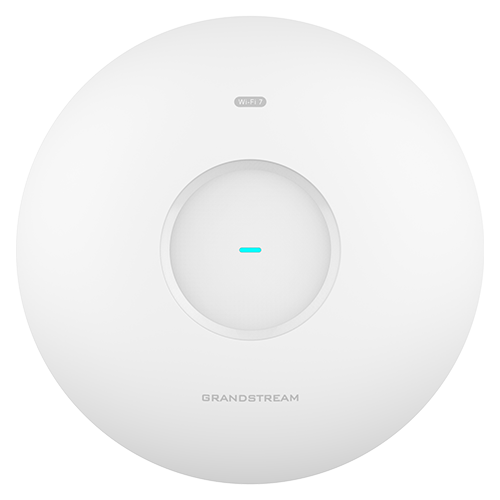
GWN7672
Indoor tri-band Wi-Fi 7 access point
High-capacity business wireless access
IEEE 802.11be with legacy client support
Embedded, GDMS Networking, or GWN Manager
Indoor ceiling or wall mounting kits included
Quantity, destination, and supplier dependent
Product Overview
Business wireless networks now carry far more than ordinary web browsing. Employees join video meetings, use cloud finance systems, upload large design files, make voice calls, access shared applications, and move between rooms with several connected devices. Guests expect a simple connection, while scanners, tablets, printers, phones, displays, cameras, and operational equipment may also depend on the same wireless environment. A basic access point can become congested when all of these demands arrive together, especially in meeting rooms, classrooms, hospitality spaces, event areas, open offices, and other busy indoor locations.
The Grandstream GWN7672 addresses this challenge as an enterprise-grade tri-band access point built around the Wi-Fi 7 standard. It operates across 2.4 GHz, 5 GHz, and 6 GHz bands where the selected regulatory domain permits 6 GHz use. Each radio uses a 2×2:2 design, allowing the platform to serve a broad mix of current and legacy devices while creating a path for newer Wi-Fi 7 clients. Published aggregate wireless throughput reaches approximately 11 Gbps, with individual maximum data rates of up to 688 Mbps on 2.4 GHz, 4,320 Mbps on 5 GHz, and 5,765 Mbps on 6 GHz. These figures describe theoretical radio capability; real application performance depends on client hardware, channel plan, interference, distance, walls, cabling, switching, internet bandwidth, and active traffic.
The access point also provides two 5 Gigabit Ethernet interfaces, giving network designers a faster wired path than a conventional single-gigabit uplink. This is important because a high-capacity wireless platform can be restricted by an undersized switch port or poor cabling. PoE+ support simplifies installation by carrying power through the network cable from a compatible switch or injector. The ceiling- or wall-mounted form factor helps place the radio where coverage is more predictable rather than leaving the device on furniture or inside a cabinet.
For operations, Grandstream provides several management paths. A built-in controller can manage up to 50 local GWN access points, which is useful for many single-site deployments. GDMS Networking offers cloud-based control for distributed environments, while GWN Manager provides an on-premises software option for larger installations. This flexibility allows an organisation to choose local independence, cloud convenience, or dedicated on-site management according to policy and scale.
For Africa buyers, the best result comes from treating the access point as one part of a complete WLAN design. FourTeck can help review expected users, room layout, PoE budget, multi-gigabit switching, cable quality, management preference, security segmentation, regional radio rules, accessories, quantity, and delivery requirements. The objective is not simply to order the right model name; it is to create a reliable wireless service that fits the building, applications, and long-term operating plan.
Key Business Benefits
A professional access point should be evaluated by the business outcomes it supports, not only by its headline speed. The following benefits explain how the platform can improve user experience, network operations, and long-term infrastructure planning when it is deployed with suitable switching, cabling, security, and coverage design.
◆ Capacity for Busy Spaces
Support for up to 384 concurrent clients gives network planners room for dense device populations in offices, education facilities, hotels, conference areas, and public-facing indoor environments. Actual service quality still depends on traffic patterns and radio design, but the capacity target makes the unit suitable for demanding zones where a small-business access point could be overwhelmed.
✓ More Efficient Spectrum Use
Wi-Fi 7 functions such as Multi-Link Operation, Multi-Resource Units, 4KQAM, and preamble puncturing are designed to use available spectrum more intelligently. Compatible clients can gain improved throughput, responsiveness, or resilience, while the network can continue serving earlier Wi-Fi generations during a gradual device refresh.
↗ Multi-Gigabit Wired Readiness
Two 5 GbE interfaces help prevent the wired backhaul from becoming an immediate bottleneck. This matters when several fast wireless clients are active at once or when the access point serves high-bandwidth local applications. Buyers should pair it with suitable multi-gigabit switch ports and verified cabling to realise this benefit.
⚙ Flexible Management Choices
The embedded controller, cloud management, and on-premises software options let an organisation choose a control model that matches its policies and scale. A single office can manage locally, a distributed group can centralise visibility, and a larger institution can retain management within its own infrastructure.
🔒 Stronger Device Protection
Secure boot, signed protection for critical data and control, unique device certificates, random default passwords, and WPA3 support help create a stronger foundation than consumer-grade wireless equipment. Security policies, firmware care, authentication, VLANs, and firewall rules remain essential parts of the finished design.
● Better Real-Time Application Handling
Advanced quality-of-service functions can prioritise sensitive traffic such as voice, collaboration, and interactive applications. This helps reduce the effect of large background transfers on time-critical communications, provided that the switching, firewall, and internet path use a coordinated traffic policy.
✓ Practical Growth Path
A Wi-Fi 7 platform can support current devices while preparing the access layer for newer laptops, phones, and specialised endpoints. This can reduce the pressure to replace the WLAN again soon after a client refresh, particularly when the wired network, power budget, management platform, and security design are planned at the same time.
Product Highlights
The GWN7672 brings together several features that matter in a modern enterprise WLAN. The tri-band radio design spreads compatible devices across 2.4 GHz, 5 GHz, and 6 GHz spectrum, giving planners more flexibility than a conventional dual-band access point. The 6 GHz band can provide additional clean spectrum and wider channels for supported devices where local regulations permit its use, while 2.4 GHz and 5 GHz continue to serve established equipment.
Up to approximately 11 Gbps aggregate wireless data rate across the three radios.
Consistent two-stream radio design across 2.4 GHz, 5 GHz, and 6 GHz.
Up to 16 service profiles per radio for structured user and device separation.
Powered through compatible 802.3at infrastructure after switch-budget confirmation.
Adds Bluetooth Low Energy capability for supported setup and location-aware uses.
Supports flexible wireless extension and controlled guest onboarding where properly designed.
The published coverage figure is up to 175 metres, but it should not be used as a guaranteed building radius. Walls, doors, lift shafts, glass, shelving, ceiling height, interference, power limits, client transmit capability, and installation position all change the result. A professional deployment uses floor plans, site measurements, and capacity targets to determine access-point quantity and placement. The value of this product comes from combining capable hardware with disciplined design rather than relying on a single range number.
Technical Specifications
| Specification Area | GWN7672 Details | Buyer Note |
|---|---|---|
| Wireless Standard | IEEE 802.11 a/b/g/n/ac/ax/be | Client capability determines the standard and rate used. |
| Radio Design | Tri-band 2×2:2 MIMO on 2.4, 5, and 6 GHz | 6 GHz operation depends on regional rules and client support. |
| Aggregate Wireless Rate | Up to approximately 11 Gbps, BE11000 class | Theoretical aggregate figure, not guaranteed application throughput. |
| Band Data Rates | Up to 688 Mbps at 2.4 GHz, 4,320 Mbps at 5 GHz, and 5,765 Mbps at 6 GHz | Results vary with channel width, client, interference, and environment. |
| Channel Width | 20/40 MHz at 2.4 GHz; up to 240 MHz at 5 GHz; up to 320 MHz at 6 GHz | Available widths depend on region, channel plan, and client support. |
| Concurrent Clients | Up to 384 | Design by active usage and application demand, not connection count alone. |
| Coverage Range | Up to 175 metres | Environment dependent; use a survey for real placement. |
| Network Interfaces | 2 x 5 GbE RJ45 | Confirm switch-port speed, link design, and cable quality. |
| SSIDs | 48 total, up to 16 per radio | Use only the profiles required to limit management and airtime overhead. |
| Security | WPA/WPA2 personal and enterprise, WPA3, unique certificate, random default password, secure boot, signed critical-data protection | Final security depends on authentication, VLAN, firewall, and update policy. |
| Network Features | IPv4, IPv6, 802.1Q, 802.1p, 802.1x, WMM, VLAN, TOS | Coordinate with switch and firewall policies. |
| Wi-Fi 7 Functions | MLO, 4KQAM, MRU, preamble puncturing, enhanced OFDMA | Benefits require compatible clients and correct radio design. |
| Bluetooth | Bluetooth Low Energy 5.3 | Feature use depends on supported applications and configuration. |
| Management | Embedded controller for up to 50 local GWN APs; GDMS Networking cloud; GWN Manager on-premises for up to 3,000 APs | Select the platform by site count, policy, staffing, and hosting preference. |
| Power | 802.3at PoE+; maximum consumption 25 W | Confirm per-port standard and total switch power budget. |
| Operating Environment | 0°C to 45°C; 10% to 90% non-condensing humidity | Indoor deployment only; avoid heat and moisture outside limits. |
| Dimensions and Weight | Approximately 220 mm diameter x 54 mm; 838.4 g | Allow room for bracket, cable bend, and maintenance access. |
| Package Contents | Access point, mounting kits, quick-start guide | Confirm PoE switch or injector separately; no adapter should be assumed. |
How to Read the Specifications
Published radio rates describe the maximum link capability under defined technical conditions. They should not be treated as guaranteed internet speed for every user. A Wi-Fi client may support fewer spatial streams, an earlier standard, or narrower channels. The building may introduce attenuation and interference. The switch, firewall, WAN connection, server, or cloud service may also set a lower practical limit. Buyers should therefore size the project around applications, peak activity, user density, coverage zones, and required service quality. FourTeck can help translate the table into a suitable access-point count, switch requirement, cabling plan, and management choice.
Configuration and Buyer Guidance
The correct wireless purchase begins with the environment, not the model number. Before requesting a quote, identify the areas that need coverage, the number of people who use each area, the devices they carry, and the applications that matter during the busiest period. A reception area with occasional guests has a different profile from a training room filled with laptops, a hotel conference hall, a clinic using mobile records, or an office floor running constant video collaboration.
How Many Active Devices?
Count peak simultaneous connections, not only employees. Include personal phones, laptops, visitors, printers, tablets, scanners, voice devices, displays, and operational equipment.
What Applications Matter?
Identify video meetings, cloud systems, voice, file transfers, streaming, point-of-sale, education tools, or latency-sensitive services so the network can be designed around real demand.
Is the Wired Network Ready?
Confirm multi-gigabit switch ports, 802.3at PoE+, total power budget, suitable copper cabling, firewall capacity, VLAN design, and internet bandwidth.
Which Management Model?
Choose between the built-in controller, cloud management, or on-premises software based on site count, administrator location, data policy, and operational preference.
What Must Be Separated?
Define staff, guest, contractor, voice, payment, IoT, and operational networks so SSIDs, VLANs, authentication, and firewall rules are planned together.
What Growth Is Expected?
Consider new floors, more users, client refreshes, branch expansion, additional cloud services, and future Wi-Fi 7 adoption before fixing quantities and switch capacity.
The floor plan is equally important. Wall material, ceiling height, corridors, lift shafts, glass partitions, metal shelving, kitchens, plant rooms, and neighbouring wireless networks can all affect coverage. A range figure from a data sheet cannot replace a site-specific design. For larger or critical deployments, a predictive plan and on-site validation can reveal where additional access points, lower transmit power, different channels, or revised mounting positions are needed.
A useful quote request should include the installation country, building type, floor plan, expected peak clients per area, important applications, current firewall and switch models, cable category, PoE availability, required SSIDs, management preference, quantity, project schedule, and whether installation support is needed. FourTeck can use this information to identify missing accessories, unsuitable assumptions, and alternative models before procurement approval.
Ideal Business Use Cases
This access point is designed for professional indoor environments where device density, application responsiveness, central management, and long-term scalability matter. The examples below show practical deployment contexts, but each project should still be checked against building layout, user behaviour, and the surrounding network.
Corporate Offices
Support cloud applications, mobile employees, meeting rooms, voice, video collaboration, visitors, and shared devices across open-plan or multi-room workplaces. Central policy can keep staff, guest, and operational traffic separate while users move between work areas.
Education and Training
Classrooms, labs, libraries, lecture spaces, and administration areas may experience sharp peaks when many learners connect at once. A planned tri-band WLAN can distribute compatible devices, support digital content, and maintain separate access policies for learners, staff, guests, and institutional equipment.
Hotels and Hospitality
Guest rooms, lobbies, meeting halls, restaurants, staff areas, and event spaces create varied coverage and capacity needs. Captive portal options, central management, and strong radio capability can support a structured guest service while business systems remain segmented.
Healthcare Facilities
Clinics and healthcare environments can use managed wireless for staff tablets, mobile records, administration, voice, waiting-area access, and connected equipment. Reliability, authentication, roaming, documentation, and network separation should be planned carefully around clinical and operational workflows.
Retail and Commercial Sites
Retailers can connect staff tablets, stock tools, customer Wi-Fi, handheld terminals, digital displays, and office systems. VLANs and firewall policy can keep guest traffic away from payment and management networks while central control supports consistent branch settings.
Conference and Event Venues
Large indoor gatherings can create sudden client density and heavy demand for presentations, streaming, messaging, and collaboration. The access-point count, channel plan, uplink capacity, and internet service must be designed for peak attendance rather than normal daily use.
Indoor Logistics and Warehouses
Scanners, tablets, voice devices, and mobile workstations can depend on continuous service along aisles and work zones. Metal racks, stock movement, ceiling height, and roaming paths make survey-led placement especially important in these environments.
Multi-Branch Organisations
Cloud or centrally hosted management can help standardise SSIDs, firmware, security settings, and monitoring across distributed sites. A common design reduces branch-by-branch variation while allowing local differences in floor plan, user density, internet links, and regulatory requirements.
Grandstream GWN7672 Tri-Band Wi-Fi 7 Performance
The most important performance feature is the combination of three service bands with Wi-Fi 7 radio techniques. The 2.4 GHz band remains valuable for older clients, many small connected devices, and areas where reach is more important than top speed. The 5 GHz band continues to carry most modern business laptops, phones, and tablets. The 6 GHz band adds new spectrum for compatible Wi-Fi 6E and Wi-Fi 7 clients where local rules permit operation. This separation gives network designers more room to distribute clients and reduce competition for airtime.
Multi-Link Operation can allow compatible Wi-Fi 7 devices to use more than one link, improving throughput, responsiveness, or resilience depending on the client and configuration. Multi-Resource Units enable more flexible resource allocation, while preamble puncturing can preserve usable portions of a wide channel when part of the spectrum is affected by interference. 4096-QAM carries more data per symbol under strong signal conditions. These technologies are useful, but they work best at suitable signal levels with modern clients and a clean channel plan.
A common buying mistake is to assume that every connected device will receive the headline aggregate rate. In practice, the 11 Gbps figure is the total theoretical capability across all radios. Individual clients negotiate a rate based on their own radio, spatial streams, channel width, distance, and signal quality. Application throughput is lower because of protocol overhead and shared airtime. A device behind several walls may use a much slower modulation than a laptop positioned near the access point.
For the business, the benefit is not simply one extremely fast user. The larger value is the ability to serve a mixed population more efficiently while preparing for newer endpoints. FourTeck can help determine whether the project needs wide coverage, high density, low latency, or a balanced combination. That decision influences access-point quantity, channel width, transmit power, mounting location, and switch design.
Grandstream GWN7672 Security and Network Control
Wireless security starts with the device, but it does not end there. The platform includes anti-hacking secure boot, unique security certificates, random default passwords, and digital-signature protection for critical data and control. WPA3 is supported for modern wireless authentication, while enterprise authentication options can work with a suitable identity and network design. These features create a stronger foundation than a shared consumer password applied to every user.
A professional WLAN should separate users and devices according to their business role. Employees may need access to internal applications, guests may need internet-only service, voice devices may require prioritised traffic, and operational equipment may need access only to specific servers. The unit supports multiple SSIDs, VLAN-related functions, 802.1X, and quality-of-service controls, allowing the wireless design to align with switching and firewall policies. The published maximum of 48 SSIDs offers flexibility, but using too many service profiles can increase management effort and consume airtime. A smaller, well-defined set is usually easier to operate.
Captive portal support can help with visitor onboarding in hospitality, education, events, reception areas, and public-facing business locations. The portal experience, data-handling policy, user terms, and internet restrictions should be defined before deployment. Mesh capability can extend wireless connectivity where cabling is difficult, but a wired uplink remains preferable for primary access points when performance and stability are priorities.
The final security level depends on continuous operational care. Administrators should maintain firmware, remove unused accounts, use strong administrator authentication, review logs, control management access, protect the management platform, document VLANs, and test guest isolation. FourTeck can help buyers identify the required network components and configuration questions so the access point is purchased as part of a secure design rather than installed as an isolated device.
Grandstream GWN7672 Management, PoE, and Deployment
Management flexibility is valuable because organisations differ in size, policy, and administrator location. The embedded controller can manage up to 50 local GWN access points without a separate hardware controller. This suits many single-building or campus deployments where the IT team wants local control. GDMS Networking provides a cloud path for central visibility across sites, while GWN Manager offers an on-premises software controller for environments that prefer to host management internally. The selected platform should be documented before rollout so provisioning, firmware, backups, administrator access, and fault handling follow one consistent process.
Power and cabling are equally important. The unit uses 802.3at PoE+ and can consume up to 25 watts. A switch may advertise many PoE ports but still lack enough total power to run every access point, phone, camera, and connected device at the same time. The project team should verify both the per-port standard and the entire switch power budget. Capacity should also be left for future devices and normal operating variation.
The two 5 GbE interfaces create an opportunity for multi-gigabit backhaul, but the rest of the path must support it. The switch needs suitable ports, the copper cable must be correctly installed and terminated, and any aggregation or firewall path must handle the expected traffic. Existing cabling should be tested rather than assumed to support higher speeds. Cable length, category, patch leads, connectors, and electromagnetic conditions can affect link negotiation and stability.
Mounting location shapes the user experience. Ceiling placement often provides more even coverage than a wall or desk, but every building is different. Avoid enclosed cabinets, large metal obstructions, heat sources, and positions where the access point is hidden behind dense construction. The included mounting kits support indoor wall or ceiling installation. FourTeck can help the buyer prepare a complete bill of materials that includes PoE switching or injectors, suitable cabling, mounting requirements, management choice, and deployment support.
What Buyers Should Check Before Purchase
Before requesting a quote, buyers should confirm the required configuration, usage environment, compatibility needs, warranty expectations, delivery location, and installation responsibility. This prevents a decision based only on the model name or published speed and helps ensure that the wireless project includes the switching, power, cabling, security, and management components needed for reliable service.
Configuration Fit
Confirm whether the project needs tri-band service, 6 GHz operation, high-density capacity, voice prioritisation, guest access, mesh, captive portal, or multi-site management. These requirements influence whether the model is the right choice and how many units are needed.
Compatibility Check
Review switch-port speed, 802.3at support, total PoE budget, cable condition, firewall capacity, VLAN plan, authentication services, management platform, and client-device support. A capable access point cannot correct an undersized or unstable wired network.
Regional Radio Rules
The 6 GHz band and maximum transmit settings are not identical in every regulatory domain. Provide the final installation country and confirm the appropriate regional model before ordering, especially for cross-border projects.
Coverage and Quantity
Do not calculate quantity from the maximum range alone. Share floor plans, wall materials, ceiling heights, high-density rooms, roaming paths, and expected traffic. Coverage and capacity may require different access-point spacing.
Accessories and Installation
Confirm whether the quote includes only the access point or also PoE switches, injectors, cabling, patching, brackets, survey, installation, configuration, testing, and documentation. The package includes mounting kits but a power adapter should not be assumed.
Warranty and Support
Ask how warranty handling, replacement procedures, firmware support, and technical escalation will be coordinated for the destination. The commercial response should describe the applicable route rather than relying on a general brand statement.
Long-Term Operating Cost
Consider switching upgrades, cabling, installation, surveys, support time, administrator training, power, replacement planning, and management operations. The access-point purchase price is only one part of the WLAN lifecycle.
Quote Preparation
Provide quantity, destination, floor plan, user count, critical applications, current network equipment, management preference, installation scope, and timeline. This information helps FourTeck prepare a clearer bill of materials and suitable alternatives.
Buyers should also ask how the GWN7672 differs from nearby models. A smaller dual-band option may be sufficient for modest sites, while a higher-radio-count model may suit extremely demanding areas. An older Wi-Fi 6 or Wi-Fi 6E access point may be appropriate when client compatibility, budget, or an installed standard matters more than adopting Wi-Fi 7 immediately. FourTeck can help compare the practical differences without assuming that the newest or fastest model is automatically correct for every building.
Africa Availability and Service Support
FourTeck supports product enquiries across Africa with assistance for product selection, configuration review, quote preparation, delivery coordination, and warranty guidance. Availability may vary by supplier status, quantity, selected regional model, project schedule, destination, and the current regulatory position of the 6 GHz band. A quotation is therefore prepared after the business requirement and delivery details are reviewed.
For a single-site requirement, buyers can share the floor plan, expected users, existing switch, cable type, firewall, internet capacity, and preferred management method. For a multi-site project, it is also useful to provide a branch list, standard SSID design, user groups, support model, rollout phases, and the person responsible for central administration. This helps create a consistent bill of materials while allowing local differences in building layout and regulatory requirements.
FourTeck can also help review alternatives when the requested model, quantity, or regional version is not immediately suitable. The objective is to keep the project moving without substituting a product blindly. Any alternative should be checked for radio design, client capacity, uplink speed, PoE demand, management compatibility, security features, mounting, and lifecycle expectations.
Africa Country and Regional Coverage
Businesses across Africa, including Kenya, Uganda, Nigeria, Ghana, Tanzania, Rwanda, Ethiopia, South Africa, Zambia, Botswana, Senegal, and nearby regional markets can contact FourTeck for wireless product availability, configuration guidance, quotation support, delivery coordination, and project-supply discussions. The installation country should be provided early because wireless regulations, import arrangements, regional model codes, delivery routes, and warranty handling can differ.
FourTeck can assist corporate offices, education groups, hotels, healthcare organisations, retailers, logistics operations, system integrators, resellers, and multi-branch enterprises. Buyers can use the FourTeck Kenya platform or the FourTeck Uganda platform for relevant regional contact routes while keeping the technical requirement, model comparison, and rollout standard consistent.
GCC, Middle East and Africa Availability
FourTeck Africa can support product enquiries for organisations operating across Africa while also guiding coordinated requirements linked to GCC and Middle East procurement. Regional groups may manage purchasing from the UAE, Saudi Arabia, Qatar, Oman, or Bahrain while deploying wireless infrastructure in African offices, hotels, schools, healthcare sites, warehouses, and commercial branches. The final installation location must remain clear because radio regulations, regional hardware codes, power accessories, import routes, and support arrangements may differ.
Cross-border projects benefit from a common technical standard. The customer should define the preferred management platform, SSID structure, authentication method, VLAN mapping, switching requirement, firmware process, and support workflow. FourTeck can help prepare a coordinated bill of materials while identifying country-specific differences that require a separate model code, revised channel plan, or alternative product.
Availability, warranty handling, delivery coordination, and final commercial terms depend on supplier status, quantity, configuration, and destination. Businesses with Gulf-linked procurement requirements can review FourTeck UAE together with the Africa contact route for a coordinated discussion.
Other Options Buyers May Consider
The correct alternative depends on coverage, client density, radio bands, management preference, security architecture, budget, and the surrounding network. The options below provide useful comparison paths without assuming that one model suits every site.
Grandstream GWN7670
Consider for a dual-band Wi-Fi 7 deployment where the 6 GHz radio and the full GWN7672 capacity are not required.
Grandstream GWN7674
A higher-capacity tri-band Wi-Fi 7 option for especially demanding enterprise areas that need more radio capability.
FortiAP FAP-231G
Useful where a Wi-Fi 6E access point must align closely with a Fortinet-managed security and switching environment.
FortiAP FAP-231F
A Wi-Fi 6 enterprise alternative for buyers standardising on Fortinet infrastructure without a current need for 6 GHz.
FortiAP FAP-223E
May suit installed-base replacement or smaller managed wireless requirements where continuity matters more than adopting the newest radio generation.
Complete Wi-Fi Project Support
Review switching, cabling, firewall, survey, installation, and support services when the requirement extends beyond access-point supply.
Why Buyers Choose FourTeck
Wireless procurement involves more than choosing an access point. The IT team needs technical fit, procurement needs a complete commercial response, finance needs cost clarity, installers need a workable bill of materials, and management needs confidence that the service will support daily operations. FourTeck helps connect these requirements so buyers can move from a model enquiry to a practical deployment discussion.
Guidance on model, quantity, regional suitability, supplier status, and alternatives.
Review of radios, management, SSIDs, VLANs, PoE, switching, and client needs.
Commercial preparation around the required hardware, accessories, and project scope.
Regional enquiry handling based on destination, quantity, timing, and supply conditions.
Help confirming the applicable support path and expectations before purchase.
Guidance on switches, firewalls, injectors, cabling, alternate access points, and services.
FourTeck can help identify common gaps such as an insufficient PoE budget, a single-gigabit bottleneck, poor cable quality, an unsuitable regional model, missing mounting details, unclear management responsibility, or an unrealistic access-point count. Detecting these issues before ordering saves time and reduces the risk of receiving hardware that cannot deliver the expected result.
Support is available for small offices, multi-floor buildings, education facilities, hospitality groups, healthcare organisations, retail projects, system integrators, resellers, and enterprises with multiple sites. The discussion can begin with a specific model or with a business problem such as weak coverage, congestion, poor roaming, guest access, or an upcoming client refresh.
Frequently Asked Questions
What is the GWN7672 used for?
It is an indoor enterprise Wi-Fi 7 access point for environments that need high wireless capacity, modern client support, central management, guest access, security controls, and multi-gigabit wired connectivity. Typical uses include offices, hotels, education facilities, healthcare sites, event venues, retail locations, and other busy indoor spaces.
Does it support 2.4 GHz, 5 GHz, and 6 GHz?
Yes. The access point uses a tri-band design with 2×2:2 MIMO on all three bands. The 6 GHz band is available only where local regulations and the selected regional model permit it, and clients must also support 6 GHz to connect on that band.
How many devices can connect?
The published maximum is up to 384 concurrent Wi-Fi clients. This figure does not guarantee equal speed for every device. Practical capacity depends on applications, airtime demand, signal quality, client capability, channel design, interference, uplink capacity, and the number and placement of access points.
Can FourTeck help determine how many units are required?
Yes. Share the floor plan, wall materials, ceiling height, expected users, important applications, high-density rooms, and roaming areas. FourTeck can help review the requirement and identify whether the design should prioritise coverage, capacity, or both before a quotation is prepared.
Does the access point require a controller?
A separate hardware controller is not required for many deployments. The built-in controller can manage up to 50 local GWN access points. Buyers can also use GDMS Networking for cloud management or GWN Manager for an on-premises software approach, depending on scale and policy.
What switch and power are needed?
The unit supports 802.3at PoE+ and has a maximum power consumption of 25 watts. A compatible switch or injector must provide the required standard. For best wired performance, review multi-gigabit switch ports and suitable cabling rather than connecting the access point to an older one-gigabit path by default.
Is the published 175-metre range guaranteed?
No. The figure is an upper reference under suitable conditions. Real range changes with walls, doors, glass, metal, interference, mounting position, transmit limits, and client radios. A site plan or survey should determine actual placement, particularly for multi-room, multi-floor, warehouse, or high-density projects.
Is it available for business buyers in Africa?
FourTeck accepts enquiries across Africa and can assist with availability checks, model suitability, quotation, delivery coordination, and warranty guidance. Final availability depends on supplier status, quantity, destination, regional model requirements, and project timing, so buyers should provide these details with the enquiry.
Can businesses request bulk or project supply?
Yes. For bulk or phased rollouts, provide the site list, quantities, floor plans, expected schedule, preferred management platform, switch standard, and installation scope. FourTeck can help structure the request, discuss alternatives, and coordinate a consistent product and accessory plan for multiple locations.
How do I request a quote?
Use the FourTeck contact page and share the model, quantity, delivery country and city, floor plan, expected users, existing switch and firewall, cable type, management preference, and required timeline. These details help the team prepare a more accurate commercial response and identify any missing accessories or compatibility concerns.
Need Help Planning Your Wi-Fi 7 Deployment?
FourTeck can help review product availability, access-point quantity, floor-plan requirements, PoE and switching readiness, management options, warranty guidance, and delivery needs for your business location. Share your project details to begin a practical quotation discussion.
Reviews
There are no reviews yet.