

Quick Product Information
Grandstream
HT812 v2
Two-port analog telephone adapter
Connect analog phones or fax devices to SIP VoIP
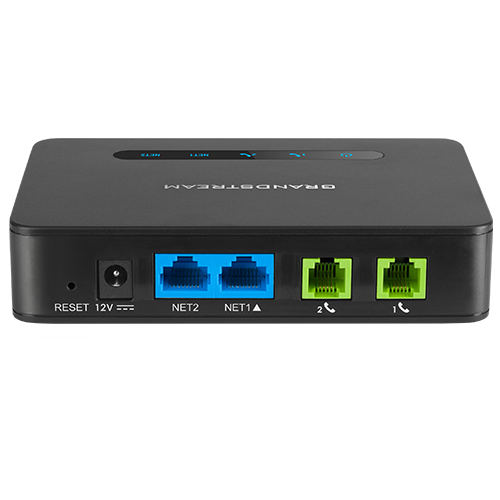
Two RJ11 FXS ports
Two 10/100/1000 Mbps RJ45 ports
Offices, branches, service providers and small deployments
Subject to supplier status, quantity and destination
Product selection, configuration review and delivery coordination
Guidance based on supplied unit and source
A Practical Bridge from Analog Devices to IP Telephony
Many organisations still depend on analog telephone devices even after moving their core communications to an IP PBX or hosted SIP service. Reception phones, elevator handsets, help-point devices, fax machines, door communication units and simple branch telephones may remain useful, familiar and economical. Replacing every endpoint can add cost, create training demands and complicate an otherwise straightforward voice migration. An analog telephone adapter solves that gap by presenting standard FXS interfaces to the existing device while registering the connection as a SIP endpoint on the VoIP platform.
The Grandstream HT812 v2 provides two FXS ports, allowing two analog lines or compatible devices to be connected through one compact appliance. It also includes two Gigabit Ethernet ports and a built-in NAT router. This combination is useful where the adapter must share a network point with another wired device, sit between an internet connection and a local endpoint, or support a small communications setup with limited cabling. The unit is not a replacement for an enterprise firewall or a full branch router; its routing function is best understood as an integrated convenience for suitable small deployments. Buyers should review their network design before placing business-critical traffic behind any compact ATA router.
For call handling, the device supports familiar functions such as caller identification, call waiting, transfer, forwarding, hold, do-not-disturb and three-way conferencing. A broad codec set, including wideband options, helps the unit work across different SIP platforms and bandwidth conditions when correctly configured. T.38 support addresses Fax-over-IP requirements, although fax reliability also depends on the service provider, PBX, network quality and remote fax path. Secure control and media options, automated provisioning and failover SIP server support make the adapter useful beyond a single desk, particularly for service providers, system integrators and organisations managing several locations.
For buyers in Africa, the important decision is not simply whether the model has two ports. The project should confirm line count, SIP compatibility, voltage and plug requirements, cabling, provider credentials, fax expectations, local network addressing, security policy and remote-management approach. FourTeck can help turn these details into a clearer quotation and deployment plan, reducing the chance of ordering an adapter that does not match the intended environment.
Key Business Benefits
The value of an ATA is measured by how effectively it protects useful equipment, simplifies migration and keeps communication manageable. The following advantages explain where this model can contribute to a practical business voice strategy.
Preserve Existing Analog Equipment
Businesses can continue using compatible analog phones or fax devices while moving the service layer to SIP. This can reduce unnecessary endpoint replacement, preserve familiar workflows and allow a phased communications upgrade rather than a disruptive all-at-once change.
Two Lines from One Compact Unit
Two FXS ports allow one appliance to serve two analog endpoints. This is useful for a reception phone and fax, two branch handsets, or two independent SIP profiles, subject to PBX and provider configuration.
Flexible Network Placement
Dual Gigabit Ethernet ports make it easier to position the adapter where only one network drop is available. A nearby workstation or another appropriate wired device may share the physical connection when the design, security policy and traffic requirements permit.
Easier Multi-Site Provisioning
TR-069, XML configuration files and secure web-based management can support repeatable deployment. Integrators and IT teams can reduce manual variation when rolling out compatible settings across several branches or customer sites.
Protected Signalling and Media Options
TLS, SRTP, HTTPS and device-level security features help protect account credentials, signalling and media when the wider SIP service supports matching security. Correct certificate handling and policy configuration remain essential.
Support for Voice and Fax Workflows
The broad codec set, telephony features and T.38 fax capability give buyers options for mixed analog requirements. Final performance depends on the PBX, provider, bandwidth, latency, jitter, packet loss and the far-end service.
Product Highlights for Business Deployments
The strongest characteristic of this adapter is the way it combines analog endpoint support with useful network and management functions. Two RJ11 FXS ports provide the physical connection expected by traditional phones and compatible fax equipment. Each port can participate in a modern SIP environment, helping organisations maintain analog workflows while benefiting from central call routing, extension plans and hosted voice services.
Support for G.711, G.722, G.723.1, G.729A/B, G.726-32, iLBC and Opus gives administrators flexibility when balancing quality, bandwidth and platform compatibility.
Caller ID, call waiting, attended or blind transfer, forwarding, hold, do-not-disturb and three-way conferencing help analog users participate in common office calling workflows.
Failover SIP server support can move registration to a secondary server when the primary becomes unavailable, provided the service and settings are planned correctly.
LED indicators for power, both network ports and both phone ports give installers an immediate view of basic link and line status during setup and troubleshooting.
Automated provisioning is especially relevant when a business needs consistent settings across many units. Rather than configuring every adapter independently, an administrator or service provider can use supported provisioning methods to distribute account, codec, dial-plan and network settings. This reduces variation and can speed replacement. The unit can also work with Grandstream UCM systems using supported zero-configuration workflows. Buyers using another PBX should confirm interoperability and provisioning methods before ordering.
The integrated NAT router is an added deployment tool rather than the sole reason to choose the model. It can support routing at up to 100 Mbps according to the manufacturer, while its physical Ethernet interfaces are Gigabit capable. Organisations with advanced security, high internet throughput, multiple VLANs or larger user populations should retain an appropriate business router and firewall. In those cases, the adapter can operate as a network endpoint while the primary network infrastructure performs routing, policy control and threat protection.
Technical Specifications
| Specification | Details |
|---|---|
| Brand and Model | Grandstream HT812 v2 |
| Product Type | Two-port analog telephone adapter with integrated NAT router |
| SIP Profiles and Lines | Two SIP profiles and two analog lines |
| Telephone Interfaces | Two RJ11 FXS ports; expansion may be possible by peering with an appropriate FXS gateway |
| Network Interfaces | Two 10/100/1000 Mbps RJ45 Ethernet ports |
| Routing | Integrated NAT router; manufacturer states routing performance up to 100 Mbps |
| Voice Codecs | G.711, G.722, G.723.1, G.729A/B, G.726-32, iLBC and Opus, with dynamic jitter buffer and line echo cancellation |
| Telephony Features | Caller ID display or block, call waiting, flash, transfer, forwarding, hold, do-not-disturb and three-way conference |
| Fax Support | T.38 Group 3 fax relay up to 14.4 kbps and automatic switch to G.711 fax pass-through |
| Security | SRTP media; TLS/SIPS/HTTPS control; secure provisioning with AES encryption and unique security certificate per unit |
| Provisioning and Management | HTTP, HTTPS, SSH, TFTP, TR-069, XML configuration, syslog and remote browser management |
| Quality of Service | 802.1Q VLAN, 802.1p, ToS, DiffServ, MPLS and traffic shaping support |
| Power | Universal input 100–240 VAC, 50–60 Hz; output 12 V / 0.5 A |
| Operating Environment | 0°C to 50°C; 10% to 90% non-condensing humidity |
| Dimensions and Weight | 28.5 × 130 × 90 mm; approximately 353.33 g |
| Compliance | FCC, CE, RCM and K.21 |
How to Read These Specifications
Two Gigabit Ethernet interfaces do not mean the integrated router will forward traffic at full Gigabit speed. The manufacturer lists routing performance up to 100 Mbps, so buyers should distinguish physical link speed from routing throughput. Where a site has a faster internet circuit or demanding data traffic, connect the ATA behind the organisation’s main router or firewall and use its Ethernet interfaces according to the approved network design.
Codec availability is also not the same as codec selection. The PBX, SIP provider and remote party must support the chosen codec, and the administrator should prioritise codecs based on voice quality, bandwidth and licensing or interoperability requirements. Fax should be tested end to end because T.38 capability on the adapter cannot correct limitations elsewhere in the transmission path. Confirm power adapter type, local plug format and any surge or UPS requirement before deployment.
Configuration and Buyer Guidance
A successful purchase starts with the analog devices and the communication platform, not with the adapter model alone. Confirm whether the endpoints are standard telephones, fax machines, cordless phone bases, paging interfaces, alarm diallers or another analog device. Some specialised devices depend on voltage, signalling, modem behaviour or local regulatory requirements that may not work reliably over every VoIP service. Ask the device manufacturer and SIP provider about compatibility where the application is safety-related, payment-related or operationally critical.
1. Count the Required Lines
The unit provides two FXS ports. Confirm whether both need separate SIP accounts, one shared profile, independent numbers or a PBX extension plan.
2. Confirm the SIP Platform
Identify the hosted provider or IP PBX, required transport, authentication method, outbound proxy, codec order, DTMF mode and provisioning process.
3. Review Network Quality
Voice quality relies on stable latency, low jitter, low packet loss, suitable bandwidth, correct QoS and a firewall that handles SIP traffic safely.
4. Plan Management
Decide who will update firmware, protect credentials, back up configuration, review logs and replace a failed unit across the service life.
The next decision is where the ATA will sit in the network. A small branch may use the integrated NAT function, while a managed office usually places the device behind a dedicated router and firewall. Confirm whether the network port will be shared, whether voice belongs in a separate VLAN, and whether the switch port, DHCP server and firewall rules are ready. The adapter uses an external 12 V power supply; it is not described by the manufacturer as a PoE-powered endpoint. A suitable UPS or protected power source can help prevent phone interruption during short power events, although the internet service, router, switch and PBX path must also remain powered.
For a quote, provide the number of units, destination, intended analog devices, PBX or service provider, required accessories, preferred warranty handling and target deployment date. This allows FourTeck to review the complete requirement rather than quoting a bare model that may leave out power, cabling, configuration or project support.
Ideal Business Use Cases
The adapter fits best where a business has one or two analog endpoints that must participate in an IP-based calling environment. It is not intended to replace a multi-port gateway where dozens of analog lines are required, but it can be an efficient choice for focused requirements and repeatable small-site deployments.
Reception and Back-Office Phones
An organisation moving to a hosted SIP platform can retain a familiar analog reception handset or back-office phone. The device registers the endpoint to the new voice environment while users continue operating a conventional handset.
Small Branch Communications
A remote office with one or two analog phones can connect to a central PBX or compatible hosted service. Standardised provisioning can help administrators deploy similar configurations across several small branches.
Fax Migration Projects
Businesses that still exchange faxes may use T.38 or G.711 pass-through, depending on provider support. This can keep a low-volume fax workflow connected during a broader voice migration, but end-to-end testing remains essential.
Hospitality and Guest Services
A compact ATA may connect selected analog phones in a reception, service room, apartment, small lodge or hospitality support area to a SIP platform. Port count and PBX features should be planned for the property’s call flow.
Clinics and Service Counters
Where staff need a simple handset for appointments, internal calls or service coordination, an existing analog telephone can be retained while the organisation centralises call routing on an IP PBX.
Service Provider Deployments
Hosted voice providers and integrators can use secure automated provisioning to prepare repeatable customer installations. Device certificates, configuration control, firmware management and replacement procedures should be included in the operational plan.
Other possible applications include compatible paging interfaces, door communication devices and specialised analog systems, but these should never be assumed. Ring voltage, REN load, dial method, disconnect signalling and modem behaviour can affect compatibility. The datasheet lists a 3 REN ring load and up to one kilometre on a 24 AWG line, yet the real site should still be checked for cable quality, interference, device requirements and local installation practice.
Grandstream HT812 v2 Voice Quality and Codec Flexibility
Voice quality is the combined result of endpoint hardware, codec selection, network behaviour, SIP service design and the quality of the analog telephone itself. The adapter supports narrowband and wideband codecs, including G.711, G.722 and Opus, as well as compressed options such as G.729A/B and iLBC. This range helps administrators adapt the unit to different PBX platforms and bandwidth conditions. A local network with stable bandwidth may prioritise a higher-quality codec, while a constrained remote link may require a more efficient codec that the provider also supports.
Codec support should not be treated as a promise that every call will use the best available format. Both ends of the call path negotiate what they can accept, and a carrier may transcode the media. The attached analog handset can also limit the audible result. For that reason, buyers should evaluate the complete call path and test with the actual telephone model, PBX, internet connection and provider. Dynamic jitter buffering and line echo cancellation help manage common voice challenges, but they cannot fully compensate for severe packet loss, overloaded links or unstable wireless backhaul.
Quality of service settings can prioritise signalling and media through 802.1p, VLAN tagging, ToS and DiffServ. These controls become valuable when voice shares a link with cloud applications, video meetings, backups and large downloads. The network switch, router and WAN provider must preserve or appropriately map the markings for the policy to work. Simply enabling QoS on the ATA does not guarantee end-to-end priority.
Grandstream HT812 v2 Secure Provisioning and Device Control
A single adapter can be configured through its browser interface, but business and service-provider deployments benefit from consistent, controlled provisioning. The unit supports HTTP, HTTPS, SSH, TFTP, TR-069 and XML-based configuration methods. This allows an administrator to prepare settings centrally, apply them to many devices and reduce the chance that each site develops a different configuration. Secure provisioning with AES encryption and a unique security certificate per device adds protection when the process is designed correctly.
Provisioning should include more than SIP usernames and passwords. A robust template can define codec priority, time servers, dial plans, DTMF handling, VLAN settings, logging, firmware source, administrative access and failover behaviour. It should also protect secrets, restrict management exposure and document which system is the source of truth. When a replacement unit is introduced, the team should be able to apply the approved configuration without relying on handwritten notes or an unknown local password.
TLS can protect SIP signalling, SRTP can protect supported media sessions, and HTTPS can protect browser management. These controls require corresponding support from the PBX, service provider and certificate infrastructure. A deployment that enables encryption without validating certificates or managing keys may create a false sense of security. Administrators should also change default credentials, limit management access, maintain firmware, monitor failed registration attempts and avoid exposing the web interface directly to the public internet.
The failover SIP server function supports continuity by allowing the adapter to use a secondary server when the primary becomes unavailable. This can reduce interruption caused by a single registration target, but it does not protect against local power loss, internet failure, firewall misconfiguration or broader provider outages. Resilience should therefore cover the entire path: power, local switching, router, WAN, DNS, SIP platform and support escalation.
Grandstream HT812 v2 Network Integration and Fax Readiness
The dual Ethernet design gives the ATA more installation flexibility than a basic single-port adapter. One port can connect toward the network while the second can provide a wired path to another suitable endpoint. This can be valuable at a desk or service counter with one available cable. The network design should still consider security segmentation, bandwidth, fault impact and troubleshooting. Placing several devices in a chain can make outages harder to isolate, so critical sites may prefer dedicated switch ports.
The built-in NAT router can serve a small and clearly defined use case, with manufacturer-stated routing performance up to 100 Mbps. It should not be treated as an enterprise security gateway. Businesses needing advanced firewall inspection, VPN concentrator functions, multi-WAN resilience, detailed reporting or high-speed routing should retain dedicated network infrastructure. In a managed LAN, the adapter may use a voice VLAN and QoS policy while a business firewall controls external access.
Fax requires special attention because traditional fax was designed for circuit-switched lines, not packet networks. T.38 converts fax signalling for IP transport and can improve reliability when every relevant part of the path supports it. The unit also offers G.711 fax pass-through. Neither method can guarantee success where the provider changes codecs, packet loss is high, timing is unstable or the remote carrier does not handle the session consistently. Buyers should define expected page volume, destinations and business importance, then run real tests before retiring the old line.
Cable length and endpoint load also matter. The published specification supports 3 REN and up to one kilometre on 24 AWG line. Old building cabling may have joints, corrosion, poor insulation or parallel devices that alter performance. Installation teams should test the actual circuit, confirm dial tone and ring behaviour, and verify caller identification, transfer, DTMF and disconnect detection. A technically compatible adapter still needs careful commissioning to become a dependable business service.
What Buyers Should Check Before Purchase
Before requesting a quote, confirm the exact job the adapter must perform. A two-port ATA is appropriate when two analog endpoints are sufficient, but buyers sometimes discover later that they need four or eight ports, an FXO interface for a public telephone line, a lifeline path during power failure, or a gateway designed for larger analog estates. The HT812 v2 has FXS ports for connecting analog devices; it does not provide FXO ports for connecting an analog carrier line. That distinction should be clear before ordering.
Configuration Fit
Confirm FXS line count, SIP profiles, extension numbers, codec order, DTMF method, dial plan, caller ID format, fax mode and failover server details. Share these items with the supplier or installer.
Compatibility Check
Verify the hosted provider or IP PBX supports the desired SIP transport, encryption, codec and T.38 behaviour. Confirm the analog endpoint’s REN, dial type and signalling needs where relevant.
Network and Power
Decide whether the ATA will route traffic or operate behind the main firewall. Check VLANs, DHCP, DNS, QoS, cabling, 12 V power adapter, local plug format, surge protection and UPS coverage.
Availability and Warranty
Ask whether the quotation covers the exact v2 model, included power supply, applicable warranty route, replacement process, delivery destination and expected quantity. Avoid assuming all regional bundles are identical.
Accessories and services can change the true project cost. A bare unit may still require network patch leads, protected power, installation labour, remote provisioning, PBX configuration, call-flow changes, testing and user handover. Multi-site buyers should decide whether units will be preconfigured before dispatch, adopted by a central management platform, or configured locally. They should also define who retains administrator credentials and configuration backups.
The most useful quote request includes model, quantity, destination, target date, PBX or provider, analog device type, fax requirement, internet speed, network topology and desired support scope. FourTeck can use this information to identify whether the two-port model is suitable or whether an alternative Grandstream ATA or gateway would better match the requirement. This approach helps buyers avoid missing ports, incompatible interfaces, unexpected accessories and unclear post-delivery responsibility.
Africa Availability and Service Support
FourTeck supports product enquiries across Africa with assistance that begins before the quotation. The team can review whether two FXS ports are sufficient, whether the selected SIP provider or PBX is appropriate, and whether the deployment requires preconfiguration, additional cabling, power protection or another gateway model. This is particularly useful for procurement teams that receive a model request without the technical context needed to confirm suitability.
Availability may vary according to the exact model revision, supplier position, order quantity, destination, power-supply bundle and project timing. FourTeck does not rely on an assumed stock statement for every enquiry. Instead, buyers can submit the required quantity and location so the sales team can review current sourcing and delivery options. For project orders, the quote can also identify whether staged supply, consolidated shipment or coordinated deployment support is required.
Configuration support can include pre-sales review of SIP accounts, network placement, codec requirements, T.38 expectations and management method. Warranty guidance is based on the unit offered, source and destination rather than a generic promise. Buyers should ask how warranty assessment, replacement and return logistics would be handled before approving a larger order.
To prepare an accurate request, share the organisation name, delivery location, number of units, PBX or hosted service, analog device types and preferred deployment date. This gives the team enough information to recommend a practical supply route and support scope.
Africa Country and Regional Coverage
Businesses across Africa, including Kenya, Uganda, Nigeria, Ghana, Tanzania, Rwanda, Ethiopia, South Africa, Zambia, Botswana, Senegal and nearby regional markets, can contact FourTeck for product availability, configuration guidance and quote assistance. The requirement may be a single adapter for a branch office, a small batch for a hospitality or clinic deployment, or a larger service-provider rollout that needs consistent provisioning and delivery planning.
Regional procurement should account for more than international freight. Power plug format, local voltage compatibility, importer requirements, delivery address type, tax handling, warranty route and technical ownership can all influence the most suitable supply arrangement. FourTeck can help buyers organise the information required to evaluate these factors, while the final quotation reflects the destination and current source.
For organisations with sites in more than one country, a standard configuration and naming plan can simplify support. Device labels, SIP profile templates, firmware policy, management access and escalation contacts should be documented before shipment. Buyers can begin through the Africa product assistance team, or review regional support through FourTeck Kenya and FourTeck Uganda where relevant to the project.
GCC, Middle East and Africa Availability
FourTeck Africa can support product enquiries for businesses across Africa while also guiding wider regional technology requirements through selected FourTeck platforms for GCC, Middle East and Africa markets. This is useful for companies that operate offices, hotels, clinics, retail locations or service networks in more than one region and want a consistent approach to analog-to-VoIP migration.
Enquiries may involve locations in UAE, Saudi Arabia, Qatar, Oman, Bahrain and African business markets. Availability, delivery options, warranty handling and configuration support can vary by country, supplier, quantity and project scope. A model offered in one market may arrive with a different plug type, documentation bundle or warranty route, so buyers should request a country-specific quotation rather than assuming every regional offer is identical.
For multi-country projects, FourTeck can help structure the request around a standard device configuration, approved firmware, SIP platform, naming convention and support responsibility. The organisation should also define whether units are configured centrally, prepared before delivery or adopted after arrival. This reduces variation between sites and makes troubleshooting more predictable.
Regional buyers can review the FourTeck Africa platform or connect with FourTeck UAE for appropriate market guidance. Provide destination, quantity, timeline, PBX or provider and support scope so the correct team can assess the request.
Other Options Buyers May Consider
The right adapter depends mainly on port count, Ethernet requirements and whether FXS or FXO interfaces are needed. The following related Grandstream options can help buyers compare the two-port unit with smaller or larger alternatives. Final model availability and specifications should be confirmed in the quotation.
Grandstream HT801 v2
A compact option for a single analog endpoint where only one FXS port is required. Suitable for simple one-line migrations and focused home-office or branch applications.
Grandstream HT802 v2
Another two-FXS-port option for buyers who do not need the HT812 v2 dual-Gigabit and integrated-routing arrangement. Compare network interfaces and deployment layout carefully.
Grandstream HT814 v2
A four-FXS-port alternative for sites that need more analog endpoints in one gateway. It may reduce the number of separate adapters in a small multi-line deployment.
Grandstream HT818 v2
An eight-FXS-port model for denser analog requirements. Consider it for hospitality, multi-room, service-provider or business environments where two ports would be insufficient.
Grandstream UCM6302 IP PBX
A related on-premise communications platform for organisations building a Grandstream-based call environment. Confirm capacity, licensing, remote access and deployment needs separately.
An FXO requirement needs a different product family because FXS and FXO ports serve opposite sides of an analog connection. Tell FourTeck whether the project connects analog devices to SIP or connects analog carrier lines to an IP PBX. That one detail can prevent a costly model-selection error.
Why Buyers Choose FourTeck
Technology procurement is easier when the supplier understands how a product will be used. FourTeck supports buyers who need more than a model code by helping translate business requirements into practical technical questions. For an ATA project, this can include line count, FXS versus FXO selection, SIP compatibility, network placement, codec policy, fax behaviour, provisioning, power and warranty handling.
Assistance for single-unit needs, branch deployments, project quantities and related network or telephony products.
Pre-sales review of model fit, SIP platform, port requirements, fax expectations and deployment approach.
A quotation prepared around quantity, destination, accessories, support scope and current sourcing conditions.
Guidance for regional delivery details, project timing and supply planning without relying on unverified stock claims.
Clarification based on the exact unit, source, destination and supplier terms included in the offer.
Help identifying a one-, two-, four- or eight-port alternative, or a different gateway interface, when the requested model is not the best fit.
FourTeck works with SMB, enterprise, hospitality, education, healthcare, retail, service-provider and multi-site requirements. The aim is to make the buying process clearer: confirm the need, choose the suitable product, include the required accessories, define support responsibility and coordinate delivery. This reduces uncertainty for procurement teams and gives technical teams a better starting point for deployment.
Frequently Asked Questions
What is the HT812 v2 used for?
It connects up to two compatible analog telephone or fax endpoints to a SIP-based VoIP service or IP PBX. The adapter converts between analog FXS interfaces and IP voice signalling, allowing an organisation to retain selected traditional devices while moving call routing and service delivery to a modern communications platform.
Does the device support two independent phone lines?
The unit provides two RJ11 FXS ports and supports two SIP profiles. How those ports are assigned depends on the PBX or hosted provider configuration. They may use separate accounts, extensions or numbers, or follow another supported call plan. Confirm the intended arrangement with the service administrator before deployment.
Can it connect an analog telephone company line to an IP PBX?
No. The model has FXS ports for analog endpoint devices, not FXO ports for analog carrier lines. A project that needs to bring a public switched telephone line into an IP PBX requires an appropriate FXO gateway or hybrid device. State clearly whether the connection is for a phone or for a provider line.
Is Fax-over-IP supported?
The adapter supports T.38 Group 3 fax relay and G.711 fax pass-through. Successful faxing still depends on the PBX, SIP provider, remote carrier, network quality and configuration. Buyers with important fax workflows should test representative destinations and page volumes before cancelling any existing analog service.
Can FourTeck help with SIP and network configuration?
FourTeck can review the requested deployment, identify the information needed for configuration and help define the supply or support scope. The final setup may require credentials and parameters from the customer’s PBX administrator or hosted provider, including server address, transport, authentication, codec, DTMF and dial-plan details.
Is the adapter available for delivery across Africa?
FourTeck accepts Africa-based product enquiries and can review delivery options according to destination, quantity, supplier position and project timing. Availability is not assumed to be identical for every country or model revision. Submit the delivery location and required quantity so the team can prepare current guidance and a suitable quotation.
Does it replace a business router or firewall?
The device includes a NAT router with manufacturer-stated routing performance up to 100 Mbps, but it is not a substitute for an enterprise firewall where advanced security, VPN, multi-WAN, high throughput or detailed policy control is required. Many businesses deploy the ATA behind their existing router and firewall instead.
How should a buyer choose between HT802 v2 and HT812 v2?
Both are two-port ATA options, but their network interfaces and routing capabilities differ. The HT812 v2 is relevant where dual Gigabit Ethernet and the integrated NAT arrangement are useful. Buyers who only need two FXS ports and a simpler network connection should compare the alternatives with their cabling and placement requirements.
Can businesses request bulk supply for multiple branches?
Yes. Share the number of sites, quantity per site, destination list, target configuration, PBX platform, desired firmware, labelling and deployment schedule. FourTeck can review sourcing and coordination requirements. A standard provisioning template and documented support process are recommended before dispatching units to many locations.
What information is needed for a quote?
Provide quantity, country and delivery city, intended analog devices, PBX or SIP provider, fax requirement, preferred support scope, target date and any required accessories. Mention whether units should be preconfigured and whether the project needs one, two, four or more analog ports at each site.
Need Help Choosing the Right Analog Telephone Adapter?
FourTeck can help review line count, FXS or FXO requirements, SIP platform compatibility, fax expectations, network design, availability, warranty guidance and delivery requirements for your business location.
Reviews
There are no reviews yet.