

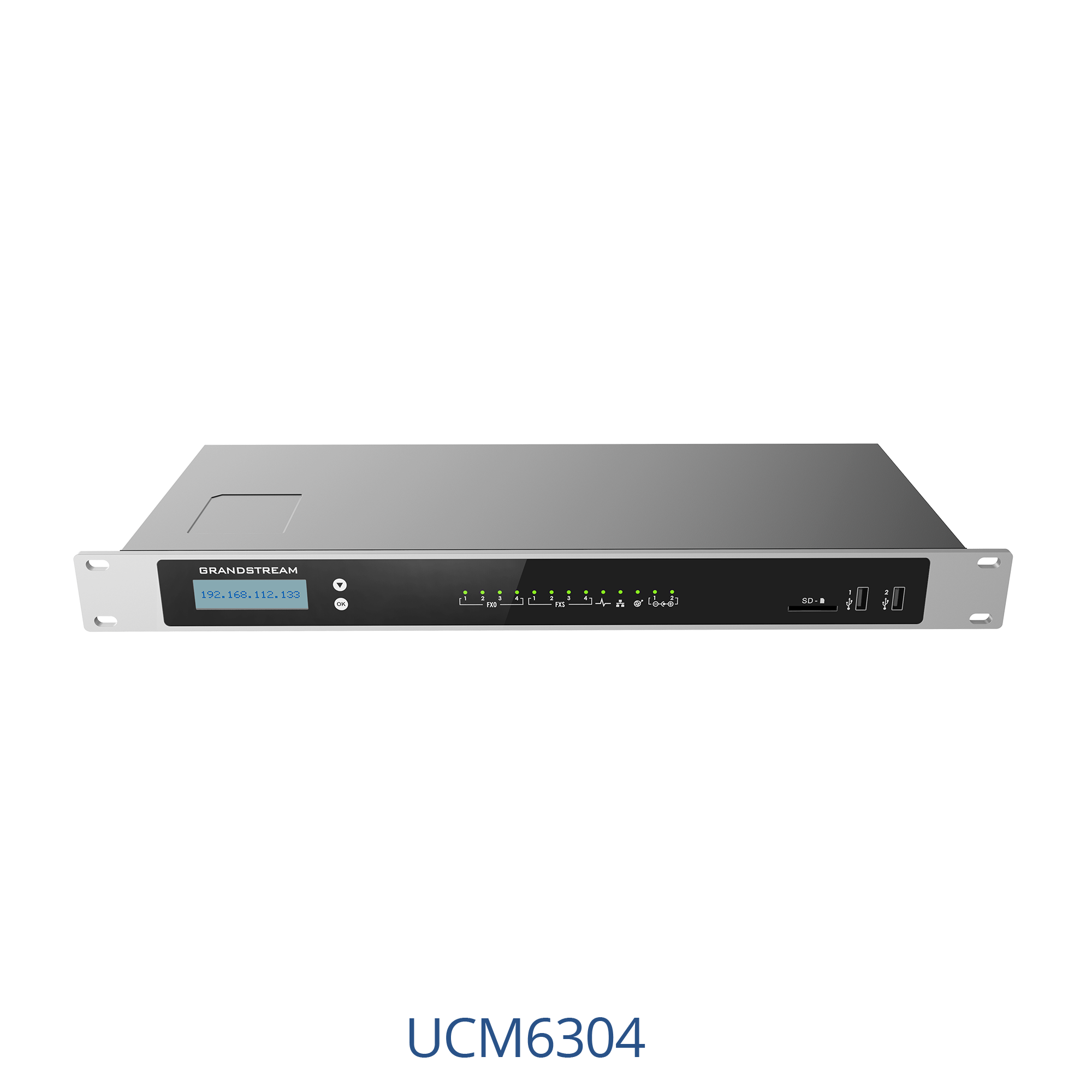
Quick Product Information
Grandstream
UCM6304
Unified communications IP PBX
Medium and larger organisations
Up to 2,000 users
Up to 300 concurrent calls
4 FXO and 4 FXS ports
Supplier and configuration dependent
Africa and selected regional markets
Selection, quote, and delivery guidance
A Central Communications Platform for Complex Organisations
A growing organisation often reaches a point where separate telephone lines, isolated branch systems, consumer meeting tools, unmanaged mobile calling, and inconsistent extension plans become difficult to control. The UCM6304 addresses that problem by placing voice, video collaboration, messaging, conferencing, call routing, analogue connectivity, and remote-user services under one administratively controlled platform. Instead of treating each communication channel as a separate project, the appliance gives IT teams a unified foundation that can be shaped around departments, locations, working patterns, service hours, and business processes.
Its capacity makes it relevant to organisations with hundreds of active extensions today and a longer-term plan for expansion. The platform supports up to 2,000 users and up to 300 simultaneous calls, providing room for office staff, reception teams, contact operations, branch users, meeting rooms, intercoms, and mobile employees. Four built-in FXO interfaces allow connection to traditional PSTN lines, while four FXS interfaces support selected analogue telephones, fax equipment, or other compatible analogue endpoints. This mix is especially useful when a business wants to modernise communications without removing every legacy line or device in one phase.
The appliance fits into an IP network through three self-adaptive Gigabit interfaces that can be used in switched, routed, or dual-network arrangements. Integrated PoE+ on the network interfaces can simplify selected deployment designs, while the built-in NAT router capability gives installers more flexibility where the PBX must take a defined network role. For wider deployments, Grandstream endpoint provisioning can reduce repetitive configuration work, and management through the web interface or compatible Grandstream services helps administrators maintain visibility across the environment.
For Africa buyers, the important question is not only whether the model has sufficient headline capacity. The correct design must also consider internet quality, local SIP trunk availability, analogue line retention, power stability, rack conditions, remote offices, security policy, call recording needs, endpoint models, and support responsibilities. FourTeck helps customers translate these practical requirements into a clear bill of materials and deployment plan before a quotation is finalised.
Key Business Benefits
The value of an IP PBX is measured by how well it supports daily operations, future growth, user experience, administration, and service continuity. The following benefits explain where this platform can make a practical difference.
◆ Capacity for structured growth
Support for up to 2,000 users gives growing businesses space to add departments, remote staff, branches, service desks, and shared facilities without replacing the core system too early. Capacity planning still needs to include busy-hour call volume, meeting activity, recording, and encrypted-call requirements, but the platform provides a strong base for expansion.
✓ Lower licensing complexity
Core PBX functions are delivered through the appliance rather than a per-user licence for each basic extension. This can simplify budgeting for organisations with many users. Buyers should still account for SIP carrier charges, optional remote-connect services, internet links, support contracts, endpoints, and any third-party software integration.
● Phased migration from analogue
Four FXO and four FXS ports help businesses retain selected PSTN lines and analogue devices during a staged move to SIP. This is useful for organisations that cannot replace every line, fax workflow, emergency route, or older endpoint at once. Additional gateways can be considered when more analogue capacity is required.
↗ Remote and mobile collaboration
Wave applications and the wider UCM ecosystem allow approved users to communicate beyond a desk phone. This supports hybrid work, travelling teams, distributed managers, and branch personnel while keeping extensions, call history, meetings, chat, and corporate contacts connected to the organisation’s communication system.
⚙ Central administration
Administrators can manage extensions, trunks, queues, IVR menus, permissions, endpoint provisioning, updates, and call policies through a central interface. A well-designed extension plan and change-control process can reduce errors, shorten onboarding time, and make support easier across large user groups.
🔒 Security-focused architecture
Secure boot, unique certificates, random default passwords, encrypted management protocols, and support for SRTP and TLS contribute to a stronger communications design. Security still depends on correct firewall rules, firmware maintenance, strong credentials, restricted administration, monitoring, and careful remote-access configuration.
Product Highlights That Matter in Daily Operations
Other notable capabilities include call queues, multi-level auto attendants, call recording, call detail records, voicemail, routing rules, paging and intercom functions, LDAP support, network quality controls, multilingual interfaces, and third-party integration through APIs. Final capability and performance can depend on firmware, active services, codec selection, call encryption, meeting usage, storage arrangements, and network quality. Buyers should therefore treat the appliance as the core of a designed solution rather than a standalone box that can be installed without planning.
Technical Specifications
| Specification | Details |
|---|---|
| Brand and model | Grandstream UCM6304 |
| Product type | Unified communications and collaboration IP PBX appliance |
| Maximum users | Up to 2,000 users |
| Maximum call capacity | Up to 300 concurrent G.711 calls; up to 200 concurrent SRTP calls |
| Analogue station ports | 4 x FXS RJ11 ports with lifeline capability |
| PSTN line ports | 4 x FXO RJ11 ports with lifeline capability |
| Network interfaces | 3 x self-adaptive Gigabit Ethernet ports; switched, routed, or dual mode; integrated PoE+ |
| NAT router | Supported in router mode and switch mode |
| Peripheral interfaces | 2 x USB 3.0 and 1 x SD card interface |
| Display and indicators | 128 x 32 dot-matrix LCD; power, FXS, FXO, LAN, WAN, and heartbeat indicators |
| Voice codecs | Opus, G.711, G.722 family, G.723.1, G.726-32, G.729A/B, iLBC, GSM; T.38 fax support |
| Video codecs | H.265, H.264, H.263, H.263+, and VP8 |
| Meeting capacity | Unlimited meeting rooms, up to 15 simultaneous public rooms, up to 200 simultaneous participants across rooms, and up to 9 video feeds per room |
| Provisioning | Grandstream ZeroConfig, encrypted XML provisioning, auto-discovery, and common network provisioning methods |
| Management | Web administration, Grandstream Device Management System compatibility, and supported cloud management services |
| Security | Secure boot, unique certificate, random default password, SRTP, TLS, HTTPS, SSH, and 802.1X support |
| Telephony platform | Based on Asterisk version 16 |
| Power | Dual 12V DC power inputs; supplied adapter specification and redundancy design should be confirmed for the quoted package |
| Dimensions | Approximately 485 mm x 187.2 mm x 46.2 mm |
| Weight | Approximately 2.49 kg unit weight |
| Mounting | Rack mount or desktop |
| Operating environment | 0°C to 45°C; 10% to 90% non-condensing humidity |
| Final configuration | Firmware, services, accessories, support, and deployment scope are configuration dependent |
Capacity figures should be read as platform limits under defined conditions, not as a substitute for a traffic assessment. An organisation with 1,500 registered users may need only 100 simultaneous calls, while a contact operation with fewer extensions may create much higher busy-hour traffic. Encryption, conferencing, recording, external storage, remote access, codec selection, failover, and trunk design can all influence the practical deployment. FourTeck can help collect extension counts, concurrent-call estimates, queue activity, meeting requirements, line types, and network information so the quoted design is aligned with real usage.
Configuration and Buyer Guidance
A successful PBX project begins with a clear requirements document. Start by counting people, shared devices, meeting rooms, analogue equipment, reception positions, service desks, and branch extensions. Then estimate how many calls can occur at the busiest time. Registered-user capacity and concurrent-call capacity are different measurements, and both should be assessed. Organisations that record calls, run multiple queues, encrypt media, or host frequent video meetings should allow additional design margin.
1. Define users and traffic
Provide total extensions, expected simultaneous calls, queue agents, remote users, and meeting participants.
2. Confirm trunk strategy
Identify SIP providers, PSTN lines, failover routes, direct inward dialling, emergency numbers, and outbound policies.
3. Review network readiness
Check VLANs, QoS, switching, firewall rules, bandwidth, latency, jitter, remote links, and PoE availability.
4. Plan endpoints
Match executive, reception, meeting-room, cordless, warehouse, common-area, and softphone requirements.
5. Protect the appliance
Include rack space, UPS capacity, grounding, cooling, surge protection, backup, and controlled administrative access.
6. Agree support ownership
Clarify who handles installation, carrier coordination, dial plans, training, firmware, monitoring, and incident response.
Compatibility should be checked before purchase, particularly where the project includes third-party SIP phones, door systems, paging equipment, analogue fax, CRM software, hotel management platforms, call recording policies, or existing gateways. A proof of concept can be appropriate for complex integrations. FourTeck can help structure the pre-sales questions and identify accessories or services that may otherwise be missed from the initial request.
Ideal Business Use Cases
Corporate headquarters
Centralise extensions, reception, executive lines, departments, meeting rooms, call routing, voicemail, mobile users, and reporting in a single managed environment. The available capacity supports an organisation that expects headcount or departmental growth.
Multi-branch organisations
Connect approved remote offices through SIP trunks, secure network links, or remote-access services. A shared extension plan and central policies can improve consistency, while local failover and carrier arrangements protect each site’s operational needs.
Customer service operations
Use call queues, IVR menus, agent distribution, recordings, reports, voicemail, schedules, and routing rules for reception desks, support teams, reservations, order handling, and internal service centres. Dedicated contact-centre software may still be required for advanced workforce management.
Education and campus communications
Support administration, faculties, classrooms, security desks, residence facilities, common areas, paging, intercoms, and remote staff. Network segmentation and emergency calling policies should be planned carefully across large sites.
Hospitality and service environments
Connect reception, back office, guest-service teams, reservations, facilities, analogue room phones, and supported property-management integrations. The four FXS ports may be useful for a small analogue requirement, while larger room counts generally need gateways.
Healthcare and distributed services
Coordinate administrative departments, appointment teams, internal extensions, reception, mobile staff, facilities, and selected intercom workflows. Security, privacy, recording permissions, power continuity, and emergency routes must be designed around local requirements.
The system can also suit logistics companies, professional services, public-sector projects, manufacturing operations, financial offices, retail groups, system integrators, and managed service providers. Suitability depends on the exact call profile, compliance needs, network design, support model, and integration scope. A detailed assessment is particularly important when communications are business-critical or distributed across multiple locations.
UCM6304 Capacity and Workload Handling
The UCM6304 is positioned for organisations that require more than a small-office PBX. Its ability to register up to 2,000 users gives the design room for named employees, common-area phones, conference endpoints, security stations, analogue devices, and remote users. More importantly, the platform supports up to 300 simultaneous G.711 calls. This allows the appliance to serve busy reception operations, numerous departments, high internal traffic, and substantial SIP trunk usage when the rest of the infrastructure is correctly sized.
Call capacity is not a single universal number for every deployment. Media encryption, transcoding, recording, conferencing, video, and codec selection can affect resource usage. The official encrypted-call figure is up to 200 concurrent SRTP calls, which should be used when secure media is part of the policy. Organisations should also check carrier channel limits, internet bandwidth, session border controls, firewall throughput, switching quality, and WAN resilience. A PBX with sufficient capacity cannot compensate for an under-sized SIP trunk or unstable network.
A practical assessment should identify the busiest thirty-minute period, not simply the total number of staff. A service centre with 250 agents can create more simultaneous traffic than a professional organisation with 1,000 occasional phone users. FourTeck can help buyers compare extension count, external call patterns, meeting activity, call recording, queue demand, and expected growth. This produces a more defensible capacity decision and reduces the risk of selecting a model only because its maximum user figure looks attractive.
UCM6304 Remote Collaboration and Meeting Experience
Modern communication extends beyond the desk telephone. The UCM6300 ecosystem includes Wave applications for desktop, web, and mobile devices, enabling approved users to call extensions, join meetings, review call history, access voicemail, chat, and work with corporate contacts from supported platforms. This gives organisations a way to connect remote staff, travelling managers, field teams, and distributed departments while keeping communication tied to the central system.
The meeting platform supports multiple rooms and a combined participant capacity that can serve internal briefings, project discussions, training, management meetings, and customer sessions. Buyers should confirm whether their typical meetings are audio-only, video-based, internal, external, scheduled, or ad hoc. Camera quality, headsets, room systems, internet uplink, firewall policy, and user training often affect meeting quality as much as the PBX itself. For larger webinar or event requirements, a dedicated service may still be more appropriate.
Remote connectivity must be deployed with care. Strong passwords, multi-level administrative controls, current firmware, secure protocols, certificate handling, restricted management access, and tested recovery procedures are essential. UCM RemoteConnect can simplify approved remote endpoint access and NAT traversal, while GDMS compatibility can support central setup and monitoring. Optional services, subscription terms, and country availability should be confirmed during quotation. FourTeck can help buyers distinguish between included appliance functions, optional cloud services, endpoint requirements, and ongoing support responsibilities.
UCM6304 Security, Provisioning, and Administration
Business telephony is part of the organisation’s security perimeter. Fraudulent calls, exposed management interfaces, weak extension passwords, unpatched firmware, and unrestricted SIP access can create financial and operational risk. The platform includes secure boot, a unique certificate, random default passwords, encrypted web management, SRTP, TLS, SSH, 802.1X, and other security controls. These features provide useful building blocks, but secure operation depends on the final configuration.
Administrators should place voice devices in suitable network segments, limit management access, remove unused services, define strong credential policies, protect trunks with appropriate authentication, and monitor logs and call records. Firewall rules should allow only required traffic. Remote administration should use secure, controlled methods rather than exposing the PBX directly to the public internet. Backups should be scheduled and stored securely, and firmware changes should follow a documented maintenance process.
For endpoint rollout, Grandstream ZeroConfig can discover and provision compatible Grandstream SIP devices, helping IT teams apply templates, extension settings, firmware policies, and common parameters more consistently. This is valuable for large phone quantities, but templates should still be tested with each endpoint model and user role. Reception phones, executives, common areas, cordless devices, and meeting spaces often need different key layouts and permissions. FourTeck can help prepare the device list, network assumptions, and configuration scope so that provisioning effort is included in the project rather than treated as an afterthought.
What Buyers Should Check Before Purchase
Before requesting a quote, buyers should confirm how the system will be used, which services must remain available during migration, and what responsibilities sit with the supplier, installer, carrier, and internal IT team. Choosing only by model name can lead to missing phones, licences for optional services, gateways, rack accessories, power protection, installation labour, cabling, or carrier work. A complete request helps FourTeck match the appliance to the wider communications requirement.
Configuration fit
Share the total extension count, expected concurrent calls, queue agents, meeting users, recording requirements, SIP trunks, and growth plan. Confirm whether encrypted calls and remote users are required because these can affect sizing and design.
Compatibility check
List existing SIP phones, analogue devices, PSTN lines, gateways, switches, firewalls, directory services, CRM or property systems, and internet links. Third-party interoperability may require testing or vendor confirmation.
Power and environment
Confirm 1U rack space, UPS sizing, dual-power expectations, ventilation, grounding, surge protection, temperature, and secure physical access. Include the switches and carrier equipment that must remain powered during an outage.
Accessories and endpoints
Prepare quantities and user profiles for desk phones, reception consoles, cordless handsets, headsets, conference devices, gateways, expansion modules, and mounting items. Different roles often need different endpoint models.
Warranty and support
Ask what warranty applies to the quoted unit, how faults are reported, who provides configuration support, whether remote or on-site assistance is included, and how replacement or escalation is handled.
Delivery and project supply
Provide destination, required date, quantity, import or delivery constraints, site-readiness status, and whether the order is part of a phased rollout. Availability can vary by supplier status and configuration.
Long-term operating cost
Budget for SIP services, internet resilience, optional cloud services, endpoint replacement, support, UPS batteries, storage, training, and periodic maintenance. The appliance price is only one part of the total project cost.
Quote preparation
Send FourTeck a concise scope with users, sites, trunks, phones, analogue ports, integrations, call flows, remote access, installation needs, support expectations, and delivery location. This allows a clearer and more comparable quotation.
Africa Availability and Service Support
FourTeck supports product inquiries across Africa with assistance for model selection, configuration review, quote preparation, delivery coordination, and warranty guidance. Availability can change according to supplier position, firmware or hardware revision, selected accessories, quantity, destination, and project timing. For that reason, the product page does not make a fixed stock or delivery promise. The sales team can check the current supply route when a buyer provides a clear requirement.
Pre-sales support can include reviewing user capacity, concurrent-call expectations, SIP trunk design, PSTN retention, FXS and FXO needs, phone models, meeting requirements, remote-access options, rack installation, power protection, and network readiness. FourTeck can also help identify related items such as IP phones, conference devices, gateways, switches, UPS systems, headsets, and cabling. Installation and configuration services depend on location and project scope and should be requested explicitly.
Warranty handling is guided by the terms attached to the quoted source and product package. Buyers should confirm coverage period, return procedure, technical support boundaries, and any regional limitations before placing an order. For project supply, provide quantity, delivery destination, required date, and whether the rollout will occur in one phase or across multiple sites.
Africa Country and Regional Coverage
Businesses across Africa, including Kenya, Uganda, Nigeria, Ghana, Tanzania, Rwanda, Ethiopia, South Africa, Zambia, Botswana, Senegal, and nearby regional markets can contact FourTeck for availability checks, configuration guidance, and quotation support. The team can help review suitable quantities, endpoint options, analogue requirements, accessories, deployment services, and delivery considerations based on the buyer’s location and project timetable.
Regional supply conditions differ, especially for import lead times, carrier compatibility, warranty routes, taxes, and on-site service. Buyers should share the exact destination and any local procurement requirements early in the process. FourTeck can then coordinate the inquiry through the most suitable regional route and explain what is included in the quotation.
GCC, Middle East and Africa Availability
FourTeck Africa can support product inquiries for organisations in Africa while coordinating selected requirements through wider FourTeck platforms serving GCC and Middle East markets. Businesses with connected offices or procurement activity in the UAE, Saudi Arabia, Qatar, Oman, Bahrain, and African countries may need consistent endpoint standards, extension plans, support expectations, and deployment documentation across regions.
Availability, delivery routes, warranty handling, optional cloud services, and installation coverage may vary by country, supplier, quantity, and project scope. A regional project should therefore identify where the PBX will be installed, where users are located, which SIP carriers will be used, and who will provide local support. Country-specific telecom rules and emergency calling requirements should be checked before deployment.
Other Grandstream Options Buyers May Consider
The correct model depends on user count, call traffic, analogue interfaces, meeting requirements, rack preference, and future expansion. A smaller appliance may be more economical for a compact organisation, while a higher-capacity model may provide better headroom for a large project. The related options below help buyers start a structured comparison; final specifications and availability should be confirmed during quotation.
Grandstream UCM6302
A lower-capacity UCM6300-series option for businesses that need unified communications with fewer analogue ports and a smaller user base.
Grandstream UCM6308
A larger UCM6300-series platform for organisations needing more users, greater call capacity, and additional built-in analogue interfaces.
Grandstream UCM6304A
An audio-focused alternative for buyers whose requirement centres on voice, messaging, and audio collaboration rather than the full video feature set.
Grandstream GRP2615
A professional desktop IP phone option for managers, reception users, and staff who need multiple lines and programmable keys.
Business IP PBX Solutions
Browse related communication platforms when comparing capacity, analogue integration, deployment model, and brand preferences.
Project Configuration Support
Ask FourTeck to review phones, gateways, switches, UPS protection, trunks, rack needs, and deployment services as one solution.
Why Business Buyers Contact FourTeck
A communications platform touches network design, user productivity, customer access, security, power continuity, carrier services, and support processes. FourTeck approaches the request as a business technology project rather than a single appliance purchase. This helps procurement teams understand what must be included, what depends on configuration, and which questions need answers before an order is approved.
Structured assistance for single units, multi-site requirements, and project quantities.
Help reviewing capacity, ports, endpoints, trunks, network readiness, and accessories.
Clearer bill-of-material preparation based on the buyer’s stated scope and destination.
Regional inquiry handling with supply conditions explained before confirmation.
Assistance understanding the warranty route and support terms attached to a quotation.
Support identifying phones, gateways, headsets, switches, UPS systems, and rack items.
FourTeck does not replace the need for qualified installation, local telecom compliance, carrier confirmation, or security governance. Instead, the team helps buyers prepare a more complete purchase request and coordinate the commercial side of the project. This is valuable for IT managers, procurement teams, resellers, system integrators, and business owners who want a clear route from requirement to quotation.
Frequently Asked Questions
What is the UCM6304 used for?
It is a unified communications IP PBX for managing business extensions, SIP trunks, PSTN lines, analogue devices, call routing, IVR, queues, voicemail, conferencing, meetings, mobile users, and supported integrations. It is suited to organisations that need a centrally controlled platform with capacity for substantial user and call volumes.
How many users and calls can it support?
The platform supports up to 2,000 users, up to 300 concurrent G.711 calls, and up to 200 concurrent SRTP calls. Practical sizing should consider busy-hour traffic, encrypted media, recording, conferencing, video use, codecs, and trunk capacity rather than relying only on the maximum extension number.
Can it connect traditional telephone lines and analogue devices?
Yes. It includes four FXO ports for compatible PSTN lines and four FXS ports for selected analogue telephones, fax equipment, or similar devices. Buyers needing more analogue interfaces can consider external gateways. Line standards, fax behaviour, emergency routing, and carrier compatibility should be checked during design.
Does FourTeck help with configuration planning?
FourTeck can help review user quantities, call volume, analogue ports, SIP trunks, phone models, remote users, network readiness, rack placement, power protection, accessories, delivery destination, and support expectations. Installation and detailed programming services depend on the project scope and should be included in the request.
Is the product available across Africa?
FourTeck accepts inquiries from businesses across Africa. Current availability depends on supplier status, order quantity, required accessories, destination, and project timing. Contact the sales team with the model, quantity, delivery location, and required date so the applicable supply route can be checked.
Can remote staff use the system?
Yes. Supported Wave applications and UCM ecosystem services can connect authorised remote users to calling, meetings, chat, voicemail, contacts, and other functions. The design should include secure remote access, suitable internet quality, firewall policy, endpoint security, service subscriptions where applicable, and user training.
Does it require per-user PBX licensing?
The core appliance provides its PBX feature set without a basic per-extension licence for every user. Separate costs can still apply for SIP carrier services, internet links, optional remote-connect plans, third-party applications, endpoints, support, installation, and related infrastructure. These items should be included in the total operating budget.
What should be included in a quote request?
Provide the number of users, sites, simultaneous calls, SIP trunks, PSTN lines, FXS devices, queue agents, meeting users, recording needs, phone models, integrations, remote staff, rack and UPS requirements, installation scope, delivery location, quantity, and required date. This information produces a more useful quotation.
Can businesses request bulk or multi-site supply?
Yes. Businesses, resellers, and project teams can request multi-unit or phased supply. Share the site list, quantities, standard phone profiles, accessories, delivery sequence, configuration responsibilities, and target dates. Availability, pricing, warranty route, and logistics will be confirmed against the final scope.
Need Help Planning Your Business Communications?
FourTeck can help you review product availability, user and call capacity, analogue interfaces, SIP trunks, compatible phones, remote-access options, power protection, warranty guidance, and delivery requirements for your organisation.
Reviews
There are no reviews yet.