

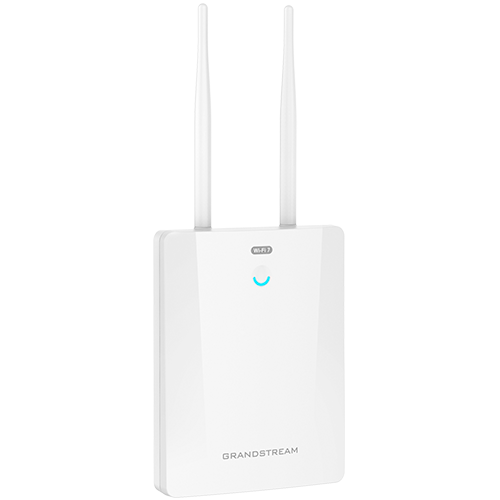
Quick Product Information
Grandstream
GWN7670LR
Long-range dual-band outdoor Wi-Fi 7 access point and bridge
Medium-to-large business sites and outdoor coverage projects
Up to 256 concurrent client devices
Up to 350 metres, environment dependent
802.3at PoE+, maximum consumption 15.5W
Contact FourTeck for current country, quantity, and project options
Africa, with wider regional inquiry support
Confirm antenna mode, PoE budget, fibre modules, mounting, cabling, and local radio rules
Product Overview
Outdoor connectivity projects often fail for reasons that are not visible on a basic equipment list. The access point may be fast, yet the uplink is too slow. The radio may have enough capacity, yet the mounting location creates shadow zones. A device may be described as long range, yet an obstacle, metal structure, tree line, neighbouring network, or incorrect antenna orientation reduces practical performance. The Grandstream GWN7670LR addresses many of these design concerns with a business-focused combination of Wi-Fi 7 radio features, directional and omnidirectional antenna options, an IP66-rated housing, multigigabit interfaces, central management choices, and controls for traffic, authentication, segmentation, and roaming.
The unit operates on the 2.4GHz and 5GHz bands using dual-band 2×2:2 MIMO. Its stated aggregate wireless throughput is 3.6Gbps, divided between up to 688Mbps on 2.4GHz and up to 2882Mbps on 5GHz. Wi-Fi 7 functions such as Multi-Link Operation, 4096-QAM, Multi-RU, and preamble puncturing are designed to use available spectrum more efficiently when compatible client devices and suitable radio conditions are present. The access point also supports earlier Wi-Fi generations, allowing organisations to introduce new infrastructure without requiring every phone, laptop, scanner, tablet, camera, or handheld terminal to be replaced at once.
For physical networking, buyers receive a 2.5 Gigabit Ethernet RJ45 interface with PoE+ input and a 2.5 Gigabit SFP interface. This gives designers useful flexibility. Copper can carry data and power from a suitable PoE+ switch or injector, while the SFP connection can support a fibre-oriented uplink strategy where distance, electrical isolation, lightning-risk planning, or building-to-building design makes fibre attractive. The final architecture should still be reviewed carefully because fibre modules, surge protection, earthing, outdoor cable pathways, PoE sources, enclosures, and local installation practices are separate project items.
For businesses in Africa, the value is not simply a higher wireless number. The practical opportunity is to extend managed connectivity to places where staff, guests, students, clinicians, security personnel, warehouse teams, mobile devices, and operational systems increasingly depend on wireless access. FourTeck can help buyers translate a site requirement into a clearer bill of materials by discussing the area to be covered, expected client density, application mix, mounting height, power source, wired and fibre uplinks, network management preference, and deployment timeline.
Key Business Benefits
A business access point should be judged by how well it supports day-to-day operations, not only by the highest figure on a data sheet. The following benefits connect the platform’s technical design with common procurement and deployment priorities.
◆ Wider Outdoor Reach
A stated range of up to 350 metres can help reduce the number of devices required for open-area coverage when placement, antenna selection, interference, elevation, client capability, and line of sight are favourable. Fewer well-positioned units may simplify cabling and management, although a proper survey remains important.
◆ Modern Wireless Efficiency
Wi-Fi 7 features provide a forward-looking foundation for organisations introducing newer client devices and bandwidth-sensitive applications. Better spectrum use can improve the experience in busy environments, while backward compatibility protects investment in existing endpoints.
◆ Flexible Uplink Design
A 2.5G PoE+ copper port and 2.5G SFP interface give network architects more options than a basic Gigabit-only outdoor unit. The design can support conventional switch connections, fibre-based building links, or mixed infrastructure based on distance and risk.
◆ Centralised Administration
The embedded controller can manage up to 50 local Grandstream GWN access points. GDMS Networking supports cloud management, while GWN Manager supports an on-premise approach. This choice helps teams match administration to security policy, site count, and available IT skills.
◆ Outdoor Deployment Confidence
The IP66-rated enclosure, broad operating temperature range, and included wall or pole mounting kits support installation in exposed locations. A complete project should also include suitable surge protection, waterproof cable handling, grounding, and professional mounting practices.
◆ Stronger Access Controls
WPA3, enterprise authentication, PPSK options, client isolation, MAC filtering, rogue access point detection, traffic rules, secure boot, and unique device credentials help administrators create a more controlled wireless environment for staff, visitors, and operational devices.
Together, these benefits can improve coverage planning, user mobility, network consistency, and administrative visibility. They do not remove the need for design work. Business value depends on the access point being matched with the correct switch capacity, power budget, cabling, fibre modules, firewall policies, VLAN plan, channel plan, mounting position, and client requirements.
Product Highlights
Designed for modern business traffic across dual 2.4GHz and 5GHz radios.
Supports medium-density outdoor environments when the network is planned correctly.
Suitable for exposed wall or pole placement with correct installation protection.
Helps match focused coverage and broader-area requirements.
Provides flexible connectivity for local switching and fibre-oriented designs.
Choose embedded, cloud-managed, app-assisted, or on-premise administration.
The platform includes 32 SSIDs in total, with 16 available per radio, along with VLAN support, bandwidth controls, scheduling, Hotspot 2.0, captive portal choices, 802.11k/v/r roaming, mesh functions, IPv4 and IPv6, DHCP options, LLDP, 802.1X authentication, PPSK, and advanced quality-of-service mechanisms. Not every function is required in every project, but the breadth of controls lets network teams build separate policies for employees, visitors, operational devices, tenants, or departments. Radio regulations differ by country, and the available frequencies and permitted transmit power should always be checked for the installation location.
Technical Specifications
| Specification | Details |
|---|---|
| Brand and model | Grandstream GWN7670LR |
| Product type | Long-range dual-band Wi-Fi 7 outdoor access point and bridge platform |
| Wireless standards | IEEE 802.11a/b/g/n/ac/ax/be |
| Wireless bands | 2.4GHz and 5GHz; allowed frequencies vary by region |
| MIMO | 2.4GHz: 2×2:2; 5GHz: 2×2:2 |
| Aggregate wireless throughput | Up to 3.6Gbps; actual throughput varies with clients, interference, distance, configuration, and environment |
| 2.4GHz data rate | Wi-Fi 7 rate up to 688Mbps |
| 5GHz data rate | Wi-Fi 7 rate up to 2882Mbps |
| Channel width | 2.4GHz: 20/40MHz; 5GHz: 20/40/80/160MHz |
| Wi-Fi 7 features | Multi-Link Operation, 4096-QAM, Multi-RU, preamble puncturing, Target Wake Time, beamforming, OFDMA, BSS colouring, and related radio functions |
| Coverage range | Up to 350 metres; coverage depends on terrain, obstruction, interference, antenna mode, mounting, and client capability |
| Concurrent clients | Up to 256 |
| SSIDs | 32 total, 16 per radio |
| Antennas | 2.4GHz internal directional 8dBi or external omnidirectional 3.5dBi; 5GHz internal directional 13.5dBi or external omnidirectional 3.5dBi; Bluetooth antenna 5.0dBi |
| Directional beamwidth | 2.4GHz: 90 degrees; 5GHz: 35 degrees |
| Network interfaces | 1 x 2.5G Ethernet RJ45 port with PoE input; 1 x 2.5G SFP port |
| Power input | 802.3at PoE+ |
| Maximum power consumption | 15.5W |
| Bluetooth | BLE 5.3 |
| Outdoor protection | IP66-rated enclosure |
| Mounting | Wall or pole mounting; kits included |
| Dimensions | 223.2 x 169.9 x 53.9mm |
| Unit weight | 1.2kg |
| Operating temperature | -30°C to 60°C |
| Humidity | 10% to 90%, non-condensing |
| Security | WPA2/WPA3 personal and enterprise modes, secure boot, unique certificate and random default password, MAC filtering, client isolation, traffic rules, rogue AP detection, ARP and ND attack defence |
| Authentication and guest access | 802.1X, MAC authentication, PPSK with or without RADIUS, captive portal with RADIUS, vouchers, password, SAML SSO, social login, or Active Directory options |
| Mobility and extension | Mesh, Hotspot 2.0, bridge mode, 802.11k/v/r roaming, Layer 2 roaming |
| Management | Embedded controller for up to 50 local GWN APs; GDMS Networking cloud management; GWN Manager on-premise management for up to 3,000 GWN APs; app integration |
| Package | Access point, mounting kits, and quick start guide; PoE source and SFP modules should be confirmed separately |
| Warranty and availability | Country, supplier, and order dependent; contact FourTeck for current guidance |
Choosing the Correct Configuration
The correct choice depends on more than the model number. Buyers should identify the coverage shape, distance, obstruction level, mounting height, number and type of clients, application requirements, existing switch ports, PoE+ budget, preferred uplink medium, and management platform. Internal directional antennas are useful when radio energy should be focused toward a target area, while external omnidirectional antennas suit broader surrounding coverage. A fibre uplink may be preferable between buildings or over longer cable routes, but it requires compatible SFP modules and a clear power plan because the access point still needs PoE+ through its copper interface. Actual radio performance should be validated through survey and testing before a large rollout.
Configuration and Buyer Guidance
A good outdoor wireless project begins with a short design brief. Start by describing what the network must support. General internet access for visitors has different priorities from voice over Wi-Fi, warehouse scanners, video monitoring, cloud applications, mobile point-of-sale devices, or operational equipment. Real-time voice and video need lower latency and consistent roaming. Guest access needs segmentation and controlled authentication. Handheld terminals may use older radio standards and transmit at lower power than the access point, which can reduce the usable edge of the coverage area.
1. Map the Area
Provide dimensions, building locations, obstacles, mounting points, and areas where service is essential. Photographs or a site plan can make early discussions more useful.
2. Estimate Client Load
State the expected number of simultaneous users and device types, not only the total number of registered devices. Peak demand should guide capacity.
3. Confirm Applications
List voice, video, cloud, guest, scanning, telemetry, security, and business applications so traffic policies and backhaul capacity can be considered.
4. Review Power and Uplink
Check PoE+ availability, switch power budget, cable distance, surge protection, fibre requirements, SFP compatibility, grounding, and outdoor cable routing.
5. Choose Management
Decide whether the site should use the embedded controller, GDMS Networking, or an on-premise GWN Manager deployment. Governance and administrator access matter.
6. Plan Security
Define employee, guest, contractor, device, and management networks. Confirm VLANs, RADIUS, WPA3 readiness, portal method, firewall rules, and logging expectations.
Future scalability should also be part of the conversation. A single unit may suit a small open yard, while a campus may need multiple cells with planned channel reuse, roaming, and backhaul. Ask whether the design will grow into additional buildings or sites. FourTeck can help review the equipment list and identify items that are easy to overlook, including managed PoE+ switches, SFP transceivers, fibre patching, outdoor-rated Ethernet, surge protectors, poles, brackets, enclosures, UPS protection, firewall capacity, and professional installation support.
Ideal Business Use Cases
The access point is designed for medium-to-large organisations that need outdoor or long-distance wireless coverage. The strongest use cases are those where a business needs centrally managed access beyond a conventional office ceiling.
Warehouses and Logistics Yards
Support handheld scanners, tablets, mobile workstations, communications devices, and staff access across loading areas, open yards, gates, and warehouse approaches. Directional coverage can be useful along defined lanes or between operational zones.
Education Campuses
Extend managed connectivity to courtyards, sports areas, walkways, residence zones, libraries, and links between buildings. Segmented SSIDs and captive portal options can separate staff, student, guest, and device traffic.
Healthcare and Institutional Grounds
Provide controlled connectivity in external waiting spaces, service areas, staff routes, mobile units, and multi-building compounds. Network design should prioritise security, coverage continuity, application performance, and resilience.
Hotels, Resorts, and Guest Properties
Expand Wi-Fi to gardens, pools, pathways, event areas, parking zones, and detached facilities. Guest access should be planned with bandwidth limits, portal policies, isolation, and a reliable internet gateway.
Business Parks and Multi-Building Sites
Connect staff and approved devices across outdoor shared areas, building approaches, and operational spaces. The 2.5G SFP interface can support fibre-oriented designs where buildings are separated.
Retail Compounds and Public Areas
Offer separate wireless services for employees, approved business systems, guests, and event users. Traffic policies, VLANs, client isolation, and quality-of-service settings can protect operational traffic.
The unit may also support selected wireless bridge scenarios. However, point-to-multipoint capability is identified by the manufacturer as pending, so buyers should confirm current firmware support and final topology before relying on that function. A professional site survey is recommended for critical links, complex terrain, dense interference, or projects where connectivity supports safety, revenue, healthcare, education, or industrial operations.
Grandstream GWN7670LR Wi-Fi 7 Radio Performance
Wi-Fi 7 improves the radio toolkit available to network designers. The access point supports Multi-Link Operation, 4096-QAM, Multi-RU, preamble puncturing, OFDMA, beamforming, Target Wake Time, BSS colouring, and wide 160MHz channels on 5GHz. In practical terms, these functions are intended to increase efficiency, reduce wasted spectrum, and improve the handling of mixed traffic when compatible clients and suitable channel conditions are present.
Multi-Link Operation can allow compatible devices to use more than one link, helping the system choose or combine available resources. Preamble puncturing can let a wide channel continue operating around a portion affected by interference instead of discarding the whole channel. Multi-RU and OFDMA help divide radio resources among clients more precisely. 4096-QAM can carry more data per transmission in strong signal conditions. These gains are most visible when client devices also support the required features and the network has clean spectrum, adequate signal strength, and correctly selected channel widths.
Buyers should not interpret the 3.6Gbps aggregate figure as the speed one user will always receive. Real throughput is lower and shared. It depends on protocol overhead, band, channel width, client radio, distance, interference, airtime use, network uplink, internet service, firewall performance, and application behaviour. FourTeck recommends planning around the expected workload and validating critical areas rather than designing from headline throughput alone.
Grandstream GWN7670LR Outdoor Coverage and Antenna Flexibility
The antenna system is one of the model’s most important design features. On 2.4GHz, the internal directional antenna is rated at 8dBi with a 90-degree beamwidth, while the external omnidirectional option is rated at 3.5dBi. On 5GHz, the internal directional antenna is rated at 13.5dBi with a narrower 35-degree beamwidth, while the external omnidirectional option is rated at 3.5dBi. This allows installers to choose between focused radio energy and broader surrounding coverage.
A directional pattern may suit a long yard, pathway, gate approach, building link, parking lane, or target zone where coverage should be projected in one direction. An omnidirectional pattern may be better when users surround the mounting point. The most powerful antenna choice is not automatically the best one. Antenna shape, client transmit power, mounting height, orientation, reflections, terrain, foliage, metal, and interference determine whether the result is usable.
The stated coverage range reaches up to 350 metres, but this should be treated as a planning reference under favourable conditions, not a guarantee at every site. Outdoor radio is a two-way conversation: the access point must hear the client as well as the client hears the access point. Smartphones and battery-powered terminals often transmit at lower power. A survey can identify dead zones, hidden interference, and the correct overlap between cells. Mounting kits are included, but the installer should still confirm pole diameter, wall strength, weather sealing, cable drip loops, grounding, surge protection, access for maintenance, and safe working procedures.
Grandstream GWN7670LR Security and Management
A business wireless network needs consistent administration across radios, switches, firewall rules, authentication systems, and user groups. This model offers several management paths. The embedded controller can manage up to 50 local GWN access points without a separate hardware controller. GDMS Networking provides a cloud approach for larger or distributed deployments, while GWN Manager supports on-premise administration for up to 3,000 access points. The app can integrate with the management platforms for operational convenience.
The wireless security feature set includes WPA2 and WPA3 personal and enterprise modes, 802.1X, MAC authentication, PPSK with or without RADIUS, client isolation, MAC filtering, inbound and outbound traffic rules, rogue access point detection and containment, ARP attack defence, and IPv6 neighbour-discovery attack defence. Secure boot, digital signatures, a unique security certificate, and a random default password per device help protect the platform itself. Captive portal options can support vouchers, passwords, RADIUS, SAML single sign-on, social login, or Active Directory integration, depending on the intended guest and identity workflow.
These controls are tools, not an automatic policy. Administrators should segment management traffic, change credentials, keep firmware current, restrict administrative access, use secure authentication, back up configurations, monitor events, and coordinate wireless rules with the firewall and switching environment. FourTeck can help buyers choose the management model and identify related infrastructure, but final policy should match the organisation’s governance, risk, and compliance requirements.
What Buyers Should Check Before Purchase
Before requesting a quote, buyers should confirm the usage environment, expected coverage, client mix, network interfaces, power source, antenna strategy, mounting plan, management preference, and delivery location. Choosing only by model name or maximum range can lead to missed accessories, unsuitable placement, or unrealistic performance expectations. FourTeck can review these details so the proposed equipment better matches the project.
Configuration Fit
Confirm whether the requirement is broad area access, a directional sector, a point-to-point link, or a future point-to-multipoint project. Check the current firmware and supported topology before relying on bridge functions.
Compatibility Check
Review PoE+ switch capacity, 2.5G port support, SFP module type, fibre standard, VLAN design, RADIUS services, firewall rules, client standards, and any existing Grandstream management platform.
Outdoor Installation
Identify wall or pole locations, cable pathways, grounding, surge protection, weatherproof glands, mounting height, access for maintenance, and the local conditions that may affect radio or equipment life.
Coverage Expectations
Provide maps, dimensions, obstacles, terrain, and critical service zones. The stated maximum range is not a universal result; client capability and environmental conditions are equally important.
Availability and Warranty
Ask for current supplier status, lead time, order quantity guidance, regional warranty handling, return conditions, and the exact accessories included. Terms can differ by country and supply route.
Quote Preparation
Share the delivery country, quantity, site type, number of users, application mix, preferred management, switch model, fibre needs, installation expectations, and project deadline for a more useful quotation.
Long-term cost also includes more than the access point. Budget for switching, power, fibre modules, patching, outdoor cable, surge protection, UPS support, mounting labour, surveys, configuration, monitoring, replacement strategy, and administrator time. A lower equipment-only figure can become expensive if the network requires redesign. For bulk or multi-site projects, standardising the switch, SFP, firmware, naming, VLAN, and management approach can reduce operational complexity.
Africa Availability and Service Support
FourTeck supports product inquiries across Africa with assistance for model selection, coverage planning questions, configuration review, quote requests, delivery coordination, and warranty guidance. Availability may vary according to product release status, supplier allocation, country, quantity, accessories, and the selected supply route. Buyers should request a current quotation rather than assume that pricing, stock, or lead time shown in another market applies locally.
For this outdoor wireless platform, useful pre-sales information includes the delivery destination, number of access points, expected coverage area, desired antenna approach, switch model, available PoE+ power, copper and fibre layout, SFP requirements, management preference, and whether installation support is needed. A site drawing or photographs can help the discussion. FourTeck can also suggest related networking components and suitable alternatives where the requested model, timeline, or project design calls for another option.
Warranty handling is based on the applicable supplier and manufacturer terms. Buyers should confirm duration, coverage, return process, serial-number requirements, and responsibilities for shipping or onsite labour before placing an order. Outdoor equipment should be installed professionally because damage caused by poor mounting, water ingress through cabling, incorrect power, lightning, or inadequate grounding may fall outside normal warranty coverage.
Africa Country and Regional Coverage
Businesses across Africa, including Kenya, Uganda, Nigeria, Ghana, Tanzania, Rwanda, Ethiopia, South Africa, Zambia, Botswana, Senegal, and other regional markets can contact FourTeck for availability guidance, configuration review, project quotations, and delivery coordination. The team can help procurement managers, system integrators, resellers, education institutions, healthcare organisations, hospitality groups, logistics operators, property managers, and enterprises evaluate the product for their intended environment.
Regional supply conditions differ. Import requirements, tax, currency, freight routes, lead times, warranty processes, radio regulations, and the availability of compatible switches or fibre modules can affect the final proposal. FourTeck therefore treats each request as a business requirement rather than repeating a single generic offer. Buyers can use the FourTeck Africa technology platform, the Kenya business technology site, or the Uganda business technology site to begin a regional inquiry.
GCC, Middle East and Africa Availability
FourTeck Africa can support product inquiries for businesses across Africa while also guiding wider technology requirements through selected FourTeck platforms serving GCC and Middle East markets. Organisations with sites in the UAE, Saudi Arabia, Qatar, Oman, Bahrain, and African countries may need consistent product standards, management practices, and documentation across several locations. A coordinated request can help identify common models, regional variations, compatible accessories, and supply considerations.
Availability, freight options, radio compliance, warranty handling, project quantities, and configuration support may vary by country. Outdoor wireless equipment is particularly sensitive to local installation standards, permitted frequencies, climate, and power design. Procurement teams should provide each destination, required quantity, target date, and site type rather than assume one regional offer covers every location.
For regional coordination, buyers may visit FourTeck UAE alongside the Africa platform. FourTeck can help structure the inquiry, review comparable product options, and clarify which elements should remain standard across sites and which should be adapted locally.
Other Options Buyers May Consider
The best related option depends on whether the priority is outdoor range, higher client capacity, indoor coverage, a lower-cost Wi-Fi 6 rollout, or a larger multi-site management design. The following internal links help buyers continue their evaluation without assuming that one model suits every environment.
Grandstream GWN7670
An indoor Wi-Fi 7 option for offices, classrooms, hospitality interiors, and modern business spaces that do not need outdoor housing or extended-range antennas.
Grandstream GWN7664LR
A long-range outdoor Wi-Fi 6 model for projects that prioritise mature Wi-Fi 6 client support and require a different capacity or budget profile.
Grandstream GWN7660ELR
A weatherproof long-range Wi-Fi 6 access point suited to buyers comparing radio generation, coverage, client density, and deployment cost.
Enterprise Wireless Access Points
Browse suitable indoor and outdoor wireless platforms when the project requires a vendor comparison, different capacity, or another management ecosystem.
Managed Network Switching
Pair access points with managed PoE+ switches, multigigabit ports, VLAN support, adequate power budget, and appropriate fibre uplinks.
Project Design Assistance
Discuss access point quantity, site plans, PoE, fibre, firewall, installation, regional supply, and suitable alternatives with the FourTeck team.
When comparing related models, focus on the radio generation, number of spatial streams, client capacity, antenna design, outdoor rating, uplink ports, PoE standard, management platform, and real site requirement. A newer model may provide future advantages, while a Wi-Fi 6 alternative may be appropriate where client devices, budget, or organisational standards favour the established platform.
Why Buyers Choose FourTeck
Business technology procurement becomes easier when the supplier understands how the product fits into the wider environment. FourTeck supports buyers with structured pre-sales conversations that cover the site, application, compatibility, accessories, delivery destination, support expectations, and project schedule. The goal is to reduce avoidable selection errors and help the buyer request a more complete solution.
Assistance for individual purchases, branch rollouts, campus projects, reseller requirements, and multi-site procurement.
Review of access point count, coverage assumptions, PoE, switching, fibre, security, management, and accessories.
Clearer quotation requests based on country, quantity, site type, project timing, and required supporting equipment.
Guidance on regional supply considerations, freight planning, lead times, and destination-specific requirements.
Support in clarifying applicable terms, documentation, serial-number handling, return procedures, and supplier conditions.
Alternative access points, managed switches, SFP modules, UPS systems, firewalls, cabling, and infrastructure options.
FourTeck does not replace the need for a qualified installer or a formal wireless survey on critical projects. Instead, the team helps buyers prepare the right questions, understand dependencies, and build a more complete procurement request. This approach is useful for SMBs, enterprises, government and education buyers, healthcare organisations, hospitality groups, logistics operations, system integrators, and resellers who need practical product guidance alongside supply support.
Frequently Asked Questions
What is the GWN7670LR used for?
It is used to provide managed, long-range outdoor Wi-Fi 7 coverage for medium-to-large business environments. Typical locations include warehouses, campuses, schools, hospitals, resorts, business parks, compounds, parking areas, logistics yards, and multi-building properties. It can serve wireless users and selected bridge requirements, subject to current feature support and proper site design.
How far can the access point cover?
The manufacturer states a range of up to 350 metres. Actual usable coverage can be shorter because radio performance depends on mounting height, antenna mode, terrain, buildings, trees, metal, interference, channel settings, weather, and the transmit capability of client devices. A survey or pilot deployment is recommended where coverage is business-critical.
How many devices can connect at the same time?
The platform supports up to 256 concurrent Wi-Fi client devices. This is a technical capacity figure, not a promise that every client will receive the same speed. Application type, airtime use, signal quality, band choice, internet bandwidth, firewall performance, uplink capacity, and channel planning affect the experience in real deployments.
Does it require a separate wireless controller?
A separate hardware controller is not required for a basic deployment because the embedded controller can manage up to 50 local Grandstream GWN access points. Larger or distributed networks can use GDMS Networking for cloud management or GWN Manager for an on-premise approach. The best choice depends on site count, administration policy, and IT resources.
What power source is needed?
The unit accepts 802.3at PoE+ and has a maximum power consumption of 15.5W. Buyers should confirm that the selected switch or injector supports PoE+ and has enough total power budget for every connected device. Outdoor surge protection, grounding, cable quality, and maximum copper distance should also be included in the installation plan.
Can the SFP port power the access point?
No. The 2.5G SFP interface is used for network connectivity, while power is supplied through the 2.5G Ethernet RJ45 PoE+ input. A fibre-oriented design therefore still needs a suitable PoE+ source. Buyers should also confirm the correct SFP module, fibre type, connector, distance, and compatibility with the connected switch.
Is it available for business buyers in Africa?
FourTeck supports inquiries across Africa. Current availability, lead time, delivery options, warranty terms, and final pricing depend on destination, quantity, supplier status, and accessories. Buyers should provide the country, required quantity, site type, and timeline so the team can prepare a relevant response instead of relying on another market’s listing.
Can FourTeck help with configuration and coverage planning?
FourTeck can help review the proposed use, site dimensions, expected users, antenna strategy, PoE+, switching, fibre, management platform, VLANs, and required accessories. For critical or complex deployments, a professional onsite survey and qualified installation are recommended because remote guidance cannot fully measure interference, obstacles, mounting conditions, or local safety requirements.
What accessories may be required?
Common project items include a managed PoE+ switch or injector, surge protection, outdoor-rated Ethernet cable, grounding components, UPS protection, suitable SFP modules, fibre patch leads, enclosures, poles or additional mounting hardware, firewall capacity, and installation services. The included package contains the access point, mounting kits, and quick start guide, but the full bill of materials is site dependent.
Can businesses request bulk or project supply?
Yes. Businesses, system integrators, resellers, institutions, and multi-site organisations can request quantity-based project support. Share the number of locations, estimated access point quantity, delivery destinations, required switches and accessories, management preference, and target timeline. A structured project request helps FourTeck review availability, alternatives, phased delivery, and configuration consistency.
Need Help Planning Your Outdoor Wi-Fi 7 Deployment?
FourTeck can help review product availability, expected coverage, antenna mode, PoE+, copper and fibre uplinks, management options, related switches, accessories, warranty guidance, and delivery requirements for your business location. Provide the site type, country, quantity, user estimate, and project timeline to begin.
Reviews
There are no reviews yet.